
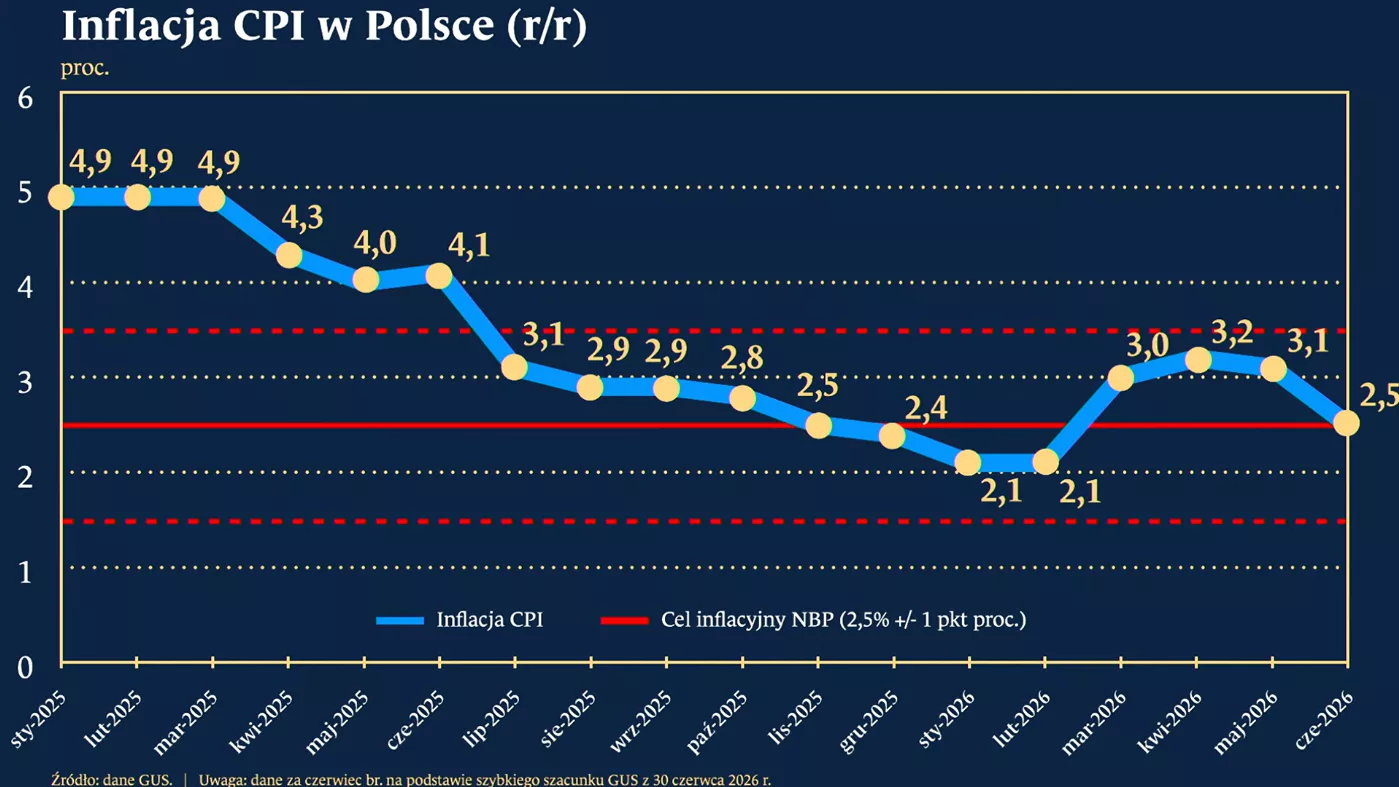
The European Commission has raised its forecast for Polish inflation in 2027 to 4.4% from 2.9% in its spring outlook, a 1.5-percentage-point revision. Its autumn economic forecast, published on 17 November, also projects government deficits exceeding 7% of GDP for three consecutive years and public debt surpassing 70% of GDP in 2027.
Energy costs drive inflation revision
The Commission expects harmonised consumer price inflation (HICP) of 3.3% in 2026, 4.4% in 2027 and 3.9% in 2028. The 2027 increase largely reflects the assumed expiry of measures shielding households from higher energy costs and subsequent rises in electricity and gas tariffs.
Inflation excluding food and energy is forecast to remain near 3% during 2026–2028, partly because wage growth continues to raise service-sector costs. The 2028 outlook also incorporates an assumption about the introduction of the EU’s second emissions trading system, ETS2; this modelling assumption does not settle its final implementation date.
HICP is the EU’s harmonised measure and differs methodologically from Poland’s domestic CPI published by Statistics Poland.
Fiscal deficits exceed 7% of GDP
The Commission projects a general government deficit of 7.1% of GDP in both 2026 and 2027, rising to 7.2% in 2028. In the spring forecast it had expected 6.5% in 2026 and 6.3% in 2027.
Defence spending, social benefits and debt-service costs are major contributors. Temporary fuel-tax reductions are estimated to cost around 0.3% of GDP in 2026. The outlook assumes certain tax measures will be reversed or changed, but their implementation remains uncertain.
Public debt set to pass 70%
Under the EU’s general government accounting methodology, Poland’s debt-to-GDP ratio is forecast to rise from 59.6% in 2025 to 67.7% in 2026, 70.1% in 2027 and 73.5% in 2028. The 2027 forecast is 1.8 percentage points above the spring estimate.
The projections reflect persistent deficits and financing operations associated with defence procurement, including funding raised ahead of equipment deliveries.
Growth slows but remains above the EU average
Polish GDP is forecast to expand 3.5% in 2026 and 2.7% in each of 2027 and 2028. The Commission expects slower private consumption growth as inflation erodes purchasing power, alongside a smaller boost from EU-funded public investment.
For comparison, EU GDP growth is projected at 1.4% in 2026 and 2027 and 1.5% in 2028. EU inflation in 2027 is forecast at 3.2%, against Poland’s 4.4%. Poland’s unemployment rate is projected at 3.1% in 2026 and 2027 and 3.0% in 2028.
Sources: European Commission, DG ECFIN, “European Economic Forecast: Autumn 2026”, Institutional Paper 348, 17 November 2026, chapter 25, pp. 158–159; Commission communication of 17 November; spring forecast for Poland, 21 May 2026.