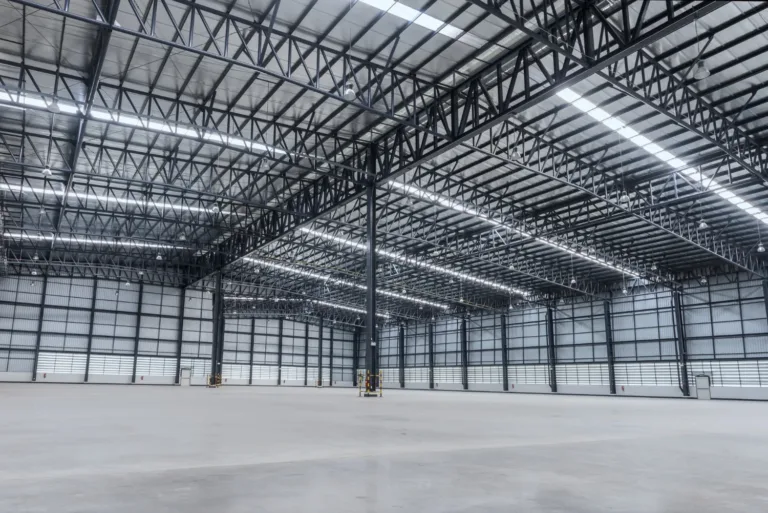
Poland’s industrial and logistics market continues to record strong occupier and investor activity against a backdrop of limited new supply. According to AXI IMMO’s latest report, Industrial & Logistics Market in Poland, Q1–Q3 2026, gross take-up reached 5.31 million sq m in the first nine months of the year (+19% y/y), while net take-up amounted to 3.36 million sq m (+56% y/y), the third-highest result on record. Meanwhile, the vacancy rate declined to 5.7% (-2.5 percentage points y/y), and total modern industrial and logistics stock increased to 38.33 million sq m (+5% y/y). Renewed momentum was also evident in the investment market, where industrial and logistics transaction volume reached EUR 1.3 billion, up 49% year-on-year.
Investment Market: The Return of Larger Portfolio Transactions
In the first three quarters of 2026, investment transaction volume in the industrial and logistics sector reached EUR 1.3 billion, representing a 49% year-on-year increase. The sector accounted for 28% of total commercial real estate investment volume in Poland, ranking second behind retail. Seven portfolio transactions were completed between January and September 2026, signalling the return of larger investment deals following a period dominated by single-asset disposals and sale and leaseback transactions. Among the largest transactions was the sale by Savills IM of a portfolio of five modern logistics parks totalling approximately 284,000 sq m to Ares Real Estate. Another significant transaction was the acquisition of four Hillwood parks, comprising approximately 200,000 sq m, by a US investor.
Sale and leaseback transactions remained an important component of the market. Five such transactions generated a combined volume exceeding EUR 200 million, involving companies including Raben, Purmo and Goodyear Dunlop. Among the largest deals was W. P. Carey’s acquisition of a portfolio of eight Raben Group properties. The largest single-asset transaction was Realty Income’s acquisition from Panattoni of H&M’s logistics centre at Panattoni Park Poznań A2, comprising approximately 150,000 sq m.
Grzegorz Chmielak, Head of Capital Markets, AXI IMMO, explains: “The 49% year-on-year increase in investment volume and the completion of seven portfolio transactions confirm a recovery in investor activity in the industrial and logistics sector. Following a period dominated by single-asset disposals and sale & leaseback transactions, we are seeing the return of larger logistics portfolio deals. US capital has been particularly prominent, accounting for approximately two-thirds of the total transaction volume. Investors are primarily targeting core assets offering stable, long-term income, although interest in value-add opportunities remains. Sustained interest from institutional investors and family offices reflects positive sentiment towards the Polish market, extending beyond the logistics sector, and supports an optimistic outlook for investment volumes in 2027.”
Net Take-up Reaches Its Third-Highest Level on Record
AXI IMMO analysts report that a total of 5.31 million sq m of industrial and logistics space was leased under long-term agreements between January and September 2026 (+19% y/y). Net take-up recorded even stronger growth, reaching 3.36 million sq m (+56% y/y), surpassed only by the results recorded in 2021 and 2022. New leases and expansions accounted for 63% of total leasing volume, an increase of 15 percentage points year-on-year. The share of lease renegotiations declined to 33%, while sale and leaseback transactions accounted for the remaining 4%.
The highest gross take-up volumes were recorded in the Slaskie (1.09 million sq m), Mazowieckie (933,000 sq m) and Dolnoslaskie (870,000 sq m) regions. E-commerce companies, particularly Shein and Temu, were among the most active occupiers, alongside logistics operators and distribution companies. The largest leasing transactions included new leases at Panattoni Park Katowice Airport (165,200 sq m, automotive), EQT Exeter Poznań Żerniki I (107,900 sq m, e-commerce) and Panattoni Park Bytom (100,000 sq m, automotive).
Renata Osiecka, Owner and Managing Partner, AXI IMMO, comments: “A substantial share of this year’s net take-up has been driven by the expansion of major Asian e-commerce platforms and several large-scale transactions. Their activity is significantly accelerating the absorption of available industrial and logistics space. At the same time, declining availability is prompting small and medium-sized occupiers to secure their space requirements earlier. Industrial developers are increasing their activity while continuing to limit speculative exposure. Occupiers remain selective in their relocation decisions, which are primarily driven by expansion requirements, the optimisation of total operating costs, and the modernisation and automation of logistics infrastructure.”
Industrial Developers Increase Activity While Limiting Speculative Exposure
In the first nine months of 2026, industrial and logistics developers delivered 1.56 million sq m of new space, bringing Poland’s total stock to 38.33 million sq m at the end of September (+5% y/y). The highest volume of new supply during Q1–Q3 2026 was delivered in the Mazowieckie region (529,000 sq m), followed by Slaskie (181,000 sq m) and Pomorskie (139,000 sq m). Following a period of subdued development activity, Q3 2026 saw a significant recovery in construction starts. New projects totaling 738,000 sq m commenced during the quarter, bringing the total development pipeline to 1.67 million sq m at the end of September 2026 (+12% y/y). AXI IMMO analysts note that more than half of the space under construction was concentrated in Poland’s two largest regional markets: Slaskie (644,000 sq m) and Mazowieckie (308,000 sq m).
Despite increased development activity, developers remain cautious about speculative projects. At the end of September 2026, approximately 638,000 sq m was under construction without secured lease commitments, accounting for around 38% of the total development pipeline (-4.4 percentage points y/y).
Availability of Large Warehouse Units Becomes Increasingly Limited
The vacancy rate in Poland’s industrial and logistics market has been on a downward trajectory since the second half of 2025. At the end of September 2026, it stood at 5.7%, down 0.7 percentage points quarter-on-quarter and 2.5 percentage points year-on-year. Declining availability has been driven primarily by accelerating occupier demand and limited speculative development. Among Poland’s five largest industrial and logistics markets, the highest vacancy rate was recorded in the Mazowieckie region (7.2%). Vacancy rates in Slaske (5.7%), Wielkopolskie (5.6%), Dolnoslaskie (4.0%) and the Lodzkie region (3.4%) remained at or below the national average. In absolute terms, the largest volumes of immediately available space were recorded in Mazowieckie (567,000 sq m) and Slaskie (465,000 sq m).
Monika Rykowska, Head of Research, AXI IMMO, adds: “The decline in the vacancy rate to 5.7% reflects strong growth in occupier demand combined with limited speculative development. Although Q3 2026 saw a recovery in development activity, new projects continue to be launched selectively. Speculative space currently accounts for approximately 38% of the total development pipeline, down from a year earlier. If occupier activity remains strong, the availability of large warehouse units in the most sought-after locations may remain limited. At the same time, market conditions vary across individual regions, meaning that decisions to launch new developments will largely depend on local demand and project leasing levels.”
Low Vacancy Rates Influence Landlords’ Pricing Strategies
In Q3 2026, several industrial and logistics markets recorded moderate increases in headline rents for big-box warehouse facilities. Asking rents in this segment typically ranged from EUR 3.80 to EUR 6.00 per sq m per month, while rents in newer developments generally ranged from EUR 4.40 to EUR 5.50 per sq m per month. Warsaw within the city limits remained the most expensive location, with headline rents exceeding EUR 6.00 per sq m per month in most developments and reaching up to EUR 8.00 per sq m per month in new small business unit (SBU) schemes.
Could Poland’s Industrial and Logistics Take-up Exceed 7 Million sq m in 2026?
AXI IMMO analysts forecast that total leasing volume in Poland’s industrial and logistics market could exceed 7 million sq m in 2026, approaching the record levels achieved in 2021–2022. Occupiers demand growth is supported by favourable economic conditions, rising consumption and investment, as well as the expansion of Asian e-commerce platforms. In Q2 and Q3 2026 alone, Shein and Temu leased approximately 750,000 sq m, accounting for nearly one-third of net take-up during this period. However, sustaining high levels of occupier activity in the coming years will also depend on demand generated by other sectors of the economy. On the supply side, AXI IMMO experts anticipate a measured increase in development activity, particularly in multi-let schemes across key regional markets and build-to-suit (BTS) facilities offering units exceeding 15,000–20,000 sq m. The national vacancy rate is expected to remain at around 5–6%, with significant regional variations. Modest rental growth is also possible, primarily reflected in effective rents.