
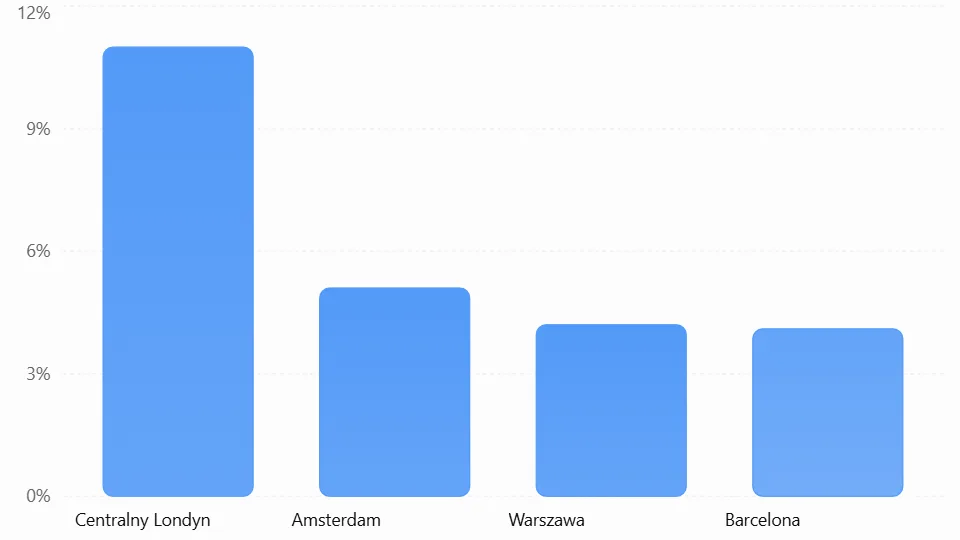
Flexible offices account for 4.2% of Warsaw’s office stock, the third-highest share among European markets in CBRE’s European Flex Market 2026 report, behind Central London and Amsterdam. In the Polish capital’s newer buildings and city-centre locations, the share reaches about 10%.
By Konrad Szaruga, Head of Flexible Workplace at CBRE. Adapted from the Polish original, published on 23 November 2026 at 09:52:41 UTC. Photo: Konrad Szaruga, CBRE Poland.
Central London leads the comparison at 11%, followed by Amsterdam at 5.1%. CBRE says Warsaw’s headline figure understates the concentration of flexible space in the locations where operators are most active.
Poland’s flexible office stock exceeds 426,000 sq m
Poland has more than 426,000 square metres of flexible office space, including 228,000 sq m in Warsaw, according to CBRE. The national market is now almost twice its pre-pandemic size.
Its composition has also changed. Traditional coworking is giving way to an “office-as-a-service” model encompassing serviced offices, managed offices and flexible space offered directly by building owners.
“Poland’s flexible workspace market is maturing rapidly. Until recently, these offices were associated mainly with start-ups; today they are a permanent part of large companies’ real estate strategies. The scale of this becomes clear when we look at how we measure the market,” said Konrad Szaruga, Head of Flexible Workplace at CBRE.
“Against Warsaw’s entire office supply, including owner-occupied buildings and historic properties, flexible space accounts for ‘only’ about 4%. But if we limit the analysis to office buildings completed after 2016 or to the city centre — the places where operators actually operate — its share already reaches 10%.”
Flexible office brands established by building owners include CitySpace, Business Link, BrainEmbassy and Ace of Space. Independent operators include the international networks Mindspace, WeWork and IWG, alongside local businesses such as OmniOffice, The Shire, Puzzle and InOffice.
Operators plan further openings in 2026–2027
CBRE expects the sector to keep expanding in Warsaw and Poland’s largest regional cities. Operators including SwitchUp, The Shire and Puzzle have announced more than a dozen new locations in Poland for 2026–2027.
“We see particularly strong potential in managed offices: spaces fitted out for a single occupier and ready for work from day one. Many companies now regard them as an attractive alternative to a conventional lease. This is especially true of Warsaw, where conventional office space is in short supply,” Szaruga added.
“The geopolitical situation and the market cycle also matter. Both factors are present in Warsaw at the same time, further fuelling demand for flexible space.”
Lower upfront spending is cited by 55% of surveyed occupiers
Companies’ desire to limit long-term commitments and adjust their space to changes in staffing remains a driver of demand. In CBRE’s European occupier survey, reducing capital expenditure was the leading reason for using flexible offices, cited by 55% of respondents.
A further 51% said they used flexible space to manage uncertain demand and changes in their business, up from 43% a year earlier.
The average premium rate per workstation in Warsaw is €750 a month, 4% higher than a year earlier. The corresponding figures are €2,200 in London, €1,800 in Paris and €1,350 in Amsterdam.
European occupiers plan to increase their flexible space
Europe’s flexible office stock grew 3.4% year on year by the end of the third quarter of 2026 and represents about 2.6% of total office space. Its share remains below 2% in many of the continent’s largest office markets.
Flexible offices accounted for an average of 9% of occupiers’ office portfolios in 2022, compared with 19% now. Companies intend to raise that share to 28% within two years, according to CBRE.
The fastest-growing segment is managed offices: fully equipped premises for a single company, generally leased for one to three years.