
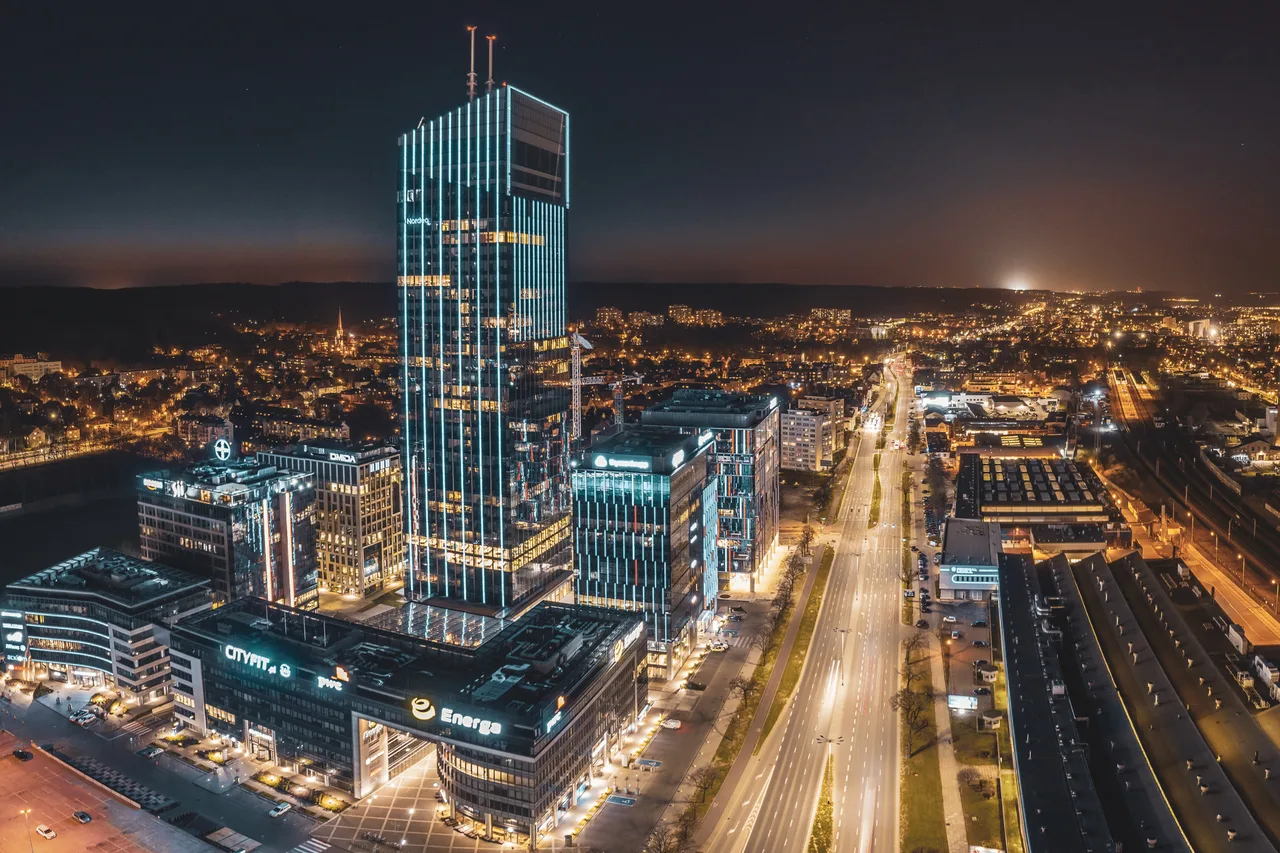
Poland’s Tri-City metropolitan area remains one of the country’s more stable regional office markets, with limited construction activity, resilient tenant demand and one of the lowest vacancy rates outside Warsaw. Modern office stock totalled 1.08 million square metres at the end of the third quarter of 2026, according to Knight Frank.
Gdańsk accounts for approximately 75% of the area’s modern office supply, Gdynia 21% and Sopot roughly 3%.
New office development remains limited
Office stock increased by almost 13,000 square metres in the first nine months of the year following completion of the Punkt building, the first new office project delivered in six quarters.
At the end of September, approximately 18,300 square metres were under construction, including some 10,300 square metres scheduled for completion before year-end.
Nine-month leasing increases despite a weaker third quarter
Gross leasing activity reached almost 15,600 square metres in Q3, a decline of 12.6% from the previous quarter and 16.6% year on year. Over the first nine months, however, leasing totalled nearly 83,400 square metres, an increase of 15.7% compared with the same period in 2025.
New leases represented more than 52% of the nine-month total, renegotiations 40%, and expansions more than 8%.
| Tri-City office market indicator | Value |
|---|---|
| Modern stock, end-Q3 2026 | 1.08m sq m |
| Q3 leasing activity | 15,600 sq m |
| January–September leasing | 83,400 sq m |
| Nine-month annual leasing growth | 15.7% |
| Space under construction | 18,300 sq m |
| Vacancy rate | 10.3% |
IT companies remain the largest tenant group
Technology firms accounted for 28% of demand, followed by manufacturing at 14% and logistics at 11%.
Edyta Szmajda, senior research analyst at Knight Frank, said the strong year-to-date leasing volume showed continued tenant activity despite a weaker third quarter. Restricted new supply was also limiting the risk of a marked increase in space available for lease.
Joanna Gomułkiewicz, director in the company’s office agency, noted that new leases had overtaken renegotiations as the dominant transaction type, suggesting that some occupiers were actively looking for new space rather than simply renewing existing contracts.
Vacancy among Poland’s lowest regional rates
The vacancy rate declined to 10.3% at the end of September, down 1.6 percentage points year on year. Among Poland’s main regional office markets, only Szczecin recorded a lower vacancy rate.
Asking rents typically ranged from €11 to €16 per square metre per month. Prime space in new buildings could command higher rates. Service charges were generally PLN 18–31 per square metre per month.
Source: Knight Frank, Tri-City regional office market analysis, Q3 2026.