
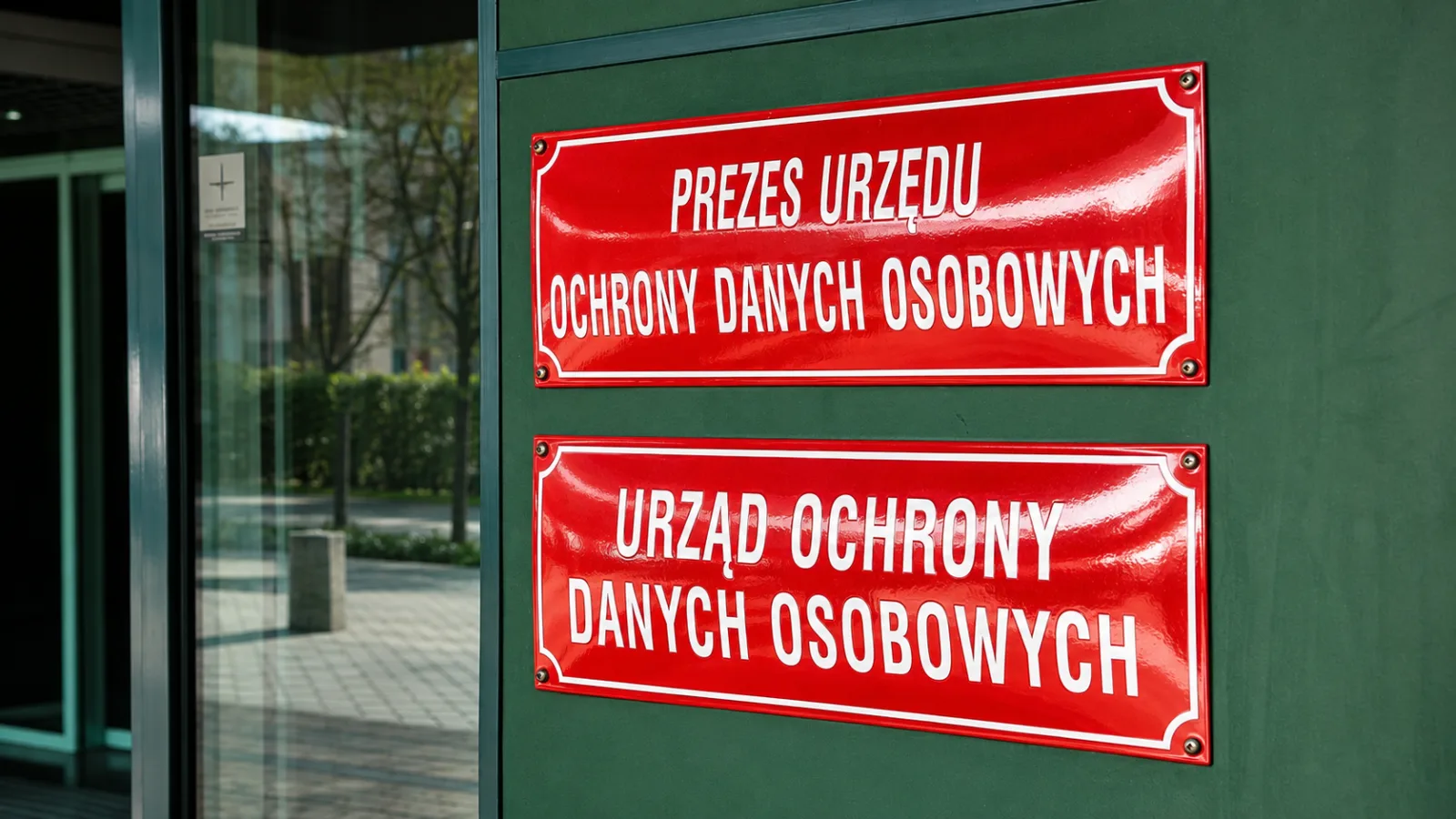
Poland’s data protection chief argues that citizens should be able to learn about past surveillance once secrecy is no longer justified. His non-binding opinion concerns a journalist’s appeal over refusals by the police and two security agencies.
By Personal Data Protection Office (UODO). English adaptation of the Polish original, published on 20 November 2026 at 09:48 UTC.
Poland’s data protection chief, Mirosław Wróblewski, has challenged the practice of withholding information about surveillance after operational work has ended. He argues that citizens should be able to establish whether they were monitored and what data were collected once there is no longer a justified need for secrecy.
The dispute, now before an appeal court, concerns requests for information about possible police and security-agency operations in 2012–2016. The position of the Personal Data Protection Office (UODO) draws on Poland’s constitution and a European Court of Human Rights judgment from May 2024.
A journalist sought information from three agencies
A journalist at the newspaper Gazeta Wyborcza asked the heads of the police, the Internal Security Agency (ABW) and the Central Anti-Corruption Bureau (CBA) whether she had been subject to operational measures between 2012 and 2016. All three refused to provide information about her.
She brought a claim alleging infringement of her personal rights, particularly privacy and access to her own data. The first-instance court dismissed the claims, finding that the refusals had a basis in existing law and that no provision expressly required the agencies to supply the requested information.
The court nevertheless recognised a legal problem: someone who does not know whether they were monitored cannot effectively pursue a claim for a possible unlawful invasion of privacy. They cannot establish whether an infringement occurred in the first place.
Its reasoning noted that this could conflict with Article 8 of the European Convention on Human Rights and Article 51(3) of Poland’s constitution. The latter guarantees access to official documents and data collections concerning the individual.
UODO disputes an indefinite bar on disclosure
The journalist appealed. In those proceedings, the head of UODO submitted a legal opinion under Article 99 of Poland’s Data Protection Act, disagreeing with the first-instance court’s interpretation.
Wróblewski argues that restrictions on disclosing information obtained through operational activity cannot apply indefinitely, regardless of whether secrecy remains justified. The dispute centres on Article 19(16) of the Police Act, which restricts access to material collected through covert surveillance.
In UODO’s view, the provision protects ongoing operations and related proceedings. Once those activities have ended, the justification for continued restrictions must be reassessed.
Where data are no longer needed for the purposes of the proceedings, Wróblewski says an individual should be able to obtain information about the surveillance and the scope of the data collected. This does not imply unconditional access to every operational file.
The decisive issue is whether disclosure could still endanger legally protected interests. Those interests include national security and the objectives of the authorities’ activities.
Constitutional access rights must inform the interpretation
Article 51(3) of Poland’s constitution gives everyone the right to access official documents and data collections concerning them, while allowing statutory restrictions. Wróblewski also cites a Constitutional Tribunal order of 25 January 2006.
The tribunal stated that the Police Act does not rule out informing a person that they were subject to covert surveillance. A complete denial of that possibility could breach constitutional guarantees of access to information about oneself.
UODO argues that courts should interpret the Police Act in light of the constitution and Poland’s international obligations. In its view, the absence of a detailed notification procedure does not automatically justify refusing rights established by higher-ranking law.
The issue also affects scrutiny of whether state authorities acted lawfully. If individuals cannot establish even whether they were monitored, it is much harder to challenge how their data were obtained and used.
The European human rights court found three privacy violations
Wróblewski’s opinion cites the European Court of Human Rights judgment of 28 May 2024 in Pietrzak and Bychawska-Siniarska and Others v. Poland. The court found three violations of Article 8 of the Convention, which protects private and family life and correspondence.
The findings concerned Polish rules on covert surveillance, the retention and disclosure of telecommunications, postal and internet data, and specified surveillance measures under anti-terrorism legislation. The court found insufficient safeguards against arbitrary surveillance.
One problem was the absence of effective mechanisms allowing people who might have been monitored to challenge the legality of the agencies’ actions. The court said the rules should allow subsequent notification when disclosure no longer jeopardises the purpose of the operations.
This does not require notification of every operation regardless of the circumstances. Exceptions justified by security and the effectiveness of state action are permissible, but legislation should not entirely deny citizens the possibility of discovering that surveillance measures were used against them.
Without information, legal remedies can be difficult to pursue
Effective legal protection is central to the journalist’s case. Anyone who suspects unlawful interception or the collection of data without a proper legal basis needs enough information to test that suspicion.
Without confirmation that surveillance occurred, it is difficult to identify a specific infringement, gather evidence or formulate a claim against the responsible institution. A person may therefore hold a constitutional privacy right without an effective way to enforce it in court.
The first-instance court recognised that contradiction but concluded that setting rules for access to classified information was a task for the legislature, not the court itself. UODO disagrees, emphasising the possibility of applying the constitution directly and the courts’ obligation to take Convention standards into account.
The appeal could affect how future requests are handled
The case extends beyond the journalist’s individual dispute with the police, ABW and CBA. It concerns how agencies should assess requests from people seeking to establish whether they were monitored and what data were gathered.
Relevant factors include when surveillance ended, whether the material remains useful and what risks disclosure would create. In Wróblewski’s view, the operational origin of the data cannot, by itself, justify a refusal: the constitutional right of access to one’s own information must also be considered.
The sources are UODO’s statement of 20 November 2026; the European Court of Human Rights judgment of 28 May 2024, applications 72038/17 and 25237/18; Article 51 of Poland’s constitution; and Article 99 of the Data Protection Act of 10 May 2018.
Wróblewski’s legal opinion is not binding on the court and does not decide whether the agencies acted lawfully. The appeal court must determine whether there were sufficient grounds to refuse the journalist’s requests.