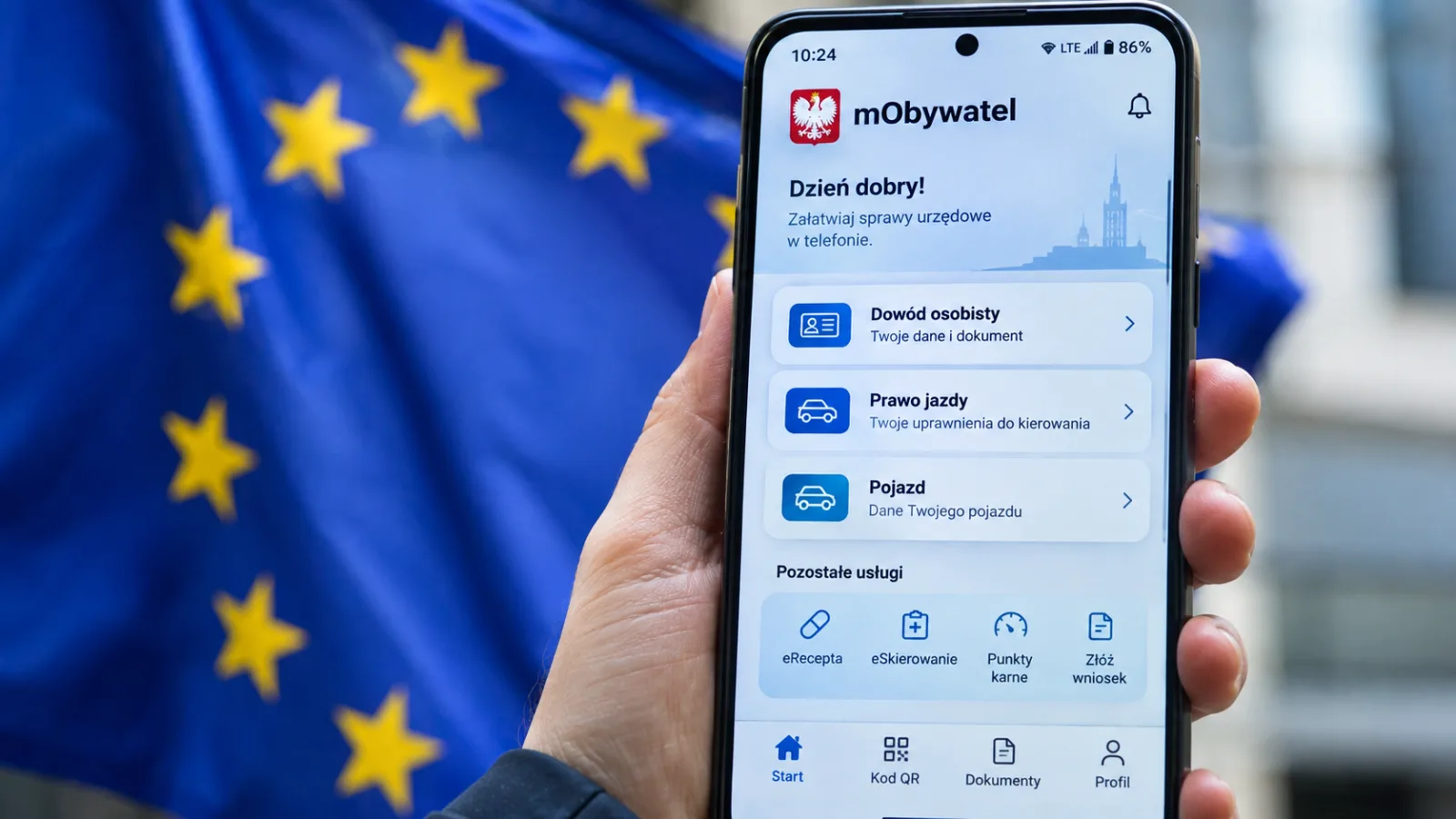
Poland’s government approved draft legislation on 17 November 2026 to introduce the European Digital Identity Wallet, a cross-border identity system linked to the country’s mObywatel digital services app. The wallet is intended to let people verify their identity, present digital credentials and sign documents electronically across the European Union. Use will be voluntary, and the system remains in testing, with 80 companies and institutions registered to participate.
Poland prepares to integrate the EU digital identity wallet with mObywatel
The draft legislation aligns Polish law with the EU’s revised electronic identification framework, commonly known as eIDAS 2.0. Its aim is to enable people to access public and private services in other EU member states without having to rely on separate national identification methods.
The European Digital Identity Wallet (EUDI Wallet) will allow users to prove their identity to public authorities and businesses, hold electronic documents and present verified attributes. Those may include age, education, professional qualifications and other entitlements.
Potential applications include banking, telecommunications and online services requiring reliable customer identification. Actual use will depend on service providers making their systems compatible with the European identity framework.
In Poland, the wallet is intended to become part of the mObywatel ecosystem, the national mobile application used for accessing digital public services and credentials. The minister responsible for digital affairs is expected to oversee its operation.
Proving age without disclosing a full date of birth
A central principle of the European system is data minimisation: individuals should be able to choose what information to disclose for a particular service.
For example, demonstrating that someone is legally an adult should not require handing a business their full date of birth or unrelated personal details. The wallet is designed to provide a verified confirmation that the age requirement is met.
The bill would establish a register of relying parties — organisations and companies that request or receive information through the wallet. The register is meant to help identify who is requesting user information and for what purpose.
Use of the wallet will be voluntary. It is not intended to eliminate every existing method of identification or require everyone to install an application.
Qualified electronic signatures recognised across the EU
The proposed wallet will also support qualified electronic signatures. Under the EU’s eIDAS rules, a qualified electronic signature has the same legal effect as a handwritten signature and is recognised across all member states.
This could support signing contracts and other documents or accessing services that require both identification and a legally recognised signature. EU rules provide for individuals to be able to use qualified electronic signatures through the wallet free of charge for non-professional purposes.
For businesses, the ability to receive verified customer information in a standardised format could reduce reliance on scanned documents, manual data entry and repeated identification across different systems.
That does not automatically remove customer due-diligence obligations, including those imposed by anti-money-laundering legislation. Banks and other regulated firms will still need to meet applicable verification requirements.
Eighty organisations register for the mObywatel Europa test environment
Poland’s Ministry of Digital Affairs and the Central Information Technology Centre (Centralny Ośrodek Informatyki, COI), the government body responsible for developing public IT services, are carrying out the technical preparations.
In September 2026, they launched the EUDI Wallet Sandbox alongside a demonstration application called mObywatel Europa. Eighty businesses and institutions from Poland and other EU countries registered to take part in testing.
The sandbox allows participants to examine the technology and prepare their systems to work with the wallet. The demonstration app is not yet a generally available service for citizens and is not intended for routine administrative or commercial transactions.
For businesses preparing to integrate the system, testing offers a chance to identify technical issues in advance. Registration for the pilot does not mean an organisation has completed implementation or is ready to serve customers using the wallet.
Government approval is not the launch of the service
The Council of Ministers’ decision on 17 November concerns approval of the draft legislation needed to adapt Poland’s legal framework. It does not mean the bill has entered into force or that the wallet has been rolled out to all users.
The proposal must still complete the legislative process. At the same time, government infrastructure and the systems of public institutions and private service providers must be prepared to meet common EU technical standards.
According to the Ministry of Digital Affairs, responsibility for operating the wallet in Poland will rest with the minister for digital affairs. Technical work continues with the COI, while the sandbox launched in September remains part of the preparation for a public rollout.
Sources: Polish Ministry of Digital Affairs, “Government Approves Draft Legislation on the European Digital Identity Wallet,” 17 November 2026; Regulation (EU) 2024/1183 (eIDAS 2.0).
Original Polish article: CEO Magazyn Polska, 17 November 2026.