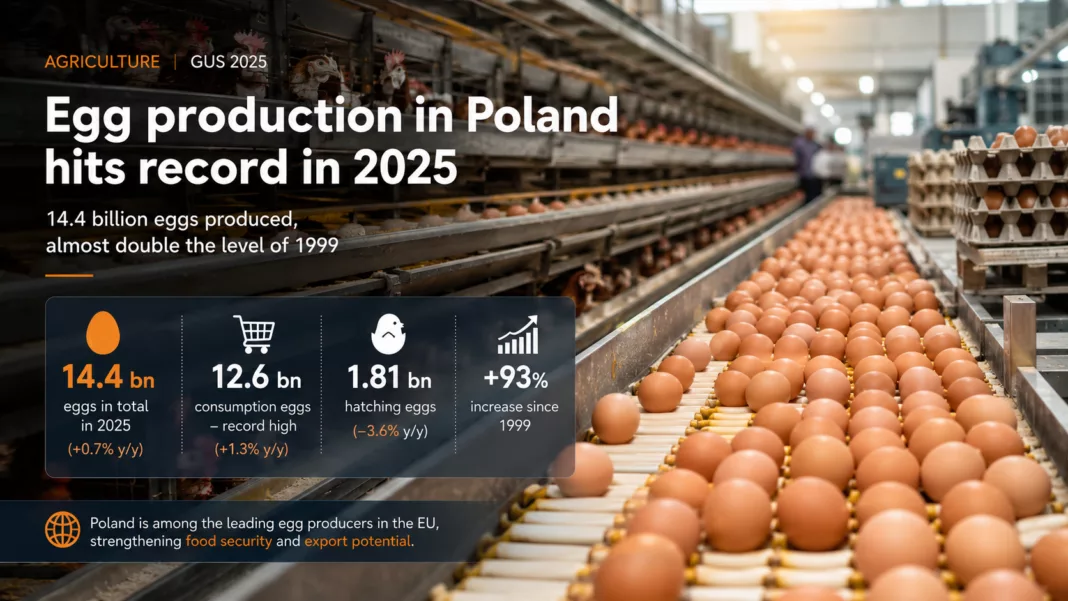

Poland’s egg industry set a new production record in 2025, with total output reaching 14.4 billion eggs. The result was driven by strong growth in table eggs, reinforcing the country’s role as one of Europe’s key poultry producers and strengthening the sector’s export potential.
Egg Production in Poland Reaches Record High: 14.4 Billion Eggs in 2025, Nearly Twice as Many as in 1999
Data period: 1999–2025 (annual data) · Source: chicken egg production across all agricultural holdings, Statistics Poland
Poland’s egg sector closed 2025 with another record. Chicken egg production reached 14.4 billion units — 0.7% more than in 2024 and nearly twice as much as at the beginning of the century. Table eggs remain the main driver of growth, with production also reaching a historic high, while the segment of hatching eggs contracted slightly.
The latest Statistics Poland data on chicken egg production across all agricultural holdings show an industry on a long-term growth path. In 2025, total production reached 14,398 million eggs, of which 12,587 million were table eggs (87.4%) and 1,811 million were hatching eggs (12.6%). Poland is among the leading egg producers in the European Union, and recent years confirm the growing scale of the market.
A Quarter-Century of Growth, Accelerating After 2023
Over the long term, the picture is clear. In 1999, Polish agriculture produced 7.46 billion eggs; by 2025, this had increased to 14.40 billion — a rise of nearly 93%. The trajectory was not linear, however. Following a peak in 2010, the sector went through several years of weaker output, while a clear rebound only emerged towards the end of the decade. The real breakthrough came in 2024, when production jumped by 11.8% year on year — from 12.79 billion to 14.30 billion eggs. In 2025, that record level was maintained and slightly exceeded.
The sharp increase recorded between 2023 and 2025 coincided with a period of high egg prices and flock rebuilding after earlier market disruptions. Statistics Poland’s data do not determine the causes, but the scale of the change — more than 1.6 billion additional eggs annually compared with 2023 — points to a substantial expansion in the sector’s production capacity.
Table Eggs Drive the Market
Structurally, the market is divided into two segments with very different dynamics. Table eggs — supplied directly to retail and food processing — account for nearly 90% of production and are driving the latest growth, rising from 10.97 billion eggs in 2023 to 12.59 billion in 2025. Hatching eggs, used for chick production, grew steadily over the previous decade, from around 1.0 billion in 2011 to nearly 1.9 billion in 2024, but declined slightly to 1.81 billion units in 2025.
| Year | Total (million units) | Table eggs (million units) | Hatching eggs (million units) |
|---|---|---|---|
| 1999 | 7,462 | — | — |
| 2011 | 10,373 | 9,325 | 1,047 |
| 2018 | 11,814 | 10,139 | 1,676 |
| 2023 | 12,786 | 10,968 | 1,819 |
| 2024 | 14,299 | 12,420 | 1,878 |
| 2025 | 14,398 | 12,587 | 1,811 |
In just two years — from 2023 to 2025 — total egg production in Poland increased by 1.6 billion units, or nearly 13%.
Virtually all of this increase came from the table-egg segment, where production rose by 1.6 billion units over the period, while the volume of hatching eggs remained broadly stable.
What This Means for the Industry
- Egg production in Poland has reached a historic high of 14.4 billion units and has nearly doubled since 1999.
- The breakthrough year was 2024, when output rose by 11.8% year on year; 2025 consolidated the record level with a modest further increase.
- Growth is being driven by table eggs, which account for 87% of output, while hatching eggs recorded a slight decline.
- The larger scale of production strengthens Poland’s position as one of the EU’s key egg producers, with implications for exports and the wider poultry supply chain.
Source: Statistics Poland, “Production of Table and Hatching Chicken Eggs Across All Agricultural Holdings” (annual data for 1999–2025, thousand units). Author’s own analysis based on Statistics Poland data.