
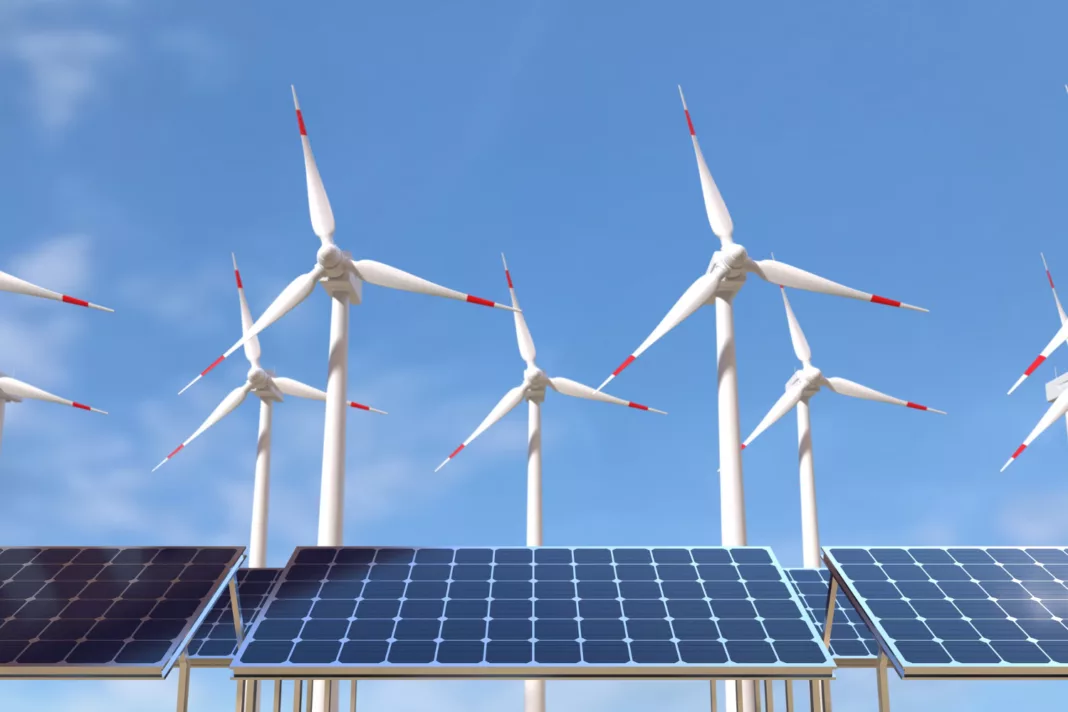

Poland’s renewable-energy register expanded to 39,070 MW by the end of March 2026, up 10.4% from late 2024, according to data from the Energy Regulatory Office (URE). Solar power accounted for almost all of the increase, adding more than 3.5 GW and overtaking wind as the second-largest technology in the register, while biomass co-firing continued to decline. The figures highlight a gradual but significant shift in Poland’s energy mix toward decentralised photovoltaic generation.
Over five quarters — from 31 December 2024 to 31 March 2026 — the number of renewable-energy installations included in the Energy Regulatory Office (URE) map rose from 8,703 to 10,371, up 19.2%, while their combined capacity increased from 35,385 MW to 39,070 MW, up 10.4%. Almost all of this growth came from a single technology: solar photovoltaics added 3,533 MW, an increase of 41.3%, and overtook wind power in the third quarter of 2025 to become the second-largest source in the register. Meanwhile, biomass co-firing — historically the largest category — is shrinking, while Silesia is the only large region to lose capacity.
Kraków, 28 June 2026
What the data show: slow capacity growth, rapid growth in the number of installations
The Energy Regulatory Office’s renewable-energy map is a register of licensed installations and assets entered in URE records — in practice, larger-scale sources such as farms, power plants and generating units, excluding the millions of prosumer micro-installations. This distinction is essential for interpreting the figures correctly: when the data show 12,089 MW of solar PV at the end of March 2026, this refers to installations covered by the map, not total PV capacity in Poland, which is materially higher once rooftop micro-installations are included.
The time series reveals two distinct dynamics. The number of installations is rising quickly and steadily — by more than 330 entries per quarter on average. Total capacity is increasing more slowly (10.4%, compared with 19.2% for the number of installations), because most new sources are relatively small solar-PV projects while one large, legacy category — co-firing — is contracting. Capacity growth was uneven, ranging from just +194 MW in the fourth quarter of 2025 to +1,167 MW in the third quarter of 2025.
| As of | Number of installations | Total capacity [MW] | Quarter-on-quarter capacity increase [MW] |
|---|---|---|---|
| 31.12.2024 | 8 703 | 35 385 | — |
| 31.03.2025 | 9 099 | 36 152 | +767 |
| 30.06.2025 | 9 435 | 36 799 | +647 |
| 30.09.2025 | 9 848 | 37 965 | +1 167 |
| 31.12.2025 | 10 134 | 38 159 | +194 |
| 31.03.2026 | 10 371 | 39 070 | +910 |
The key trend: solar PV overtakes wind
A single chart captures the essence of the shift. The register’s three largest capacity categories are moving in different directions: solar PV is rising steeply, wind power is increasing gradually, and co-firing is declining. As a result, the lines cross: in the third quarter of 2025, solar capacity (10,934 MW) exceeded wind capacity (10,853 MW) for the first time, and by the end of March 2026 the gap had widened to more than 700 MW.
The scale of solar PV’s dominance in incremental capacity is striking. Of the 3,684 MW added to total capacity in the register, as much as 3,533 MW came from PV. Solar’s share of the register’s total capacity increased from 24.2% to 30.9%, while co-firing’s share fell from 38.3% to 33.0% and wind’s share remained broadly stable (29.7% → 29.1%). Wind power grew slowly for most of the period but accelerated in the final quarter (+387 MW), potentially signalling the impact of more liberal rules for turbine siting.
Technologies: where capacity increased and where it declined
Beyond solar PV and wind, the remaining technologies play a supporting role in the register, but their trajectories are instructive. Biogas is growing steadily (from 313 MW to 335 MW, with the number of installations rising from 412 to 443), reflecting increasing interest in biomethane and the use of agricultural waste. Waste-to-energy facilities increased capacity by more than a quarter (from 185 MW to 233 MW). Hydropower has remained virtually unchanged (at around 985 MW), reflecting the exhaustion of major site potential. Biomass has contracted slightly, while renewable hydrogen — with one 1 MW installation — remains a symbolic category.
Co-firing requires separate commentary. The capacity reported for this category is the capacity of entire conventional generating units authorised to co-fire biomass or biogas, rather than the capacity of the green fuel input itself — which is why it inflates the renewable-energy total in the register. Its 683 MW decline is, in effect, a signal that co-firing is being phased out in ageing coal-fired units. Excluding co-firing, the “pure” renewable fleet (PV, wind, hydro, biogas, biomass, waste-to-energy and hydrogen) grew from 21,826 MW to 26,194 MW, or 20.0% — twice the pace implied by the aggregate indicator.
| Technology | Capacity 31 Dec 2024 [MW] | Capacity 31 Mar 2026 [MW] | Change | Installations 31 Mar 2026 |
|---|---|---|---|---|
| Co-firing | 13 559 | 12 876 | −683 (−5,0%) | 35 |
| Solar PV | 8 556 | 12 089 | +3 533 (+41,3%) | 7 835 |
| Wind | 10 522 | 11 363 | +840 (+8,0%) | 1 495 |
| Biomass | 1 263 | 1 187 | −76 (−6,0%) | 49 |
| Hydropower | 985 | 985 | ≈ 0 | 499 |
| Biogas | 313 | 335 | +22 (+7,0%) | 443 |
| Waste-to-energy | 185 | 233 | +48 (+26,0%) | 14 |
| Renewable hydrogen | 1 | 1 | ≈ 0 | 1 |
Regional map: leaders are expanding while Silesia retreats
The geographical distribution of capacity is changing slowly, but the direction is clear. At the end of March 2026, four voivodeships exceeded 4.7 GW: Mazowieckie (5,145 MW), Zachodniopomorskie (5,008 MW), Śląskie (4,771 MW) and Wielkopolskie (4,738 MW). Capacity expanded fastest where two factors coincide — wind resources and intensive PV-farm development: in Wielkopolskie (+686 MW), West Pomerania (+580 MW) and Pomerania (+575 MW). Wielkopolskie stands out for the highest number of installations (1,627), reflecting the dispersed nature of its sources, namely solar PV and biogas.
Silesia stands out in this context as the only large region where capacity declined (by 275 MW). This is a direct consequence of shrinking co-firing and biomass capacity in the heart of Poland’s coal-based power sector. Świętokrzyskie also recorded a modest decline (−75 MW). Opolskie, meanwhile, showed the strongest relative growth: from the lowest base, capacity rose by 330 MW, or almost three quarters. Taken together, these movements paint a consistent picture of the transition: capacity is being added where new PV and wind farms are built, and removed where legacy combustion-based generation is being phased out.
| Voivodeship | Capacity 31 Mar 2026 [MW] | Change od 31.12.2024 [MW] | Installations |
|---|---|---|---|
| mazowieckie | 5 145 | +205 | 796 |
| zachodniopomorskie | 5 008 | +580 | 807 |
| śląskie | 4 771 | −275 | 475 |
| wielkopolskie | 4 738 | +686 | 1 627 |
| dolnośląskie | 2 826 | +110 | 649 |
| pomorskie | 2 749 | +575 | 511 |
| kujawsko-pomorskie | 2 096 | +142 | 933 |
| świętokrzyskie | 2 094 | −75 | 316 |
| lubuskie | 1 591 | +370 | 649 |
| łódzkie | 1 585 | +253 | 786 |
| warmińsko-mazurskie | 1 493 | +180 | 697 |
| małopolskie | 1 246 | +116 | 344 |
| podkarpackie | 1 009 | +276 | 508 |
| podlaskie | 1 024 | +97 | 481 |
| lubelskie | 910 | +116 | 508 |
| opolskie | 783 | +330 | 284 |
Poland’s renewable-energy mix is undergoing a quiet changing of the guard. Co-firing — a relic of the previous era that inflates statistics with the capacity of coal-fired units — is giving way to solar PV, which has added more than 3.5 GW in a year and a half and taken second place in the register. This is not a sudden revolution but a steady, quarter-by-quarter expansion of distributed energy sources.
What it means for businesses, investors and the grid
For developers and investors, the data confirm that solar PV remains the easiest route to rapid capacity additions: a low entry threshold and short delivery cycle translated into more than 1,590 new PV installations in the register over 15 months. Wind acceleration in the final quarter is a signal worth watching when planning onshore projects. For grid operators, growing distributed generation means mounting pressure on connection capacity and energy storage — a bottleneck that will increasingly determine the pace of new grid connections in the coming quarters. For coal regions, led by Silesia, the figures illustrate the real cost of transition: retiring capacity must be replaced with new technologies, preferably locally.
What comes next?
If the pace of the most recent quarters is sustained, total renewable capacity in the URE register will exceed 40 GW during 2026, while solar PV will steadily close the gap with co-firing and could become the largest category in the ranking within several quarters — particularly as co-firing capacity is likely to keep declining. Much, however, depends on factors that historical data alone cannot determine: the pace of grid connections, the outcome of liberalised wind-power rules and the development of energy storage, all of which will shape the further expansion of weather-dependent sources. This forecast is subject to uncertainty: the figures presented describe past conditions and do not guarantee their continuation.
Key takeaways
- Renewable capacity in the URE register rose from 35,385 MW to 39,070 MW (+10.4%), while the number of installations increased from 8,703 to 10,371 (+19.2%) between December 2024 and March 2026.
- Solar PV is the growth engine: +3,533 MW (+41.3%); it overtook wind in Q3 2025 and is now the register’s second-largest source.
- Co-firing is contracting (−683 MW); excluding it, the “pure” renewable fleet grew by 20% — twice as fast as the aggregate indicator.
- Regionally, Wielkopolskie, West Pomerania and Pomerania are expanding fastest; Silesia is the only large region losing capacity.
- The register covers larger-scale sources and excludes millions of prosumer micro-installations, so it does not provide a complete picture of Poland’s PV capacity.
Sources and methodology
Data source: URE. Own calculations based on URE data — “Renewable Energy Map”, positions as of: 31 December 2024, 31 March 2025, 30 June 2025, 30 September 2025, 31 December 2025 and 31 March 2026. All values are historical data (register positions on the specified dates); the “What comes next?” section contains a forecast subject to uncertainty. The number of installations and capacity [MW] were aggregated by the “Renewable-energy type” and “Voivodeship” columns; capacity was summed and rounded to whole MW (shares to one decimal place).
Methodological notes: the URE map covers licensed installations and assets entered in URE registers (larger-scale sources) and does not fully include prosumer micro-installations; the stated capacities — especially solar PV — are therefore lower than the country’s total capacity in each technology. Capacity in the “co-firing” category corresponds to the capacity of conventional units authorised to co-fire biomass or biogas (the capacity of the entire unit), which inflates total renewable capacity; changes in this category primarily reflect decisions affecting conventional units. The register is subject to ongoing updates and reclassifications, hence small fluctuations in the number of installations in certain categories (such as hydropower) between reporting dates. Data are comparable only within the same URE-register methodology.