
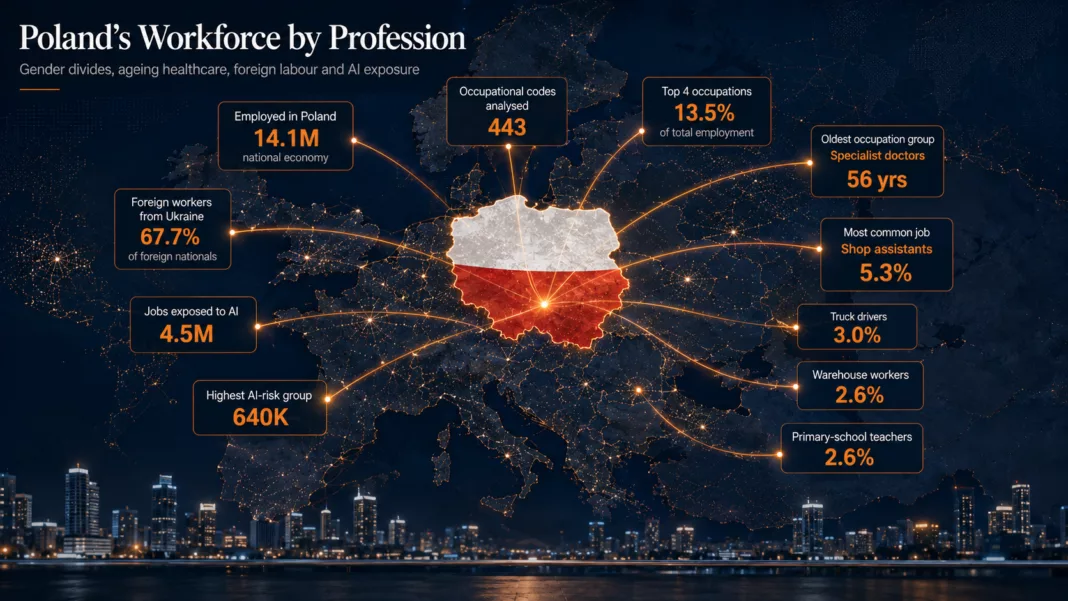

Statistics Poland has published the first dataset of this level of detail on the occupations people actually perform in Poland—not the professions they trained for, but those reported in social-insurance records. Rather than relying on the once-in-a-decade Population Census, the data draw on administrative registers, making it possible to examine 443 four-digit occupational codes by gender, age and place of residence. The picture that emerges is of a labour market deeply divided by gender, ageing in healthcare, reliant on Ukrainian workers in transport and increasingly exposed to automation in office work.
Four occupations that underpin the labour market
The most common occupation in Poland is shop assistant or cashier, accounting for 5.3% of all workers; the average worker is 40 years old and 83.7% are women. They are followed by truck drivers (3.0%; average age 44; only 1.3% women), warehouse workers (2.6%; age 39; 23.8% women) and primary-school teachers (2.6%; age 47; 86.8% women). Together, these four occupations—representing retail, transport and education—make up 13.5% of total employment in the country, even though the occupational classification covers as many as 443 distinct categories active in the labour market.
| Occupation | Share of employment | Average age | Women’s share |
|---|---|---|---|
| Shop assistants and cashiers | 5.3% | 40 years | 83.7% |
| Truck drivers | 3.0% | 44 years | 1.3% |
| Warehouse workers and related occupations | 2.6% | 39 years | 23.8% |
| Primary-school teachers | 2.6% | 47 years | 86.8% |
| Office and hotel cleaners and helpers | 1.7% | 49 years | 91.2% |
| Accountants | 1.5% | 44 years | 92.1% |
A labour market split in two
The dataset confirms strong gender-based occupational segregation. Occupations that are almost entirely female include midwives, early-childhood education specialists and dental assistants; women account for more than 99% of workers in each of these groups. At the other end are male-dominated occupations—miners, bricklayers, agricultural-machinery operators and roofers—where men account for almost 100% of workers. Statistics Poland notes that single-gender concentration is stronger in male-dominated occupations: as many as 19 occupations exceed the 98% male threshold, while fewer categories meet the similarly high 95% threshold for women.
Rare exceptions to the pattern. Only a handful of occupations have a relatively balanced gender split close to 50/50, including shop owners, bakers and pastry chefs, domestic-service workers, head chefs and university teachers. These are exceptions in a labour market where the vast majority of occupations are strongly female- or male-dominated.
Ageing specialist doctors
The highest average age in the entire economy is recorded among specialist doctors—56 years—and specialist dentists—55 years. This is around 20 years higher than the average age of doctors without a specialisation, which Statistics Poland attributes to the longer route to obtaining specialist status. More than 66% of specialist doctors are over 50, with the largest share in the 60-and-over group. A similar, though slightly less pronounced, pattern applies to specialist nurses, nearly 60% of whom are over 50.
A warning of a generational gap in healthcare. The high concentration of workers aged over 50 in specialised medical occupations may mean a clustering of departures from the profession—a wave of retirements—within a relatively short period. Statistics Poland directly links this to the fact that doctors have for years appeared on the list of shortage occupations in most Polish counties, according to the Occupational Barometer.
At the opposite end are occupations with the youngest demographic profile: fast-food preparation workers as well as athletes and jockeys average 29 years of age, while models and flight attendants average 31. Application programmers and other IT specialists also have a young profile, at 34–36 years, reflecting the relatively recent and dynamic development of this sector in Poland.
Foreign workers: transport for men, retail and cleaning for women
Ukrainian citizens clearly dominate among foreign nationals working in Poland, accounting for 67.7%, followed by Belarusians (13.0%), Indians (1.8%), Georgians (1.4%), and Vietnamese, Russians and Turks (1.1% each). The most common occupation among foreign workers overall is truck driver (12.6%)—an occupation that is itself listed as a shortage occupation in Poland by the Occupational Barometer. Among the four largest male nationalities—Ukrainians, Belarusians, Indians and Georgians—truck driver is the number-one occupation in every group, although with markedly different intensity: as many as 45.3% of Belarusians employed in Poland work in this occupation, compared with 16.9% of Ukrainians.
Women account for 37% of all foreign nationals working in Poland and are most often employed as shop assistants, warehouse workers and cleaners, at around 5% each. The structure differs markedly by nationality, however: while Ukrainian women most often work in warehouses, shops and cleaning, IT occupations predominate among Belarusian and Indian women—application programmers and computer-systems analysts, with an average age of 32–33 years respectively.
Who will be most affected by artificial intelligence
For the first time, the publication links occupational data with two independent analyses of exposure to automation: a report by NASK-PIB and the International Labour Organization (ILO), and a report by the Polish Economic Institute (PIE). According to the NASK-PIB and ILO analysis, more than 4.5 million people working in Poland are in occupations that could be partly automated by generative AI, while more than 640,000 are in the highest-risk group, where artificial intelligence could take over a substantial share of everyday tasks. Women account for as much as 77.2% of this latter group, whose average age is just under 40.
Independent estimates based on the PIE methodology indicate that around 3 million people work in occupations ranked among the 20 most exposed to the impact of artificial intelligence, with an average age of 41 and a 57.8% share of women. The most exposed are occupations based on repetitive information processing; among secretaries, women account for 98.8% of the at-risk group. Geographically, occupations threatened by automation are concentrated in large urban areas with developed service sectors—where business-process outsourcing centres, call centres and accounting offices operate—and are least prevalent in rural and peripheral regions.
Civil-law contracts: from teenagers to retirees
In addition to employees on standard employment contracts, Statistics Poland also analysed 1.4 million people working solely under contracts of mandate and similar civil-law arrangements. Cleaners and helpers (6.0%) and workers performing elementary jobs in industry (3.7%) are most frequently employed on this basis, together accounting for nearly 10% of this population. Age variation in this group is exceptionally wide: public officials and specialist doctors are the oldest, averaging 65 years, while athletes, jockeys and product demonstrators are the youngest, averaging 27. Flexible work arrangements in catering, customer service and transport favour younger workers, who combine work with study or gain their first professional experience.
The geography of occupations
For the first time, the experimental study enabled Statistics Poland to map the distribution of selected occupational groups at municipal level using the location quotient. IT occupations are concentrated almost exclusively in major cities and their suburban zones—Warsaw, Kraków, Wrocław, Poznań, the Tri-City and the Katowice conurbation. Transport, warehousing and logistics are arranged along the main transport corridors—the A2 and A4 motorways—with the strongest concentration in the Łódź and Mazowieckie voivodeships. Construction is decentralised, with local clusters in peripheral regions and smaller centres. Tourism and hospitality are the most evenly distributed, with visible clusters on the coast, in Masuria and in the mountains; however, an end-of-December data snapshot shows mountain municipalities ahead of coastal ones, reflecting the seasonality of tourist traffic.
Data source: Statistics Poland, “Occupational diversity in Poland’s labour market” (Experimental Studies, July 2026), the Statistics Poland Department of Methodology and Survey Quality in cooperation with the Statistical Office in Bydgoszcz. Data on exposure to automation and AI: NASK-PIB and ILO, “Generative Artificial Intelligence and the Polish Labour Market” (2025), and the Polish Economic Institute, “AI in the Polish Labour Market” (2024). Authors’ own analysis based on Statistics Poland data. The data are based on administrative registers (Social Insurance Institution records and registers of regulated professions) and the 2021 National Population and Housing Census; the occupation performed was identified for 85.9% of workers in the national economy and 78.3% of people working under contracts of mandate, with remaining gaps filled using hot-deck imputation.