
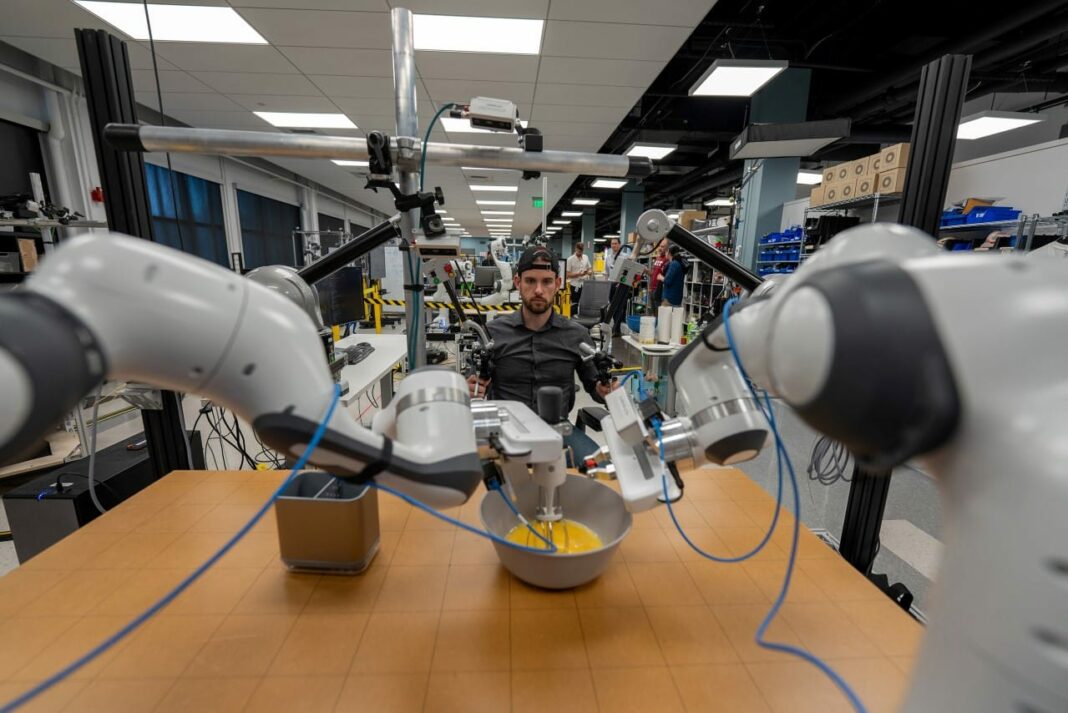


Scientists from the Toyota Research Institute (TRI) are using artificial intelligence to teach robots new, useful tasks. This groundbreaking method allows for the rapid enhancement of machine capabilities. By 2024, the number of robot skills will increase from 60 to over 1000.
Toyota Research Institute is a leading research center of Toyota. Since 2015, top scientists and engineers have been working on the development of safety systems and crash-free and autonomous driving technology. TRI’s research also covers a broader spectrum of mobility, advanced robotics and issues related to artificial intelligence, which Toyota is already using to design electric cars.
Now, in collaboration with Northwestern University, Toyota’s research center has developed a groundbreaking method. Thanks to this method, robots, using artificial intelligence, quickly learn new, often complicated tasks and will soon be able to assist humans.
In recent years, AI technology has dynamically developed “Large Language Models (LLM)”. Advanced artificial intelligence systems can carry out smooth chat conversations, understand the context of written statements, and successfully generate texts. TRI wants to apply a similar principle in robotics to create “Large Behavior Models (LBM)”. The center has already achieved its first, spectacular successes in this field.
Thanks to an innovative approach to artificial intelligence, based on the so-called “Diffusion Policy”, robots have “learned” over 60 dexterous skills – from pouring liquids, using tools, to operating flexible objects. Importantly, not a single line of new code was written by programmers. All of this was achieved by providing the robot with appropriate data. This is a significant revolution compared to traditional robot programming techniques, which were often labor-intensive, insufficiently efficient, and limited to specific tasks.
“Our robotics research is aimed at assisting people, not replacing them. This new teaching technique is very effective and enables robots to effectively support people in many aspects” – said Gill Pratt, CEO of Toyota Research Institute, and Chief Scientist of Toyota Motor Corporation.
The progress in teaching robots has prompted TRI to set even more ambitious goals. Toyota’s scientists plan to teach robots several hundred new skills by the end of this year and as many as 1000 by the end of 2024. The Drake virtual system for designing and testing robots will be useful in this. This is advanced software that allows for the development of technology at an accelerated pace and on a larger scale than with the use of traditional methods. The system pays a lot of attention to safety issues to ensure that robots will not crash into each other or environmental elements.
“A year ago, I wouldn’t have thought we would achieve so much. Thanks to the new approach, the speed of introducing new skills and the reliability of operation are impressive. Based on the image from cameras and data from tactile sensors, our robots effectively cope even with tasks related to flexible objects, fabrics, or liquids, which until now have been a great challenge for this type of machines” – noted Russ Tedrake, Vice President for Robotics Research at TRI.