
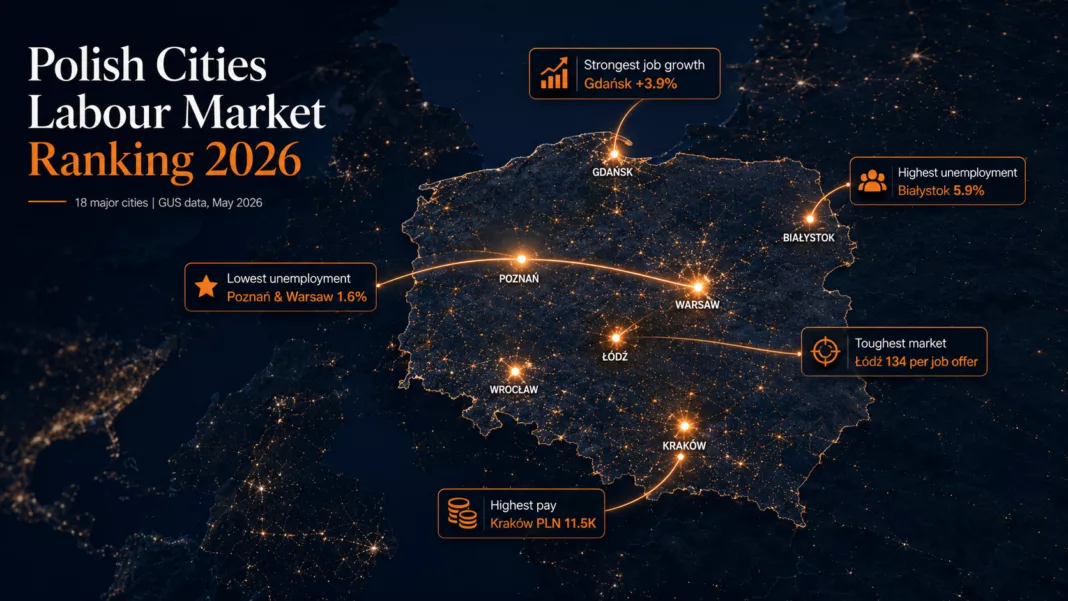

Poland’s largest regional cities entered May 2026 with sharply different labor-market conditions. While Poznań and Warsaw combined the country’s lowest registered unemployment rate of 1.6% with above-average wages, Białystok, Łódź and Kielce remained at the opposite end of the ranking. The comparison of all 18 voivodeship capitals also shows that low unemployment does not necessarily mean rising employment: only three cities recorded year-on-year job growth, while wage increases remained strong across the country. Łódź stood out as the weakest market in the ranking, combining high unemployment, a steep fall in enterprise-sector employment and by far the highest number of unemployed people per advertised vacancy.
Unemployment: lowest in Poznań and Warsaw, highest in Białystok
The registered unemployment rate in May 2026 ranged from 1.6% to 5.9%, meaning the gap between the best- and worst-performing cities was more than threefold. The lowest rates were recorded in Poznań and Warsaw (1.6% each) and in Katowice (1.8%). At the opposite end were Białystok (5.9%), Łódź (5.8%), and Kielce (5.5%).
| Rank | City | Unemployment rate (%) |
|---|---|---|
| 1–2 | Poznań / Warsaw | 1.6 |
| 3 | Katowice | 1.8 |
| 4 | Wrocław | 2.5 |
| 5–6 | Bydgoszcz / Kraków | 2.8 |
| … | … | … |
| 16 | Kielce | 5.5 |
| 17 | Łódź | 5.8 |
| 18 | Białystok | 5.9 |
Wages: Kraków, Warsaw and Gdańsk lead the field
Average monthly gross wages in the enterprise sector reached their highest levels in Kraków (PLN 11,469.00), Warsaw (PLN 11,204.68), and Gdańsk (PLN 11,040.40). The lowest wages were recorded in Kielce (PLN 7,813.12), Białystok (PLN 7,862.01), and Gorzów Wielkopolski (PLN 7,867.58) — a gap of more than PLN 3,600 per month between the extremes.
Year-on-year wage growth
In terms of wage growth momentum, Poznań leads with average pay up 8.4% year-on-year, even though the city’s overall employment level contracted. Opole (+7.5%) and Szczecin (+7.3%) also posted strong growth. Wages rose most slowly in Zielona Góra (+3.6%) and Kielce (+4.5%) — both cities that also have unemployment rates below the national average (5.9%), suggesting weaker wage pressure in their local labor markets.
| Rank | City | Wage change y/y |
|---|---|---|
| 1 | Poznań | +8.4% |
| 2 | Opole | +7.5% |
| 3 | Szczecin | +7.3% |
| 4–6 | Białystok / Lublin / Warsaw | +6.9% |
| … | … | … |
| 16 | Wrocław | +5.3% |
| 17 | Toruń | +5.1% |
| 18 | Zielona Góra | +3.6% |
Employment: Gdańsk grows, Opole loses the most
On a year-on-year basis, average employment in the enterprise sector rose in only three of the eighteen cities: Gdańsk (+3.9%), Szczecin (+1.4%), and Wrocław (+0.6%). In the remaining fifteen cities, the number of jobs contracted. The steepest declines were recorded in Opole (−5.0%), Łódź (−3.0%), and Białystok (−2.9%).
Notably, falling employment does not always correspond with a high unemployment rate. Poznań and Warsaw — the cities with the lowest unemployment in the country — both saw job losses (−2.4% and −0.5%, respectively). This suggests that the low unemployment rate in these cities stems more from limited labor supply registered with employment offices than from expanding employment among local businesses.
Job vacancy availability: easiest in Gorzów and Opole, hardest in Łódź
The number of registered unemployed per job vacancy posted in a given month is a useful measure of how much real competition exists for available positions. The most favorable situation was found in Gorzów Wielkopolski and Opole (6 people per vacancy each), Kraków (7), and Wrocław (8). Łódź fared worst by far, with 134 registered unemployed per vacancy — a figure many times higher than the rest of the field. Lublin also posted a high ratio, at 53 people per vacancy.
Full comparison table
The table below compares all eighteen cities across four core labor market indicators for May 2026.
| City | Unemployment rate (%) | Employment y/y | Average wage (PLN) | Wage growth y/y | Unemployed/vacancy |
|---|---|---|---|---|---|
| Białystok | 5.9 | −2.9% | 7,862.01 | +6.9% | 16 |
| Bydgoszcz | 2.8 | −1.8% | 8,890.32 | +6.8% | 26 |
| Gdańsk | 3.3 | +3.9% | 11,040.40 | +6.7% | 11 |
| Gorzów Wlkp. | 4.4 | −2.8% | 7,867.58 | +5.9% | 6 |
| Katowice | 1.8 | −0.6% | 9,920.97 | +6.0% | 16 |
| Kielce | 5.5 | −2.2% | 7,813.12 | +4.5% | 13 |
| Kraków | 2.8 | −2.0% | 11,469.00 | +6.2% | 7 |
| Lublin | 4.4 | −1.0% | 8,722.43 | +6.9% | 53 |
| Łódź | 5.8 | −3.0% | 8,640.88 | +6.3% | 134 |
| Olsztyn | 2.9 | −0.2% | 8,303.04 | +6.7% | 17 |
| Opole | 3.2 | −5.0% | 8,780.44 | +7.5% | 6 |
| Poznań | 1.6 | −2.4% | 10,952.17 | +8.4% | 30 |
| Rzeszów | 4.4 | −1.1% | 9,012.83 | +5.9% | 27 |
| Szczecin | 4.2 | +1.4% | 9,595.30 | +7.3% | 24 |
| Toruń | 3.9 | −0.4% | 8,568.45 | +5.1% | 16 |
| Warsaw | 1.6 | −0.5% | 11,204.68 | +6.9% | 17 |
| Wrocław | 2.5 | +0.6% | 9,904.47 | +5.3% | 8 |
| Zielona Góra | 4.4 | −2.2% | 8,568.46 | +3.6% | 26 |
Data source: Statistics Poland (GUS). Own compilation based on GUS data — statistics for voivodeship capital cities, May 2026, as of July 1, 2026.