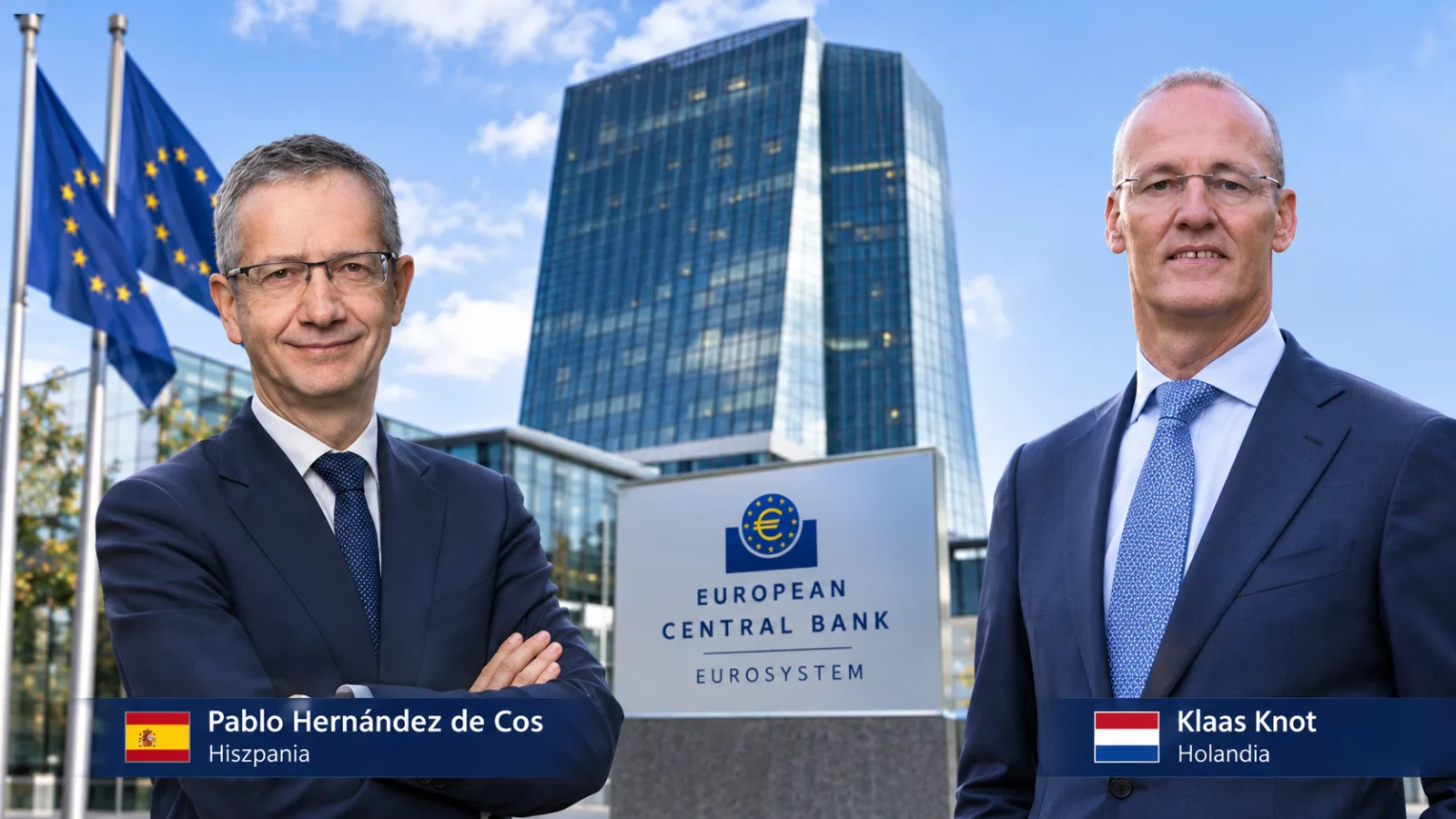
Eurogroup President Kyriakos Pierrakakis confirmed on 6 November 2026 that Spain and the Netherlands have nominated two candidates to succeed Christine Lagarde as president of the European Central Bank (ECB). Spain has put forward Pablo Hernández de Cos, former governor of the Bank of Spain and current general manager of the Bank for International Settlements (BIS), while the Netherlands has nominated Klaas Knot, who led its central bank for 14 years. Eurozone finance ministers are due to discuss the nominations on 9 November, with European leaders aiming to complete the appointment process in December.
Spain and the Netherlands put forward ECB candidates
Pierrakakis announced on Friday that nominations for the ECB presidency had closed. Only Hernández de Cos and Knot had been nominated before the deadline. Both previously led national central banks and served on the ECB Governing Council, which sets monetary policy for the euro area.
The process follows Lagarde’s decision to leave office early. On 29 October, the incumbent ECB president announced that she would step down on 7 February 2027, nearly nine months before her eight-year term was due to expire. Her successor will lead an institution whose interest-rate decisions influence borrowing costs, deposit returns and corporate financing conditions across the euro area’s 21 member countries.
The Eurogroup will hold its first discussion of the two candidates on 9 November. No formal selection is scheduled at that stage. The next steps will depend on negotiations and an agreement among governments of countries using the euro.
Pablo Hernández de Cos: From the Bank of Spain to the BIS
Hernández de Cos served as governor of the Bank of Spain from 2018 to 2024. Since July 2025, he has been general manager of the Bank for International Settlements in Basel, an institution that facilitates central bank cooperation on financial stability, banking regulation and international economic risks.
During his tenure at the Bank of Spain, Hernández de Cos was a member of the ECB Governing Council. He also chaired the Basel Committee on Banking Supervision from 2019 to 2024, overseeing work on international standards intended to strengthen banking-sector resilience.
Spain formally submitted his candidacy on 6 November. In a letter to the Eurogroup president, Deputy Prime Minister and Economy Minister Carlos Cuerpo highlighted his experience in monetary policy, public finances and banking supervision, as well as his independence and ability to build consensus.
Hernández de Cos is generally regarded as having a relatively balanced approach to monetary policy, weighing the outlook for both economic growth and inflation. His central banking experience spans the pandemic, the subsequent inflation surge across Europe and the cycle of interest-rate increases that followed.
Klaas Knot: Fourteen years leading the Dutch central bank
Knot was president of De Nederlandsche Bank from 2011 to 2025. Throughout that period, he served on the ECB Governing Council, contributing to eurozone monetary policy during the sovereign debt crisis, the prolonged era of very low interest rates and the fight against inflation after 2021.
The Dutch economist is associated with a more restrictive monetary policy stance. He previously criticised some of the ECB’s stimulus measures, particularly asset purchase programmes introduced during Mario Draghi’s presidency. He was also among those advocating earlier monetary tightening as inflation pressures intensified.
Knot has experience beyond the Eurosystem. From 2021, he chaired the Financial Stability Board (FSB), an international body that monitors threats to the global financial system and coordinates regulatory standards.
The Netherlands officially announced his candidacy on 4 November. For the Dutch government, Knot’s long experience of interest-rate decisions and his knowledge of the ECB’s institutional processes are important arguments in his favour.
How will the new ECB president be chosen?
The final appointment will be made by the European Council acting with the participation of euro-area member states. First, the Council of the European Union must recommend a candidate, while the European Parliament and the ECB Governing Council will be consulted.
The recommendation requires a reinforced qualified majority: support from at least 16 of the euro area’s 21 countries, representing at least 65% of its population. The same voting threshold applies to the European Council’s final decision.
Germany and France, given their large shares of the eurozone population, will carry considerable weight in negotiations. A candidate supported by many smaller member states would still need a sufficiently broad agreement to clear the population threshold.
According to Reuters reporting cited in the Polish article, European leaders could seek to complete the appointment at the European Council summit on 17–18 December. That timetable is not guaranteed. If political consultations take longer, a formal appointment could instead follow in January 2027.
The succession comes amid wider changes to the ECB Executive Board
The leadership contest coincides with other planned changes to the ECB’s six-member Executive Board. The Polish report notes that Isabel Schnabel, whose responsibilities include market operations, is due to leave in early January 2027. It also identifies 31 May 2027 as the expiry date of Philip Lane’s term.
Source: CEO Magazyn Polska, based on Eurogroup announcements, information from Spain and the Netherlands, and Reuters reporting cited in the original article. The candidacies and appointment timetable are reported as of 6 November 2026; no selection has yet been made.