
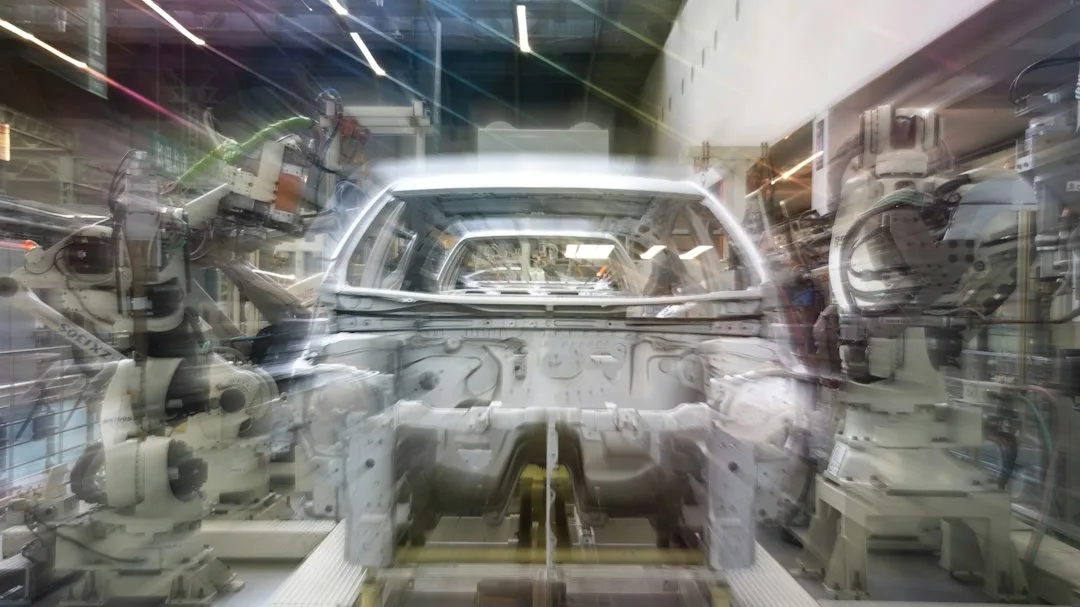
Artificial intelligence could reduce unplanned factory downtime by 30–50% and improve productivity by 20–30%, but more than three-quarters of industrial AI pilot projects fail to develop into coordinated deployments across plants and production lines, according to an Everest Group report produced with Capgemini.
The principal obstacle is not a lack of algorithms but the difficulty of connecting data, industrial machines and production management systems. The April 2026 report, Operationalizing Adaptive AI across the Manufacturing Shop Floor, found that more than 80% of manufacturers struggled to scale AI beyond pilots and over 60% lacked data environments sufficiently prepared for AI applications.
Pilots work locally but do not spread across factories
Manufacturers can already deploy systems that identify defective products, anticipate machine failures or optimise production schedules. Difficulties arise when technology proven on one line must be integrated into factories using different hardware, software and procedures.
More than 75% of pilots did not progress to consistent deployment across multiple plants, lines and key operational processes. This is not the same as saying that 75% failed technically: some may operate successfully at a single location without being expanded.
| Reported adoption obstacle | Share or proportion |
|---|---|
| Manufacturers struggling to scale AI | More than 80% |
| Pilots without broad deployment | More than 75% |
| Manufacturers without AI-ready data | More than 60% |
| Manufacturers facing IT–OT integration problems | Almost 50% |
The measures describe different groups or issues and should not be added together. The report identifies fragmented data, legacy equipment, rigid decision-making and shortages of specialised skills as the main barriers.
Potential economic benefits are substantial, but not guaranteed
Adaptive manufacturing systems may deliver improvements in downtime, quality, resource use and decision speed. Everest Group estimates potential gains of 25–35% in the Right First Time metric, which measures the proportion of products manufactured correctly on the first attempt, and reductions of 15–25% in material losses and unplanned overtime.
| Potential effect | Estimated range |
|---|---|
| Lower unplanned downtime | 30–50% |
| Higher productivity | 20–30% |
| Better Right First Time performance | 25–35% |
| Reduced waste and unplanned overtime | 15–25% |
Decision-to-action cycles could also become three to five times faster, according to the report. These are estimated opportunities, not independently verified savings at every plant. Returns will depend on integration costs, quality of data, production processes and the economic cost of existing disruptions.
From predictive maintenance to adaptive decisions
Conventional automation typically follows predetermined rules, such as issuing an alarm when a machine’s temperature exceeds a threshold. AI can assess combinations of temperature, vibration, equipment load and maintenance history to detect failure risks earlier.
Plants can then schedule repairs, organise replacement parts or change production sequences. More advanced systems may carry out limited approved actions automatically, provided higher-risk decisions remain subject to human oversight.
A truly adaptive factory requires a closed decision loop: detecting an event, evaluating its impact, choosing an action, implementing it and monitoring the outcome. Producing forecasts alone does not improve operations unless they are connected to daily production management.
Siemens’ Erlangen factory illustrates what is possible
The report highlights Siemens’ electronics factory in Erlangen, where AI-supported robotics can identify irregularly positioned components and determine their orientation for assembly without programming every possible arrangement.
A digital twin allows processes and AI models to be simulated and tested with synthetic data before deployment on operational equipment. Such tools reduce the risks of experimentation but cannot entirely replace testing under real production conditions.
Connecting operational technology with IT
Industrial AI requires data flowing between sensors, controllers, manufacturing execution systems and business software. The report identifies standards and architectural approaches including OPC UA, MQTT and Unified Namespace as ways to organise IT–OT communication.
Some decisions must run locally near production equipment to avoid latency, while cloud infrastructure can help analyse information from multiple sites and train models. Systems also need to remain safe and reliable during connection failures.
Rafał Kurman, lead connectivity and network engineer at Capgemini Poland, said the central challenge is safely connecting AI models to machines and operational processes and then reproducing deployments across lines and factories.
Autonomy requires clear limits
AI agents in manufacturing need explicit limits on what they can change without approval, audit trails, access controls and procedures for reversing incorrect actions. Teams must combine manufacturing engineering, automation, IT, data and cybersecurity expertise.
For large industrial groups, the real competitive test will be the ability to reuse solutions at multiple sites without repeating the entire integration exercise each time.
Source: Everest Group, Operationalizing Adaptive AI across the Manufacturing Shop Floor, April 2026, a report licensed and partially funded by Capgemini; comments supplied to the Polish editorial team.