

Sławomir Patyra has announced that he will not participate in Constitutional Tribunal rulings or its internal organisational procedures until all four judges elected by the Polish parliament in March are allowed to perform their duties. His decision has added another layer to the continuing institutional crisis surrounding Poland’s constitutional court.
Sławomir Patyra made the announcement shortly after taking the judicial oath before President Karol Nawrocki on Tuesday, 28 July.
Although the ceremony formally opened the way for him to begin serving on the Constitutional Tribunal, Patyra said that he would not take part in adjudication under the current circumstances. He also intends to stay away from organisational proceedings connected with the functioning of the court.
His position is conditional: he plans to resume his duties only when four other judges elected by the Sejm in March are permitted to participate fully in the work of the Tribunal.
Patyra explained that he could not swear to uphold the Constitution one day and then, in his view, participate in violating it the next.
Patyra expresses solidarity with excluded judges
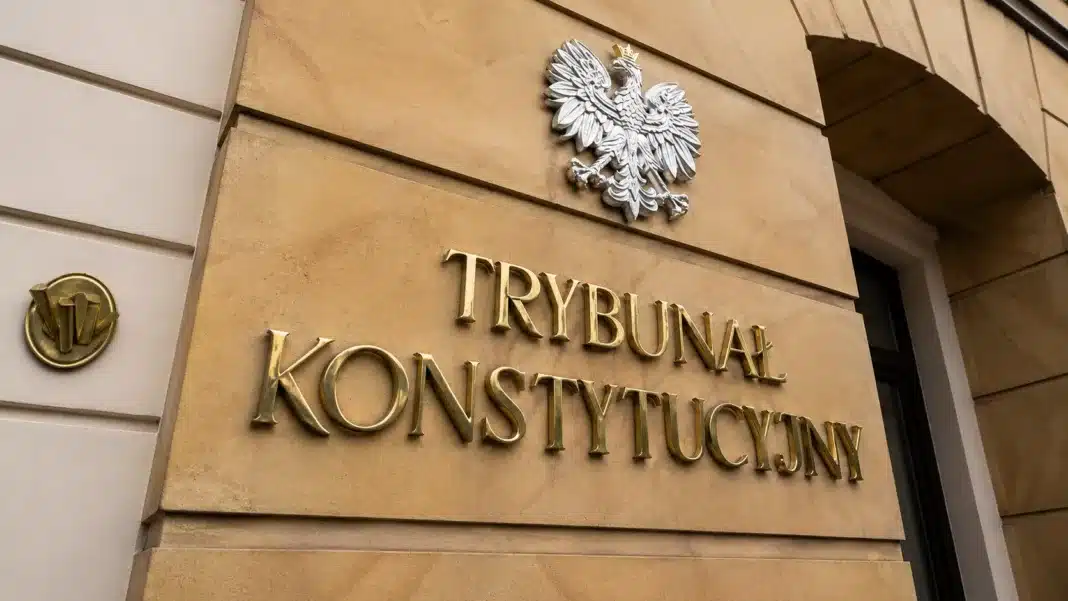
After leaving the Presidential Palace, Patyra appeared outside the Constitutional Tribunal’s headquarters accompanied by several judges elected by the Sejm earlier this year.
Among those present were Magdalena Bentkowska and Dariusz Szostek, who took their oaths before President Nawrocki in April and were subsequently admitted to the Tribunal’s work. Anna Korwin-Piotrowska and Krystian Markiewicz, who have not been allowed to adjudicate, also joined the appearance.
Two other judges elected in March, Maciej Taborowski and Marcin Dziurda, were unable to attend.
Patyra said he stood in solidarity with the judges who, in his assessment, were being unlawfully prevented from carrying out their constitutional duties. He announced that he intended to submit a formal declaration refusing to adjudicate until the dispute was resolved.
The newly sworn-in judge presented his decision as a matter of judicial ethics rather than political strategy. He argued that a Constitutional Tribunal judge must remain loyal to the Constitution even when doing so requires opposing the way in which the institution is currently managed.
Six judges elected by the Sejm in March
The latest controversy is connected with the Sejm’s decision of 13 March 2026 to elect six new members of the Constitutional Tribunal.
The parliament selected Magdalena Bentkowska, Dariusz Szostek, Anna Korwin-Piotrowska, Krystian Markiewicz, Maciej Taborowski and Marcin Dziurda to fill vacancies at the court.
President Nawrocki accepted the oaths of Bentkowska and Szostek on 1 April. They were later admitted to the Tribunal and formally began performing judicial duties.
The president did not accept the oaths of the remaining four judges. They later read and signed the oath during a ceremony held in the Sejm without the president’s participation.
This created a fundamental disagreement over their legal status.
The four judges and representatives of the governing parliamentary majority argue that they were properly elected by the Sejm and should be allowed to take office. The leadership of the Constitutional Tribunal maintains that they have not completed the procedure required to assume judicial duties because they did not take the oath before the president.
As a result, Korwin-Piotrowska, Markiewicz, Taborowski and Dziurda remain outside the Tribunal’s adjudicating panels and have not been granted full participation in its internal bodies.
Competing interpretations of the appointment procedure
The dispute concerns the relationship between the Constitution and legislation regulating the status of Constitutional Tribunal judges.
Article 194 of the Polish Constitution provides that the Tribunal consists of 15 judges elected individually by the Sejm for nine-year terms. The relevant legislation also requires a newly elected judge to take an oath before the president.
The disagreement centres on whether the president’s participation is merely a formal obligation following the parliamentary vote or whether taking the oath before the head of state is necessary for a judge to enter office.
Supporters of the four excluded judges argue that the president should not have the power to block a person properly elected by parliament. In their view, allowing the head of state to select which elected judges may take the oath would give the president influence over the composition of an institution that is supposed to remain independent.
The Presidential Chancellery and the current leadership of the Tribunal have taken a different position. They maintain that the statutory procedure has not been completed and that the four individuals therefore cannot participate in adjudication.
The conflict has remained unresolved despite letters, public appeals and attempts by the elected judges to enter the Tribunal and participate in its meetings.
Patyra says oath was made to the nation
Patyra emphasised that although he took the oath inside the Presidential Palace, the commitment itself was made to the Polish nation.
He pointed to the wording of the oath, which requires a Constitutional Tribunal judge to remain faithful to the nation and to protect the Constitution. In his assessment, accepting a place on the court while other properly elected judges are excluded would be inconsistent with that obligation.
Patyra also said that the judges elected in March should be viewed as a team prepared to restore the Constitutional Tribunal to what he described as its proper constitutional and institutional role.
He praised their professional experience and argued that their participation would strengthen the court’s ability to examine cases involving the rule of law, constitutional rights and the limits of state authority.
His statement indicates that he intends to cooperate closely with the judges elected by the current parliamentary majority rather than operate separately after being sworn in by the president.
Who is Sławomir Patyra?
Sławomir Patyra was elected to the Constitutional Tribunal by the Sejm on 11 June 2026. His appointment was connected with the expiry of Judge Andrzej Zielonacki’s term.
Patyra is a constitutional law professor associated with Maria Curie-Skłodowska University in Lublin. He has worked at the university since the 1990s and heads its Department of Constitutional Law.
He is also a legal counsel, academic lecturer and author or co-author of publications devoted to constitutional law and Poland’s political system.
His candidacy was supported by parties belonging to the governing parliamentary majority. Law and Justice backed a different candidate for the vacant position.
President Nawrocki’s decision to accept Patyra’s oath initially appeared to represent a possible step towards reducing the conflict over appointments to the Tribunal. Patyra’s immediate refusal to adjudicate, however, means that the ceremony is unlikely to improve the court’s ability to operate.
Tribunal crisis remains unresolved
The Constitutional Tribunal has been at the centre of Poland’s political and legal disputes for years.
The current government and parliamentary majority question the legitimacy of parts of the court’s composition and accuse the institution of having become politically dependent under the previous Law and Justice government.
The Tribunal’s leadership rejects those accusations and continues to treat its current members and decisions as legally valid.
The refusal to admit four judges elected in March has created an additional internal conflict. Even Bentkowska and Szostek, who were admitted to the court after taking their oaths before the president, have supported calls for the remaining judges to be allowed to participate.
Patyra’s decision further complicates the situation. The Tribunal now has another formally sworn-in judge who is legally capable of hearing cases but does not intend to do so.
His stance could affect the formation of adjudicating panels, the organisation of general assemblies and the Tribunal’s ability to reach the required quorum in certain proceedings.
The development also demonstrates that accepting an oath from an individual judge does not resolve the broader conflict over the court’s composition. Unless the president, parliament and the Tribunal’s leadership reach an agreement on the status of the four excluded judges, the institution is likely to remain divided.
Patyra’s refusal to adjudicate is intended as an act of solidarity. In practice, however, it may deepen the operational paralysis of a court already struggling with questions about its composition, authority and public legitimacy.