
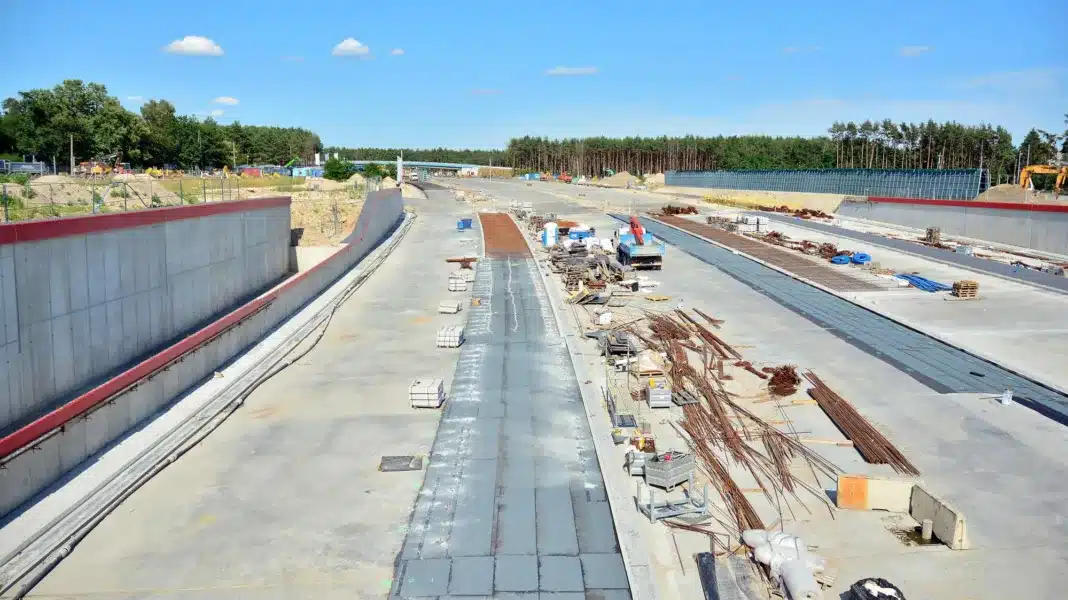


Construction and assembly output in Poland increased by 5.2% year on year in June 2026 and by as much as 11.5% compared with May. After seasonal adjustment, however, annual growth amounted to only 1.8%, while the month-on-month increase was 0.1%. The headline result masks a sharply differentiated picture across the industry: strong growth in linear infrastructure investment accompanied by declines in building construction and specialised construction activities.
The data are preliminary and cover enterprises employing more than nine people whose principal activity is classified under Section F, “Construction”, of the Polish Classification of Activities 2007. Compared with the average monthly level recorded in 2021, construction and assembly output in June 2026 was 12.6% higher in unadjusted terms and 7.8% higher after seasonal adjustment.
Strong seasonality, weaker underlying trend
The chart below shows the seasonal pattern typical of the construction industry: sharp declines in output around the turn of the year, particularly in January and February, followed by peaks in November and December as companies seek to complete contracts before the end of the budget year. After seasonal adjustment, however, annual momentum is visibly weaker. From peaks of around 110–120 points in 2022–2023, the index declined to approximately 96–108 points in 2025–2026, with a pronounced low around the turn of 2025 and 2026.
Construction and assembly output (constant prices, average monthly level in 2021=100), 01/2022–06/2026
Source: Statistics Poland. Author’s own analysis based on Statistics Poland data.
Infrastructure drives growth as buildings and specialised works decline
In June 2026, output increased year on year only in civil engineering, rising by 18.7%. At the same time, output declined among companies carrying out specialised construction activities (-5.7%) and those engaged in building construction (-2.9%). Compared with May 2026, civil engineering output increased by as much as 28.9%, while activity in the other two segments remained virtually unchanged, falling by 0.1% in each case.
Construction and assembly output by type of construction, June 2026
Source: Statistics Poland. Author’s own analysis based on Statistics Poland data.
This picture is confirmed by cumulative data for January–June 2026. Output in building construction declined by 6.5% year on year, while specialised construction activities fell by 2.9%. Civil engineering, by contrast, recorded a marginal increase of 0.2%. Large infrastructure projects, rather than building construction, are currently the main engine of Poland’s construction industry.
The June increase in construction and assembly output was driven mainly by linear infrastructure – roads, railways and transmission networks – supported in part by the final phase of spending under Poland’s National Recovery Plan. Building construction remains under pressure.
Investment work rises sharply as renovation activity falls
In terms of the nature of the work performed, investment-related output increased by 19.2% year on year and by 13.7% month on month in June 2026. Renovation work, meanwhile, fell by 26.8% year on year, although it increased by 4.2% compared with May. A year earlier, the differences were much less pronounced: in June 2025, investment work increased by 9.3% year on year, while renovation work declined by 11.3%. The contrast is therefore considerably sharper this year.
Construction and assembly output by nature of work, year-on-year change
Source: Statistics Poland. Author’s own analysis based on Statistics Poland data.
On a cumulative basis, renovation output fell by as much as 29.1% year on year in January–June 2026, while investment work increased by 8.9%. This confirms that investment budgets, both public and in parts of the private sector, were concentrated on new projects in the first half of 2026 at the expense of maintaining and modernising existing assets.
Full data: construction and assembly output, June 2026
| Category | 05/2026 = 100 (m/m) | 06/2026 = 100 (m/m) | 06/2025 = 100 (y/y) | 01–06 2025 = 100 (y/y) |
|---|---|---|---|---|
| CONSTRUCTION (total) | 107.9 | 111.5 | 105.2 | 97.1 |
| Building construction | 105.7 | 99.9 | 97.1 | 93.5 |
| Civil engineering | 110.7 | 128.9 | 118.7 | 100.2 |
| Specialised construction activities | 106.6 | 99.9 | 94.3 | 97.1 |
The table presents each index with the comparison period set at 100. For example, 111.5 indicates an increase of 11.5%. The 05/2026 and 06/2026 columns refer to month-on-month changes, while the remaining columns show year-on-year changes.
What this means for the market
For construction companies and property developers, the picture in June 2026 was divided. The infrastructure segment – including roads, railways, energy networks and water systems – is benefiting from accelerated spending of EU funds and domestic investment programmes, reflected in double-digit growth both year on year and month on month. Building construction, including residential and commercial projects, and specialised construction activities remain under pressure, signalling caution in private investment demand and the continued impact of high financing costs. The sharp fall in renovation work also suggests that some investors are postponing expenditure on the modernisation and maintenance of existing assets, concentrating their budgets instead on new, large-scale contracts.
Source: Statistics Poland. Author’s own analysis based on Statistics Poland data. Figures for June 2026 are preliminary.