
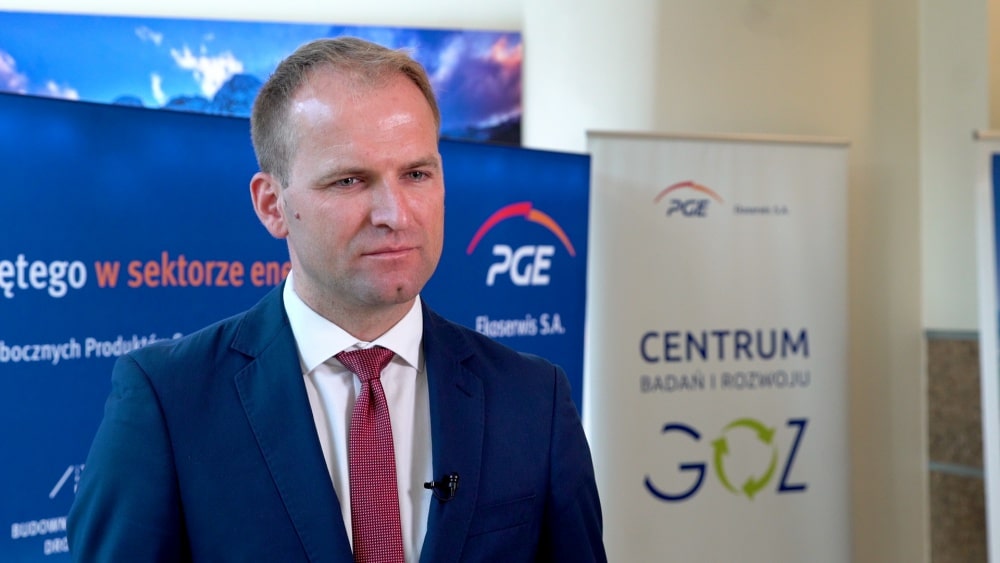


About 20 million tons of ash, slag, and gypsum, by-products from coal burning, are produced annually in Poland. Instead of ending up as waste, these so-called UPSs can be successfully processed into valuable products for various other sectors, in line with the concept of a circular economy. This aspect of activity is increasingly emphasized by the PGE Group. Its subsidiary, PGE Ekoserwis, is strengthening its position as the leader in the Polish market for handling and processing UPSs.
“The use of UPSs in construction, cement or road industry brings many economic and environmental benefits because it is an effective way to reduce both CO2 emissions and extraction of natural resources.” says Lech Sekyra, President of the Management Board of PGE Ekoserwis. “UPSs also hold significant value in the economic transformation of regions. Thanks to them, we carry out land reclamation and conduct projects related to rehabilitating previously degraded areas for local communities.”
UPSs are by-products generated by power plants and CHP plants during the process of coal burning, with about 20 million tons produced annually in Poland.
“We use UPSs in infrastructure construction, building industry, mining, production of agricultural fertilizers, and various land engineering solutions. Hence, UPSs have numerous beneficial uses for the economy.” Lech Sekyra points out.
Technologies and solutions developed within the PGE Group enable the processing and use of UPSs in many industries. They are a valuable raw material used, for example, in construction, cement and concrete production, as well as crop farming and animal husbandry to produce subfloors and hydraulic binders, for example.
PGE Ekoserwis annually processes about 7 million tons of waste and by-products from energy production into 200 different, high-quality products, supplying them to concrete and prefab manufacturers, cement factories, building material producers, mines, and farms. The company stresses that such utilization of UPSs aligns with the concept of zero-emission and zero-waste energy and the idea of a circular economy.
“In response to these transformation challenges, we have established the Research and Development Center for the Circular Economy at PGE Ekoserwis,” says the company’s President. “On the one hand, we are trying to adapt to the current conditions related to conventional energy production and heating, improving the use of combustion by-products and mining by-products. On the other hand, we also look to the future, implementing projects related to recycling materials from renewable energy installations, such as wind turbine blades. We also see the potential in recycling photovoltaic panels.”
The operation of the Research and Development Center for the Circular Economy in Bełchatów was launched at the end of last year. The center’s mission is to create and implement solutions aimed at optimal use of post-industrial waste and recovery of valuable materials from decommissioned renewable energy installations.
The investment carried out by PGE Ekoserwis is an important step in supporting the transformation of the Bełchatów region. It aligns with the EU strategy of achieving climate neutrality by 2050 and the concept of developing a circular economy in the PGE Group. Two years ago, a special segment handling resource loops was established within its structure. As part of the development of this business segment, PGE Ekoserwis and its subsidiary Epore have combined their resources and now operate under a common name – PGE Ekoserwis SA, creating unique competences in the energy and construction industries. This integration has strengthened PGE Group’s position as a national leader in the circular economy in the energy sector.
“The creation of a circular economy segment within the PGE Group is unique,” says Lech Sekyra. “This segment consists of three companies, PGE Ekoserwis, Epore, and Zower. Their fusion allows us to integrate the entire process with very positive results for implementing a circular economy. We reduce the storage of materials in landfills and use them more efficiently in our operational activities, which impacts both economic and environmental aspects.”