
Poland’s foster care system supported 78,300 children at the end of 2025, up 1.3% from a year earlier, according to Statistics Poland. More than three-quarters of children were placed in family-based care, but substantial regional differences and an ageing population of foster carers highlight the challenges facing the system.
Foster Care in 2025: 78,300 Children in Care, More Than Three-Quarters Living in Families
Data period: situation as at 31 December 2025 (compared with year-end 2024) · Statistics Poland publication: 23 April 2026
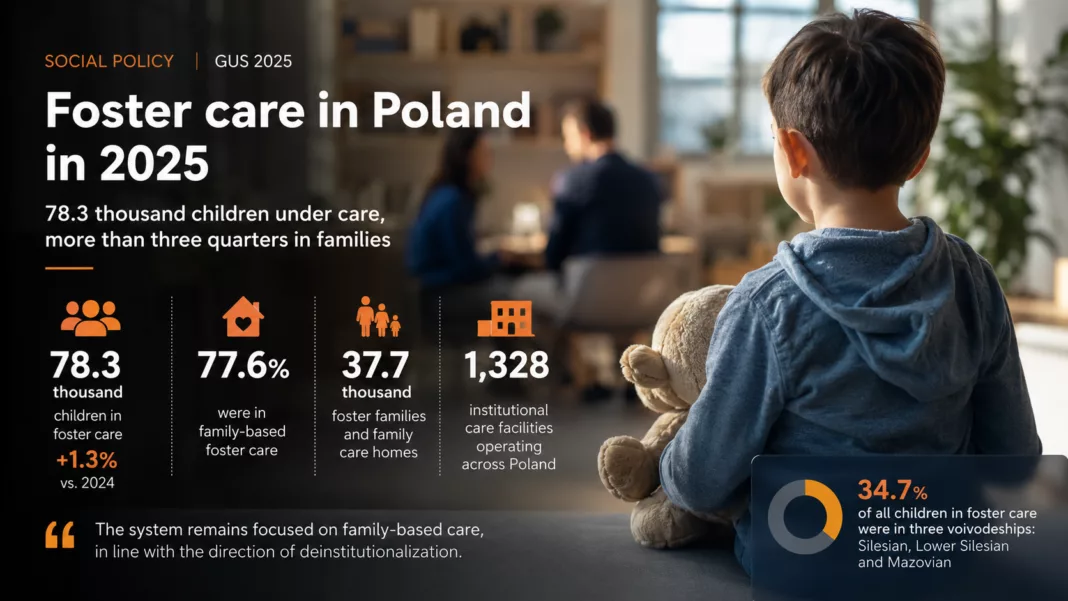
At the end of 2025, Poland’s foster care system covered 78,300 children — 1.3% more than a year earlier. Most of them, 77.6%, were in family-based care, while the remainder lived in institutional facilities. The system relies on nearly 37,700 foster families and family children’s homes, as well as 1,328 facilities, most of which are run by local governments.
The latest Statistics Poland data describe the structure of care for children who, for various reasons, cannot remain with their biological parents. Of the 78,300 children in care, 60,700 were placed in family-based care and 17,500 in institutional care. This confirms the direction set by the policy of deinstitutionalisation: placing children with families, rather than in facilities, remains the priority.
Family Care vs. Facilities: Regional Differences
The share of children in family-based care varies substantially across voivodeships. The highest proportions were recorded in Greater Poland (85.0%) and West Pomerania (82.7%), while the lowest were in Świętokrzyskie (68.7%) and Subcarpathia (72.1%). The scale of the phenomenon is strongly concentrated: around one-third of all children in care (34.7%) were in just three voivodeships — Silesia, Lower Silesia and Mazovia.
Among the 36,800 foster families, kinship families predominate, accounting for 63.5%. Non-professional foster families make up 30.2%, while professional families account for 6.3%. The role was performed by 18,800 married couples and 18,000 single people, while more than half of carers (52.8%) were aged 51–70 — an important signal for planning the future replacement of the care workforce.
| Voivodeship | Families | Children (family care) | Facilities | Residents | % family care |
|---|---|---|---|---|---|
| Greater Poland | 3,436 | 5,450 | 71 | 963 | 85.0 |
| West Pomerania | 2,360 | 4,065 | 65 | 851 | 82.7 |
| Pomerania | 2,627 | 5,015 | 85 | 1,147 | 81.4 |
| Lubusz | 1,381 | 2,196 | 42 | 545 | 80.1 |
| Opole | 1,032 | 1,652 | 31 | 440 | 79.0 |
| Mazovia | 4,130 | 6,429 | 140 | 1,809 | 78.0 |
| Silesia | 5,007 | 8,142 | 179 | 2,345 | 77.6 |
| Podlaskie | 936 | 1,445 | 33 | 420 | 77.5 |
| Łódź | 2,737 | 4,067 | 85 | 1,185 | 77.4 |
| Lower Silesia | 4,027 | 6,360 | 153 | 2,037 | 75.7 |
| Warmia-Masuria | 1,736 | 2,901 | 71 | 985 | 74.7 |
| Lublin | 1,801 | 2,840 | 91 | 965 | 74.6 |
| Kuyavia-Pomerania | 2,325 | 3,775 | 95 | 1,346 | 73.7 |
| Lesser Poland | 2,071 | 3,201 | 94 | 1,142 | 73.7 |
| Subcarpathia | 1,173 | 1,829 | 46 | 709 | 72.1 |
| Świętokrzyskie | 968 | 1,381 | 47 | 630 | 68.7 |
| Poland | 37,747 | 60,748 | 1,328 | 17,519 | 77.6 |
Children’s Ages: Facilities Mainly Care for Teenagers
The age structure reveals a clear division in the roles played by the two forms of care. In family-based care, children aged 7–13 are the largest group (35.3%), while infants under one year old are the least numerous (1.7%). The pattern is entirely different in institutional facilities: teenagers aged 14–17 are the largest group, accounting for as much as 47.0% of residents. This shows that younger children are far more often placed with families, while facilities in practice mainly take responsibility for older adolescents.
Among institutional facilities, socialisation-type care and education centres predominate, accounting for 65.3% of the 16,900 available places. Three-quarters of all facilities (74.9%) are run by local-government entities, mainly counties (558) and cities with county rights (406). The remainder are run by associations (127), churches and religious associations (111), and foundations (95).
In 2025, 10.0k children entered family-based care for the first time, while 8.500 children under the age of 18 left it. A total of 2.600 residents returned to their birth families, and 1.200 children were adopted.
Among adult residents leaving family-based care, 2.300 established their own households, but 1.300 people who exited the system after turning 18 had still not become independent — a group particularly exposed to difficulties entering the labour and housing markets.
Key Findings
- System rośnie umiarkowanie (+1.3% r/r) i pozostaje oparty na pieczy rodzinnej (77.6%), zgodnie z kierunkiem deinstytucjonalizacji.
- Regional differences are considerable — from 85.0% of children in families in Greater Poland to 68.7% in Świętokrzyskie.
- Facilities instytucjonalne specjalizują się de facto w opiece nad nastolatkami (14–17 lat to 47.0% wychowanków), podczas gdy młodsze dzieci trafiają głównie do rodzin.
- An ageing care workforce (52.8% of carers are aged 51–70) and adult care leavers who have not achieved independence are challenges requiring attention in social policy.
Source: Statistics Poland, “Foster Care in 2025” (Statistical Office in Kraków, publication of 23 April 2026); situation as at 31 December 2025. Author’s own analysis based on Statistics Poland data.