

After two decades of sharp swings, Poland’s housing market is once again approaching a pivotal moment. Lower interest rates are gradually improving mortgage affordability, but a cooling labour market, rising unemployment and worsening demographics could limit demand in the years ahead. Our analysis of housing prices, monetary policy, employment and population trends examines whether Poland is heading for further growth, a divided market or a broader correction.
Correction or Further Growth? What Two Decades of Data Say About the Future of Housing Prices in Poland
Over the past two decades, housing prices in Poland have gone through a full cycle: a pre-crisis boom, a multi-year correction, prolonged stagnation and a sharp surge driven by cheap credit. Today, the market is once again at a familiar crossroads—the question is which way the pendulum will swing. We compared NBP price data with demographic trends and labour-market conditions to examine which arguments support further price growth and which point to a correction.
Two Decades in Four Phases
The history of housing prices in Poland since the National Bank of Poland launched its BaRN database in 2006 can be divided into four distinct phases. The first was the pre-crisis boom of 2006–2007, fuelled by easily available foreign-currency loans and post-EU-accession optimism. The second phase was the 2008–2013 correction, during which prices in some cities, including Kraków, fell by nearly 28% from their peak. The third phase was a lengthy period of stagnation and gradual recovery from 2013 to 2019, as the market absorbed the supply surplus of the previous decade. The fourth phase was the pandemic and post-pandemic boom of 2020–2026, culminating in a sharp rise in prices after the government introduced the “Safe Mortgage 2%” programme in 2023. Prices in Kraków alone rose by more than 28%.
The scale of price growth varies widely between cities and is largely explained by the low-base effect: cities that were relatively inexpensive in 2006 now record the highest percentage gains, even though in PLN per square metre the biggest centres—Warsaw and Kraków—have gained the most. The absolute gap between the most expensive and least expensive markets therefore remains substantial, but the relative distance has narrowed significantly.
Interest Rates: From Prohibitive Borrowing Costs to a Gradual Thaw
For years, Poland’s housing-price cycle has moved in tandem with the NBP interest-rate cycle. Record-low rates before 2020 and near-zero rates during the pandemic fuelled credit demand, while sharp increases in 2021–2022—to a peak of 6.75%—effectively froze household borrowing capacity for more than a year. Since May 2025, the Monetary Policy Council has been easing monetary policy: the reference rate has fallen from 5.75% to 3.75%, which, for a PLN 500,000 mortgage, translates into a monthly instalment several hundred zloty lower. The Council has, however, paused further cuts since March 2026 and signalled that the next move may not come before 2027.
Why does this matter for housing prices? Lower rates increase buyers’ borrowing capacity without any change in their incomes—often enough to revive demand faster than underlying economic conditions would suggest. This mechanism, further strengthened by a subsidised-loan programme, drove the price jump in 2023–2024. Whether that scenario can repeat in the coming years depends on whether the Monetary Policy Council finds room for further cuts, which in turn depends on inflation, still above the NBP target in mid-2026.
Demographics: The Weakest Link in Long-Term Demand
While interest rates and labour-market conditions are cyclical, the demographic trend is structural and, as forecasts from Statistics Poland and Eurostat indicate, largely irreversible over the coming decades. At the end of 2025, Poland’s population stood at 37.33 million, compared with nearly 38.5 million a decade earlier. By the end of Q1 2026, it had fallen to 37.281 million, while the natural decrease—the difference between births and deaths—totalled around 168,000 people in 2025. The fertility rate remains around 1.10–1.14, compared with the replacement level of 2.1.
According to Eurostat’s demographic forecast from April 2026, Poland’s population is expected to decline to 32.94 million by 2050 and 25.65 million by 2100. This directly affects the number of potential homebuyers over the next 10–20 years: the working-age population, the core group of mortgage borrowers, is shrinking in particular. Labour migration—including the inflow of foreign nationals—mitigates the trend only partly, because some migration is temporary rather than permanent settlement. The result is a rapidly rising ageing index: in 2010 there were 89 people aged 65+ per 100 children aged 0–14; by 2025, there were already 148.
Arguments for Downward Pressure
A shrinking number of people aged 25–45 means a smaller pool of natural mortgage-financed homebuyers over the coming decade, especially outside large metropolitan areas, where population outflows are the fastest.
Mitigating Factors
Population decline is not evenly distributed—large cities with strong labour markets continue to attract internal and international migration, concentrating demand geographically rather than reducing it evenly.
Labour Market: Cooling After Years of Record-Low Unemployment
The registered unemployment rate can be a useful leading indicator for the housing market: a low unemployment rate means stable incomes and a greater willingness to take on long-term obligations. Compared with the price cycle, the pattern shows a clear correlation: in 2008, at the peak of the pre-crisis boom, registered unemployment fell to 8.8%—its lowest level in years. In 2013, precisely at the bottom of the housing-price correction, it reached 14.4%. After six years of uninterrupted decline, it approached the lowest levels in the history of the series in March 2020.
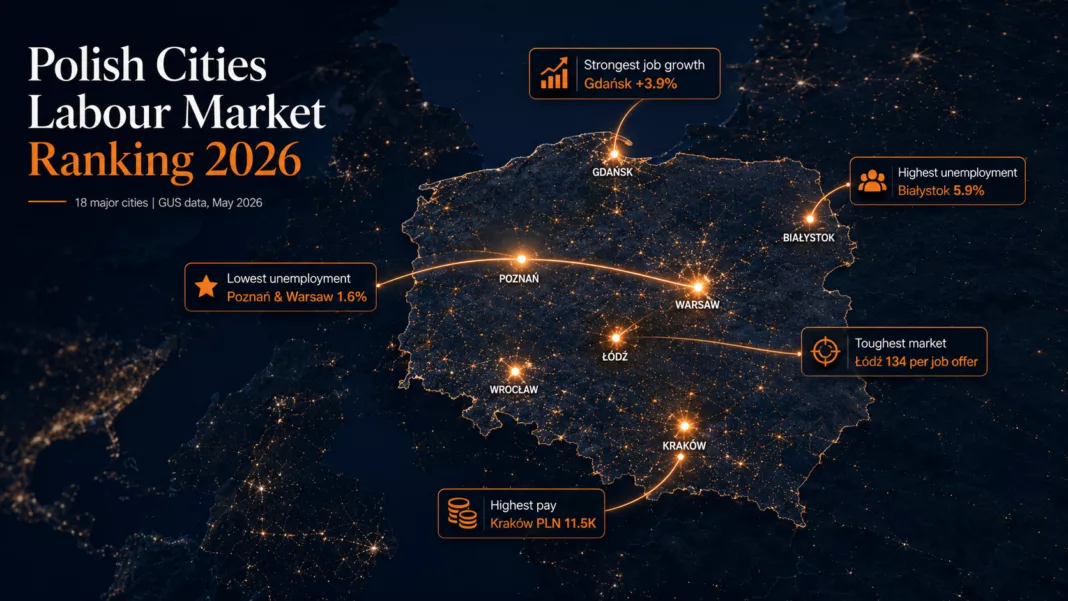
In May 2026, the registered unemployment rate was 5.9%. This was the second consecutive monthly decline and reflected the typical seasonal pickup in construction and services. However, year-on-year unemployment was 0.8 percentage points higher than a year earlier (5.1% in May 2025), while the number of registered unemployed people rose by more than 130,000. Historically, Poland remains a country with relatively low unemployment—ranking among the EU leaders—but the direction of change over the past year has been unfavourable, and the number of new job offers reported to labour offices has almost halved year on year.
What the Numbers Say: Three Scenarios Instead of One Forecast
Putting these three variables together—historical prices, interest rates, and demographic and labour-market conditions—does not produce a single clear answer, because they operate in opposite directions and over different time horizons. Lower interest rates are a short-term factor supporting demand today. A cooling labour market is a warning signal over the next several quarters. Demographics are a structural force that will shape the market for decades regardless of the business cycle. As a result, framing the market through scenarios is more meaningful than relying on a single forecast.
Moderate growth
Further monetary easing—although slower than in 2023–2024—and recovering borrowing capacity, alongside a stabilising labour market, sustain demand, especially in large cities with positive net migration. Prices rise, but much more moderately than during the “Safe Mortgage 2%” period.
Stabilisation / a two-speed market
Prices in Warsaw, Kraków, Wrocław and the Tricity remain close to current levels thanks to concentrated demand, while smaller centres with negative net migration and weaker labour markets see stagnation or slight real declines after inflation is taken into account.
Correction
Persistently high inflation prevents further rate cuts, year-on-year unemployment growth deepens, and the high price base after the 2023–2024 boom proves misaligned with real purchasing power—particularly outside the largest metropolitan areas.
Important methodological caveat. The scenarios above describe boundary conditions derived from historical data; they are not investment advice or a binding forecast. The property market also responds to factors that are difficult to anticipate, including political decisions on support programmes, land supply, construction costs and regulatory changes. The data describe past and current conditions; they do not guarantee that they will continue in either direction.
Source Data Overview
| Indicator | 2006–2008 | 2013 | 2020 | 2025–2026 |
|---|---|---|---|---|
| Housing prices (Kraków, primary market) | boom | correction trough (-27.9% from peak) | gradual recovery | PLN 16,859.05/m² (+180% since 2006) |
| NBP reference rate | high (pre-crisis) | post-crisis rate-cutting cycle | 0.10% (record low) | 3.75% (after cuts from 5.75%) |
| Registered unemployment rate | 8.8% (Oct 2008) | 14.4% (Feb 2013, peak) | c. 5.2% (before the pandemic) | 5.9% (May 2026; +0.8 pp year on year) |
| Population of Poland | c. 38.1 million | c. 38.5 million | c. 38.3 million | 37.28 million, declining trend |
Data sources: NBP—BaRN residential property price database and Monetary Policy Council announcements on interest rates; Statistics Poland—registered unemployment rate, population size and structure; Eurostat—demographic forecast for Poland (April 2026). Prepared in-house based on data from Statistics Poland, NBP and Eurostat. Housing-price data cover asking prices in multi-family housing, including VAT. Where approximate or estimated values are used in the text, this is explicitly indicated (“c.”); these are not figures verified for an individual quarter.