

US fiscal policy supported economic growth in the third quarter of 2026 but is expected to become a drag by year-end. Brookings forecasts that it will reduce real GDP growth by around 0.7 percentage points in 2027. Tax cuts are expected to be outweighed by weak growth in government purchases, tariffs and the fading effect of an earlier investment stimulus.
Estimates by the Hutchins Center at the Brookings Institution put fiscal policy’s contribution to US real GDP growth in Q3 2026 at around 0.4 percentage points. Federal government purchases provided the main support, while state and local government purchases held growth back.
The Fiscal Impact Measure (FIM), released on 30 October, tracks fiscal policy’s effect on real GDP growth. It covers federal, state and local government, as well as the effect of taxes and benefits on consumption.
Federal purchases sustain the positive contribution
Brookings’ quarterly data show that federal purchases of goods and services added around 0.5 percentage points to GDP growth in Q3. State and local purchases subtracted around 0.2 points. Other factors, including taxes, benefits, tariffs and estimated supply-side effects, added around 0.1 points, taking the overall fiscal contribution to about 0.44 points.
It was the third consecutive quarter of positive fiscal support. The contribution was around 0.83 points in Q1 and 0.33 points in Q2. Fiscal policy therefore supported growth throughout the first nine months, although the strength of that support varied.
The contribution is forecast to turn negative in Q4
For the final three months of 2026, fiscal policy is forecast to subtract around 0.4 percentage points from GDP growth. Weak growth in government purchases and the burden of tariffs are expected to outweigh the stimulus from tax cuts.
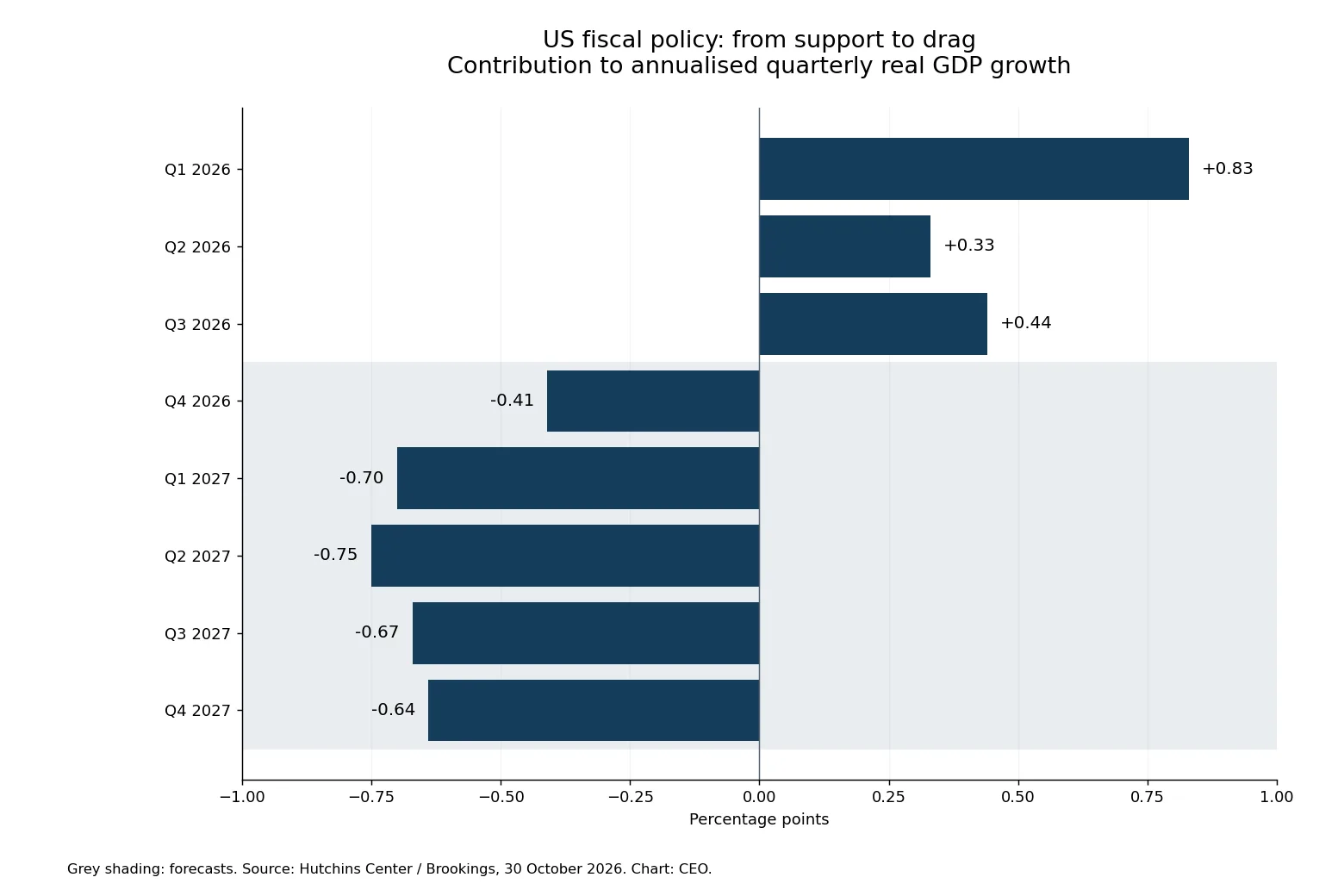
| Period / component | Contribution, percentage points |
|---|---|
| Q1 2026 | +0.83 |
| Q2 2026 | +0.33 |
| Q3 2026 | +0.44 |
| Q4 2026 | -0.41 |
| Q1 2027 | -0.70 |
| Q2 2027 | -0.75 |
| Q3 2027 | -0.67 |
| Q4 2027 | -0.64 |
Tax cuts are not expected to offset the drag
Brookings estimates that the One Big Beautiful Bill Act will continue to support activity in 2027. Its total positive contribution is forecast at around 0.37 percentage points in each of the first two quarters. It is then expected to weaken to around 0.15 points in Q3 and 0.14 points in Q4.
Brookings assumes that CHIPS, which supports the semiconductor industry, and the Inflation Reduction Act (IRA), which includes incentives for energy and climate investment, previously encouraged equipment purchases. Their estimated contribution to GDP growth nevertheless turns negative, falling from around +0.08 points in Q3 2026 to −0.26 points in Q1 2027 and −0.42 points at the end of 2027.
This reflects a change in those investments’ contribution to growth rather than the end of every project supported by the two programmes. Excluding estimated supply-side effects, Brookings puts the fiscal drag in 2027 at around 0.4 points, compared with around 0.7 points in its main scenario.
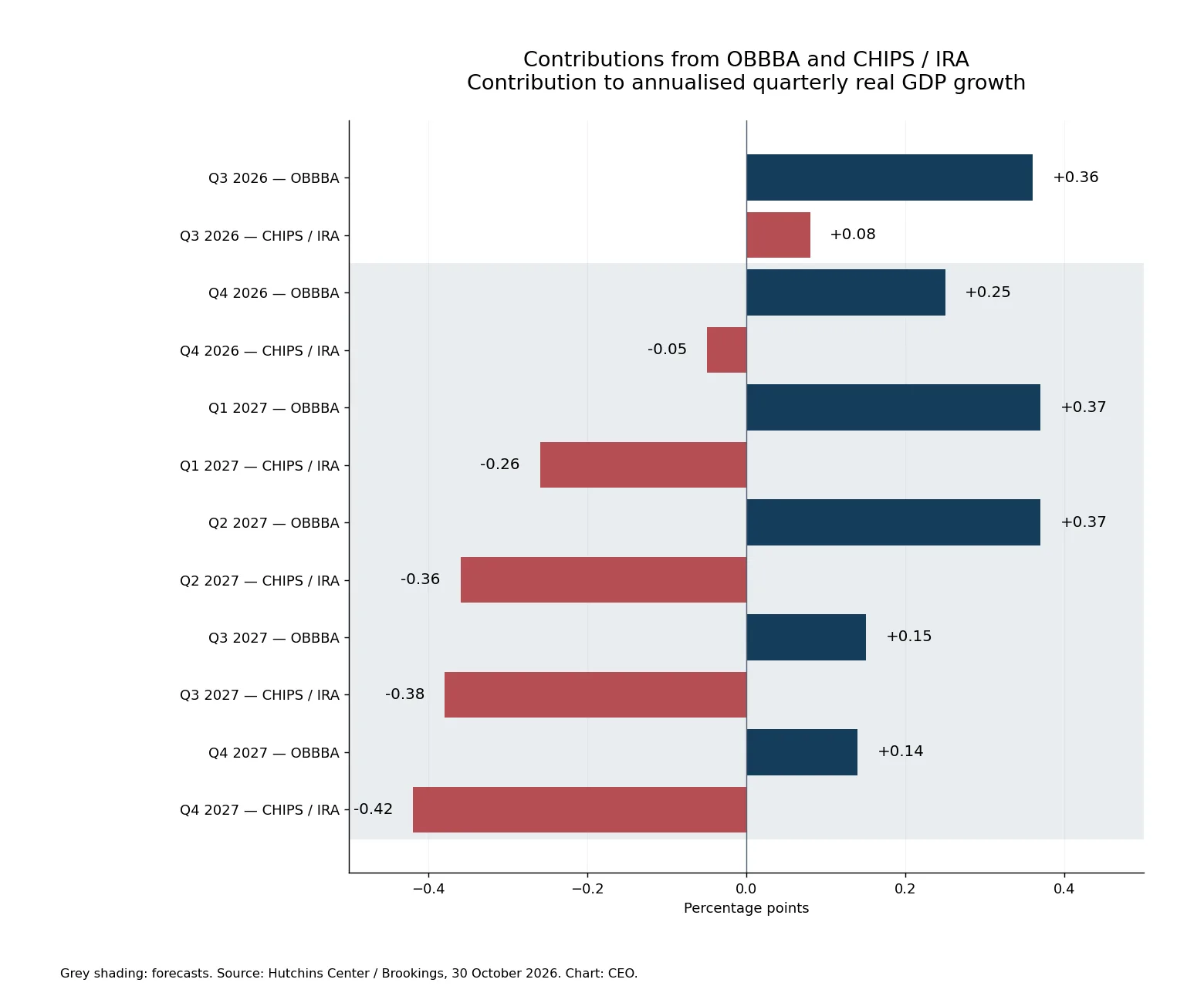
| Period / component | Contribution, percentage points |
|---|---|
| Q3 2026 — OBBBA | +0.36 |
| Q3 2026 — CHIPS / IRA | +0.08 |
| Q4 2026 — OBBBA | +0.25 |
| Q4 2026 — CHIPS / IRA | -0.05 |
| Q1 2027 — OBBBA | +0.37 |
| Q1 2027 — CHIPS / IRA | -0.26 |
| Q2 2027 — OBBBA | +0.37 |
| Q2 2027 — CHIPS / IRA | -0.36 |
| Q3 2027 — OBBBA | +0.15 |
| Q3 2027 — CHIPS / IRA | -0.38 |
| Q4 2027 — OBBBA | +0.14 |
| Q4 2027 — CHIPS / IRA | -0.42 |
A negative fiscal contribution does not imply recession
A negative FIM reading means fiscal policy reduces GDP growth relative to the model’s benchmark. The economy can therefore continue to expand. The measure covers both tax and spending decisions and automatic changes in taxes and benefits associated with the economic cycle.
The model does not include fiscal multipliers, meaning subsequent rounds of effects from tax and spending changes. The forecast assumes current law remains in place, with no new tax or spending legislation, and tariff rates remain close to Q2 2026 levels. Changes to those assumptions could alter the projected drag.
Based on the Hutchins Center Fiscal Impact Measure and Fiscal Impact Breakdown, updated on 30 October 2026, and Brookings Institution methodology. Polish original published on 31 October 2026: CEO.