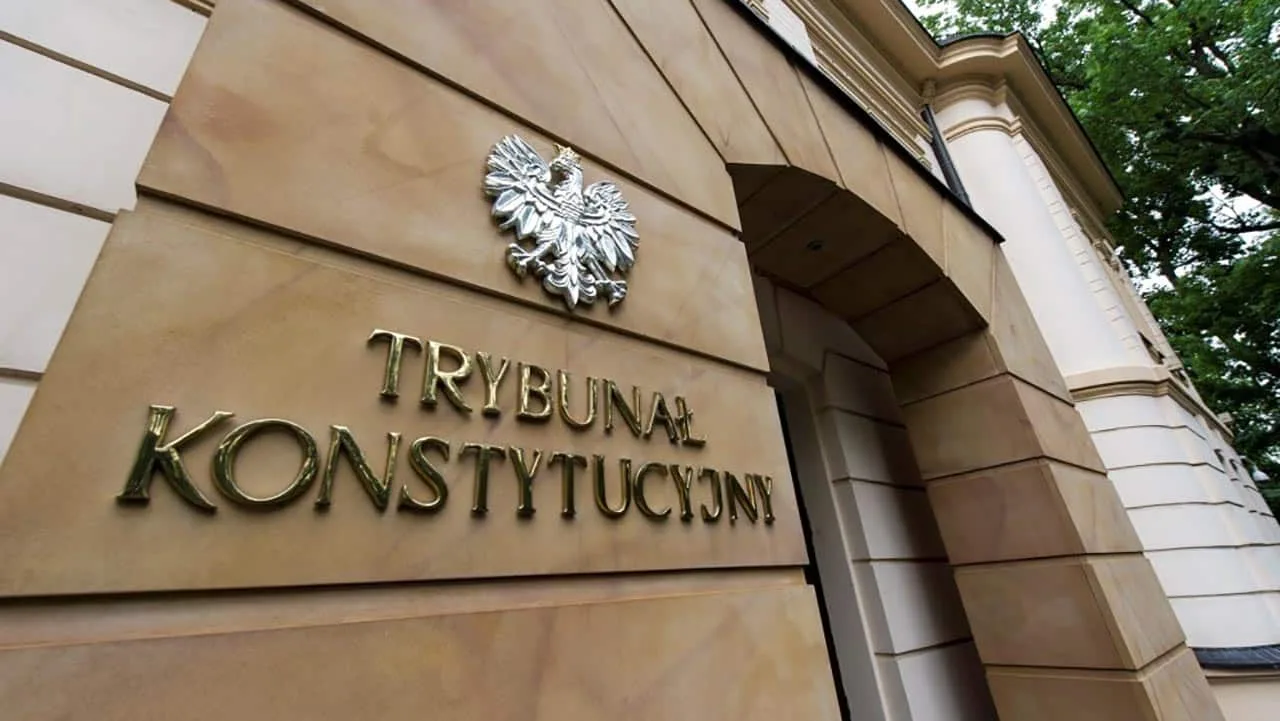
The dispute over Poland’s Constitutional Tribunal escalated sharply on Friday evening, when judges elected by the current parliament announced that the court’s president had been suspended from his duties. Police and protesters gathered outside its Warsaw headquarters, while President Karol Nawrocki cut short a flight to Senegal and later entered the building amid a confrontation. The events unfolded after the Warsaw stock market had closed.
Commentary by Michał Stajniak, originally published on 31 October 2026. The market outlook below refers to the following Monday’s opening.
The All Saints’ Day weekend may give emotions time to subside. Markets could react on Monday, but the response may be smaller than some expect. The key facts and their potential implications for Polish assets are set out below.
What happened at the Tribunal?
On Friday evening, the Tribunal’s website published a notice announcing a one-month interruption of the duties of its president, Bogdan Święczkowski, and vice-president, Bartłomiej Sochański. Judge Anna Korwin-Piotrowska made the decision, citing her seniority as a judge and provisions allowing a judge’s duties to be interrupted immediately. She accused the leadership of blocking other judges and of irregularities.
Justice Minister Waldemar Żurek separately submitted applications to lift the two judges’ immunity. Seven newly elected judges entered the building with the State Protection Service, known by its Polish acronym SOP, through a gate at the Chancellery of the Prime Minister.
The Tribunal’s account on X was taken over, and the existing leadership used it to accuse the other side of mounting a coup. Law and Justice (PiS) politicians and supporters gathered outside. After security fastenings were cut, Święczkowski entered the grounds but was stopped by police and withdrew, saying he would return with the president.
Police detained three people following attempts to force their way through the perimeter fence. Prime Minister Donald Tusk defended the actions as necessary to restore the rule of law, while PiS leader Jarosław Kaczyński said Poland had become a police state. Some Polish ambassadors resigned.
Nawrocki returns to Warsaw
President Karol Nawrocki interrupted his flight to Senegal and, after returning, met the First President of the Supreme Court and Święczkowski. He entered the Tribunal building during the night. Accounts of his entry differ: the government side says there was no scuffle, while the president’s entourage says judges tried to stop him.
The president called consultations with parliamentary representatives. Korwin-Piotrowska announced a General Assembly for 3 November.
The origins of the dispute
The conflict dates back to 2015, when PiS appointed judges to seats that were already filled, appointments subsequently found defective by the European Court of Human Rights and the Court of Justice of the European Union. Since March 2026, the Sejm, Poland’s lower house of parliament, has elected eight new judges. The president refused to swear in some of them, while Święczkowski prevented them from adjudicating.
The government’s refusal to publish Tribunal judgments has deepened the conflict. Political nominations made by the current governing coalition have also attracted criticism. Experts note that while the European Court of Human Rights proceedings concerned allowing judges to take up their duties, the legal basis for removing the president from his duties raises doubts and creates rule-of-law risks.
International reaction
The strongest foreign response came from US Ambassador to Poland Tom Rose. “The events unfolding this evening at Poland’s Constitutional Tribunal are very serious. We appear to be witnessing an unprecedented confrontation over the government’s exercise of state power and the independence and authority of a constitutional institution,” he said, as quoted in the Polish article’s own translation.
He added: “America stands with Poland. It is not our role to judge or interfere in its internal affairs. We care about the stability, security and democratic future of a country we proudly call a friend and ally.” These quotations have been translated into English from the Polish wording reproduced in the original article.
BBC, Sky News and Deutsche Welle reported extensively on the events, while images of police outside the Tribunal circulated internationally. The BBC noted that Poland is due to hold a parliamentary election next year. Some observers see the government’s actions as an attempt to mobilise voters, while some coalition supporters have long criticised the prime minister for not acting decisively enough.
In mid-October, analysis service Adalytica had already described Poland as a market where, until the dispute is resolved, “the price of risk is determined by political control rather than the finality of legal decisions”. A response from the European Commission would probably have to wait until the start of the week.
Political tensions offer little support for Polish assets
The weekend gives markets time to digest events, with Monday’s opening providing the first test. It is difficult to see Friday’s developments helping either the zloty or the WIG20 index. Their significance should nevertheless be kept in proportion: global factors are likely to matter more for most assets, and international markets had not ended Friday on a particularly positive note.
Polish original by Michał Stajniak, published on 31 October 2026: CEO.