



The findings of the EY European Attractiveness Survey 2025 show that, despite global economic and geopolitical volatility, Poland is strengthening its position not only regionally, but also on a European scale. In 2025, the number of foreign direct investment projects in Poland increased by 10% year on year, while across Europe it fell by 7%. In addition, Warsaw recorded a remarkable rise of 21 places, moving up to fifth position among the cities perceived as the most attractive investment locations.
The EY European Attractiveness Survey analyses foreign direct investment inflows and investor sentiment. This year’s 25th edition points to growing selectivity in investment activity across the continent. Traditional sectors and established investment destinations in Western Europe are recording declines, while areas such as artificial intelligence, defence and low-carbon energy are gaining momentum. In geographical terms, the sharpest falls in the number of projects are being seen in Western Europe, while increases are being recorded in Southern, Central and Eastern Europe.
Poland gains in the number of investment projects
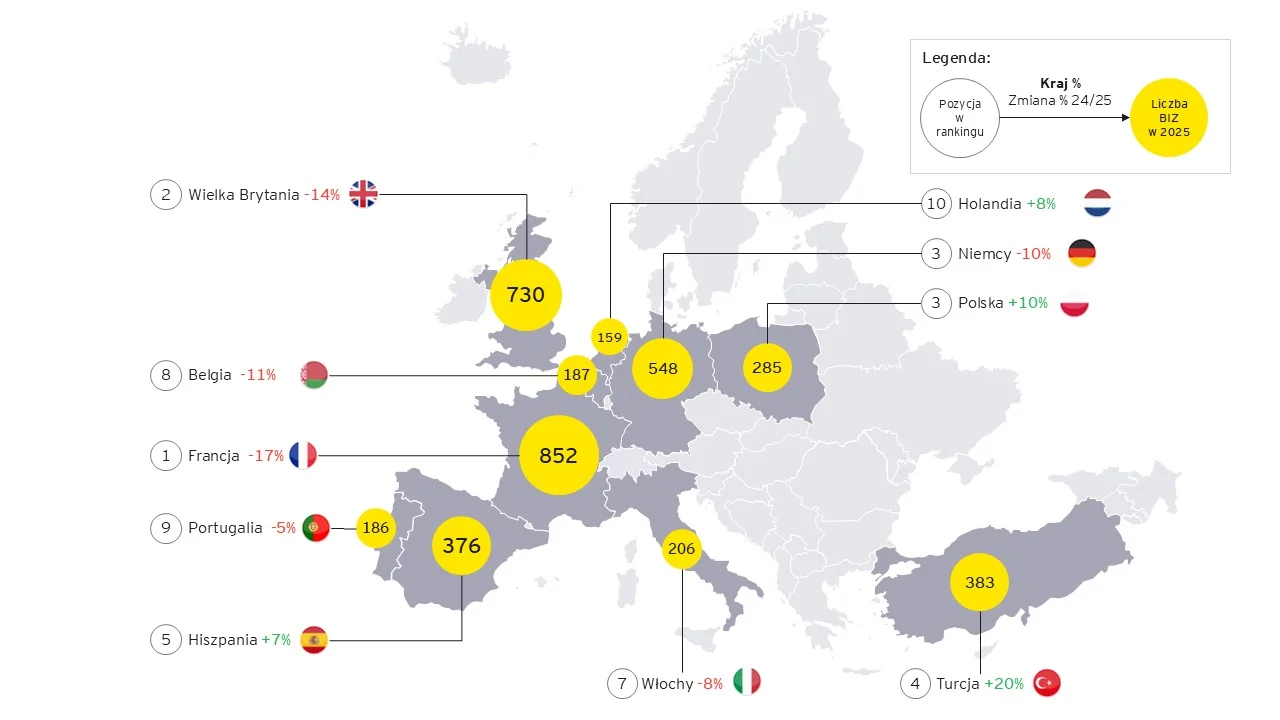
Compared with Europe’s largest economies, Poland is gaining importance as a destination for capital allocation. While markets such as France (-17%), the United Kingdom (-14%) and Germany (-10%) are recording double-digit declines in the number of investment projects, Poland is attracting an increasing number of new projects, posting growth of 10% year on year, with 285 projects. This continues the positive trend already visible earlier, when the decline in investment projects in 2023 was followed by a rebound in the following year. The sectors showing significant growth in the number of projects include defence and artificial intelligence, whose importance is clearly increasing both regionally and across Europe.
Chart 1. Top 10 FDI locations in 2025 – number of projects and year-on-year growth
In addition, according to more than 500 board-level decision-makers, Poland will remain one of the most attractive markets in 2026. This view was expressed by 17% of respondents, placing Poland sixth in Europe. Interestingly, a similar assessment applies to city attractiveness, where Warsaw made a huge leap of 21 places to rank fifth, ahead of cities such as Amsterdam, Berlin and Madrid.
“The growing number of investments in Poland is no coincidence. It is the result of several overlapping factors: strategic defence spending driven by the geopolitical situation, the development of investment in data centres, and the continuing nearshoring trend. National and EU funds supporting infrastructure development also play an important role. What is particularly encouraging is that the positive trend is visible both nationwide and at metropolitan level. The increasingly strong perception of Warsaw as an attractive location for investment capital confirms that Poland is seen as a stable partner, despite the tense geopolitical situation in the region,” says Mateusz Pociask, Managing Partner of EY Poland from 1 July 2026.
Europe is seeing a downward trend, but new sectors are driving investment
EY data show that Europe remains an attractive destination, but investors are approaching investment decisions with greater caution and increasing selectivity. In 2025, the number of FDI projects fell by 7% year on year to 5,026 projects, continuing the trend seen in the previous year, when a 5% year-on-year decline was recorded. The change in the structure of investment is even more visible in the number of jobs generated by new projects, which dropped by as much as 25% year on year to around 200,000, compared with a 16% year-on-year fall a year earlier. Against this backdrop, countries such as Turkey (+20%), Romania (+16%), Spain (+7%) and Poland (+10%) stand out. Depending on the country, they are characterised by competitive labour costs, strong economic growth, or the availability of land and fewer administrative restrictions.
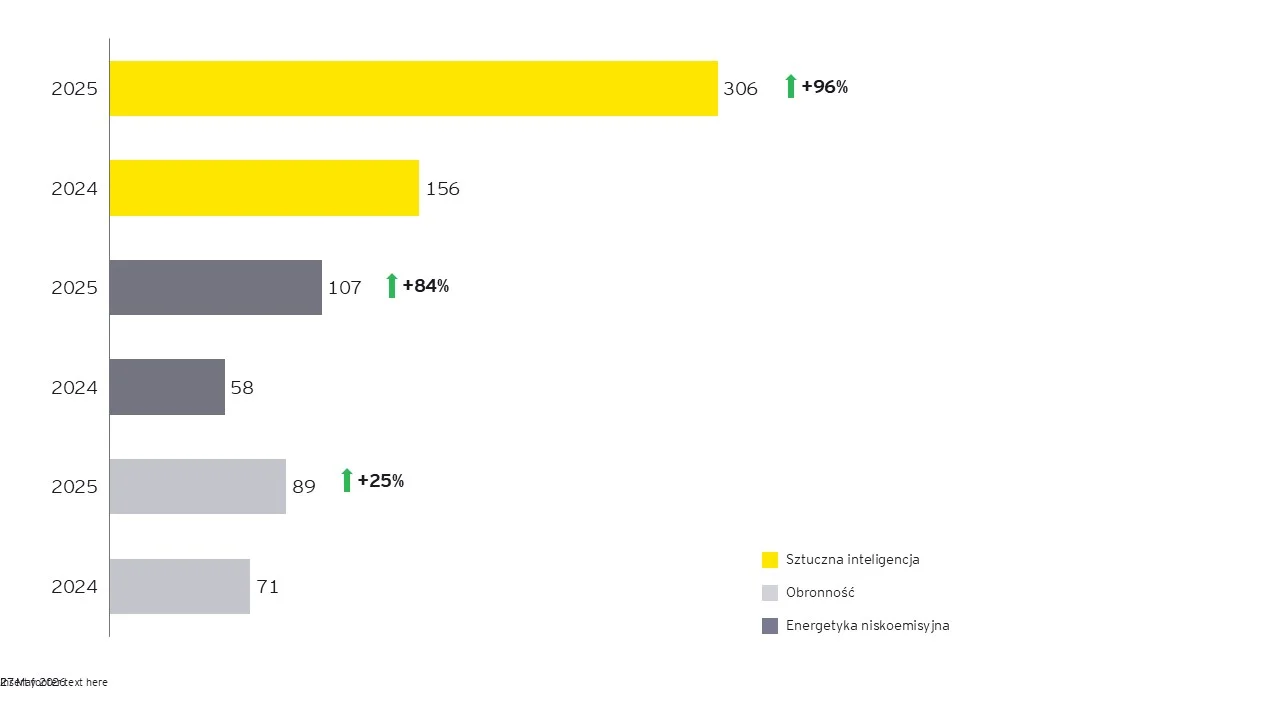
In terms of sectors, it is clear that data centres linked to the development of AI, together with the defence sector, now account for an increasingly large share of investment in Europe. The former recorded growth of 96%, reaching 107 projects, while the latter grew by 84%, with 89 investments.
Chart 2. Growth in the number of projects in AI, defence and low-carbon energy
“EY’s data on foreign direct investment in Europe show the structural changes taking place. Investment capital is currently shifting towards AI, defence and low-carbon energy. Projects that build resilience, technological development and supply chain security are gaining in importance. Although geopolitical tensions continue to have a negative impact on the scale of investment, and globalisation is increasingly giving way to geopolitics, Europe remains an attractive destination for investors in the longer term. Sixty percent of respondents to the EY survey expect Europe’s investment attractiveness to increase over the next three years, confirming continued confidence in European economies,” says Jacek Kędzior, Managing Partner of EY Poland and Managing Partner for the Central Europe Region.
Short-term caution, long-term optimism
Current investor decisions are marked by clear caution, but this does not translate into a lasting deterioration in the assessment of Europe. The percentage of companies planning new investments over the next year fell to 54%, down from 59% a year earlier, confirming short-term concerns. At the same time, as many as 60% of companies expect Europe’s attractiveness to increase over the next three years.
It is also worth noting that, although US investments in Europe still represent the largest number of projects, they are on a downward trend. German companies are also carrying out fewer projects on the Old Continent than in previous years. Between 2019 and 2025, the share of US investments decreased by 38%, while the decline among German investments amounted to 28%. This gap, at least in terms of jobs created, is being filled by Asian companies. Singapore recorded the largest percentage increase in its share of investment in Europe, rising by 117% year on year, which translated into 4,713 new jobs.
“Investors are not withdrawing from Europe, but they are adopting a more selective and wait-and-see approach. In the short term, they are primarily weighing energy and labour costs, as well as tax challenges. In the longer term, however, investment attractiveness continues to be determined by fundamentals: market scale, economic growth potential, infrastructure quality and institutional stability. We have limited influence over geopolitics, but we can strengthen Europe’s competitiveness where we still have real tools at our disposal: skills, technology and the quality of the investment environment,” concludes Mateusz Pociask.
About the survey
The EY European Attractiveness Survey 2025 consists of two parts. The first is quantitative data collected as part of the EY European Investment Monitor, in cooperation with OCO. It covers foreign investments announced in 47 European countries in 2025 that resulted in the creation of jobs and the opening of new facilities.
The following categories of investment projects are excluded from the survey: mergers and acquisitions and joint ventures, unless they result in the creation of new facilities or new jobs; licensing agreements; retail and leisure facilities, hotels and real estate; utilities; extractive activities; portfolio investments, including pensions, insurance and financial funds; investments in factories and other investments related to the replacement of production capacity; and non-profit organisations.
The second part consists of the results of a survey carried out by Longitude on behalf of EY among 500 global business leaders between 11 February and 30 March 2026.