




Oil prices are taking control of markets amid mixed diplomatic signals and tightening supply.
- Oil continues to influence broader risk appetite through its impact on inflation expectations, bond yields and the US dollar.
- Donald Trump’s alternating diplomatic and confrontational rhetoric has pushed oil prices lower, but has not materially improved the prospects for reopening the Strait of Hormuz.
- Physical market indicators continue to point to tightening conditions, despite the recent weakness in futures prices.
- The elevated negative correlation between gold and oil, yields and the dollar shows how strongly oil is currently influencing different asset classes.
As Ole Hansen, Head of Commodity Strategy at Saxo Bank, explains, oil continues to exert influence far beyond the energy market itself. More than any other asset in the current environment, oil prices are shaping broader market sentiment through their impact on inflation expectations, central bank policy assumptions, government bond yields and the US dollar. In practice, oil has now become the main transmission mechanism for markets.
The performance of different asset classes increasingly reflects this dependence. Gold, despite persistent geopolitical uncertainty, is struggling to generate sustained demand. Higher oil prices increase concerns about sticky inflation, lift bond yields and strengthen the dollar, creating less favourable conditions for non-yielding assets. At present, there is an elevated negative correlation between gold on the one hand and oil, bond yields and the dollar on the other. Until this relationship changes, oil is likely to remain the dominant macroeconomic driver across markets.
Recent price moves once again showed how sensitive the market is to political rhetoric. Oil prices fell sharply after Trump said the United States was in the “final stages” of talks with Iran, raising hopes that a diplomatic breakthrough could eventually ease supply disruptions. Those hopes faded after further comments in which he warned that “there will be more fighting if Iran does not get smart”.
Markets increasingly appear trapped between these alternating signals. The result is significant price volatility, but without the one development that matters most: the reopening of the Strait of Hormuz and the normalisation of regional energy flows.
At the same time, market attention is shifting increasingly from missile launches to logistics and storage. Kpler data show that since mid-April, no tanker carrying Iranian crude has crossed the blockade line, while crude loadings have fallen from around 2.1 million barrels per day before the disruption to the current level of 640,000 barrels per day. Meanwhile, floating inventories in the Gulf have risen from around 23 million to 42 million barrels, with another 15 million barrels accumulating onshore. These rising inventories represent barrels that are stranded, not barrels removed from the market — and they form a pressure point that the US administration hopes to use to eventually push Iran back to the negotiating table.
There have, however, been some cautious signs of movement. Limited tanker traffic from China and South Korea has recently resumed, while India is preparing to receive cargoes again from Middle Eastern suppliers. These volumes, however, remain only a fraction of normal levels and do not yet indicate any meaningful normalisation.
The latest weekly EIA oil market report provided further evidence of continued tightening in the physical market. Total US oil inventories fell by a record 17.8 million barrels, although almost 10 million barrels of that decline came from the release of crude from the Strategic Petroleum Reserve. Commercial crude inventories nevertheless fell by a significant 7.9 million barrels, while stocks at Cushing declined for the fourth consecutive week.
Imports increased, supported by Venezuelan crude deliveries that reached their highest level since 2018, but this was largely offset by another rise in exports, as international demand continued to draw US light sweet crude onto global markets. Distillate inventories rose slightly, but remain close to their lowest seasonal levels in more than two decades, reinforcing signals of continued tightness in the middle distillates segment.
Meanwhile, Goldman Sachs estimates that visible global inventories of crude oil and petroleum products are falling at a record pace, declining so far this month by 8.7 million barrels per day.
For now, futures prices may continue to react to reports about diplomatic activity and shifting political rhetoric. However, if these developments do not translate into a meaningful increase in physical flows, price weakness may remain driven more by expectations than by fundamentals. Futures respond to headlines; physical markets still depend on actual deliveries.
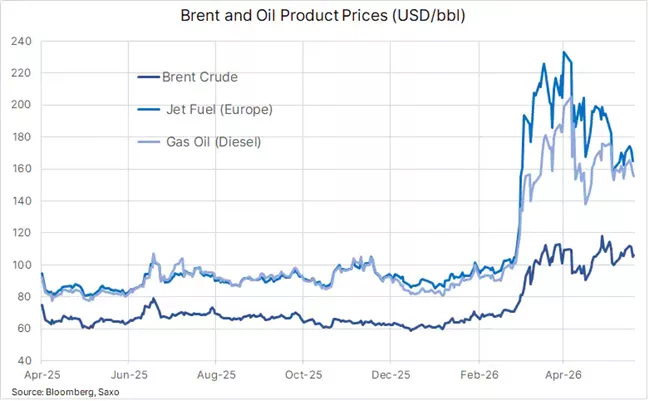
While Brent remains in a sideways trend, diesel and jet fuel prices have fallen – source: Bloomberg and Saxo
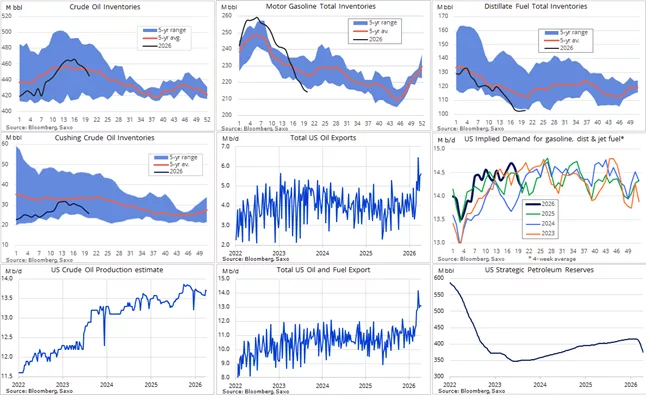
EIA data showing a decline in crude oil and petroleum product inventories and a sharp increase in exports – source: Bloomberg and Saxo.