


From 1 July 2026, e-commerce parcels valued at up to EUR 150 and imported from outside the European Union will no longer benefit from customs-duty exemption. During a transitional period — provisionally until 1 July 2028 — they are expected to be subject to a EUR 3 charge for each tariff line in a shipment, rather than for each individual item. Five identical T-shirts would therefore count as one tariff line, while a T-shirt and a pair of shoes would count as two. Although seemingly technical, this change could significantly affect the operating model of non-EU platforms, particularly Asian e-commerce players that have so far based a substantial part of their sales on direct shipments to European consumers.
In 2025, imports from China to Poland amounted to EUR 57.9 billion, while Polish exports to China reached EUR 3.1 billion. It is worth noting that imports from China already account for 15.5% of Poland’s total imports. They have been growing at an annual rate of 13%, compared with growth of around 6% for total imports. The same trend is visible in e-commerce: Temu, Shein and AliExpress generated approximately PLN 11.6 billion in turnover in Poland between autumn 2024 and autumn 2025, translating into around 100 million parcels annually. This shows that trade relations are now considerably stronger than investment ties, with Poland serving Chinese companies primarily as a consumer and distribution market.
For the warehouse real estate market, this creates a very tangible demand driver. A natural response from Chinese giants may be to locate a larger share of inventory within the European Union. In practice, this would mean additional demand for fulfilment centres, buffer warehouses, transhipment hubs, and facilities supporting returns handling and rapid distribution across several markets at once.
We can also see this in discussions with potential tenants from China. As part of Unlock Europe, a Cushman & Wakefield initiative delivered with the support of the APAC team, we met in Shanghai and Guangzhou with representatives of companies planning to enter or expand their operations in the European Union market. Interest in logistics space in Poland and the CEE region is genuine, although its scale is difficult to estimate precisely at this stage. These estimates should nevertheless be approached cautiously, as the same enquiries can circulate through the market via several channels at the same time. Even on a conservative basis, the potential volume is significant compared with the Polish market, where gross demand reached 1.58 million sq m in the first quarter of 2026.
Poland has a strong position in this equation. It is the largest warehouse market in CEE, with stock exceeding 37 million sq m, developed road infrastructure, access to the ports of Gdańsk and Gdynia, proximity to Germany, and a strong base of logistics operators specialising in e-commerce services. At the same time, it does not always compete with direct investor incentives as aggressively as some other markets in the region, including Hungary. Its advantage must therefore lie primarily in market scale, infrastructure quality, availability of modern space and operational predictability.
For warehouse owners and developers, this is both an opportunity and a challenge. Chinese tenants expect large-scale facilities, short delivery times, technical flexibility and highly efficient decision-making processes. At the same time, their risk profile differs from that of traditional long-term logistics operators. For property owners and investment funds, the key issue is therefore not only the scale of demand itself, but also the strength of the tenant guarantee, the company’s compliance profile, and the risk of re-letting space tailored to a single occupier. The number of square metres must therefore be assessed alongside the certainty of a specific lease agreement.
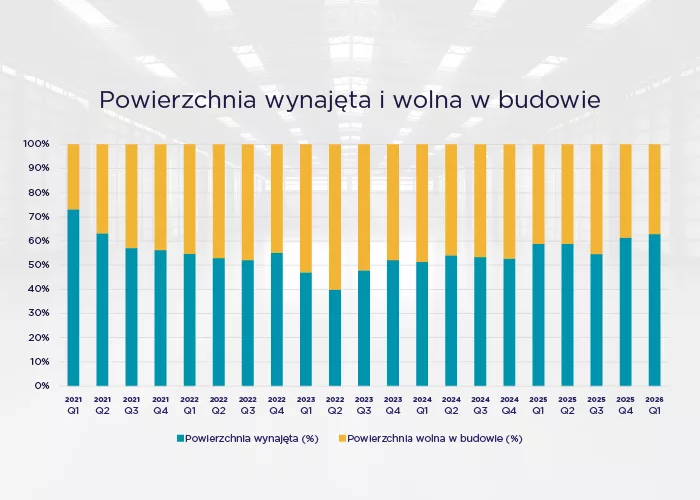
Such demand could increase pressure on the availability of ready-to-occupy facilities and, in selected locations, reopen the discussion around greater speculative supply, which has been limited in recent quarters following the peak e-commerce boom. Data from the first quarter of 2026 illustrate this backdrop well: net demand in Poland increased by 78% year on year, but only around 37% of space under construction is being developed speculatively, while the remainder is being delivered for tenants with signed lease agreements. This is particularly visible in highly active markets such as Lower Silesia, where vacancy rates fell from double-digit levels to just a few percent within a single quarter. This means that there are currently relatively few large, contiguous units available immediately. Should the increased wave of Chinese enquiries materialise, the market may struggle to accommodate it without delay, and the issue of speculative development is likely to return.
According to Cushman & Wakefield data, the construction of a built-to-suit warehouse in Poland takes an average of around five quarters.
The customs change may therefore become one of the factors accelerating the shift of some goods flows away from direct cross-border parcel shipments towards European distribution hubs. For Poland, this is an opportunity to strengthen its position as one of the main entry points for global e-commerce into the European Union. However, this will require a rapid market response, availability of appropriate space and readiness to operate at the pace expected by new tenants. It is also worth remembering that warehouse decisions should not be made solely under time pressure. In Europe, the biggest cost is not always the rent itself, but a poorly selected location or facility that is difficult to exit later.
Author: Szczepan Gowin, Partner, Head of Industrial & Logistics Agency, Poland, Cushman & Wakefield