
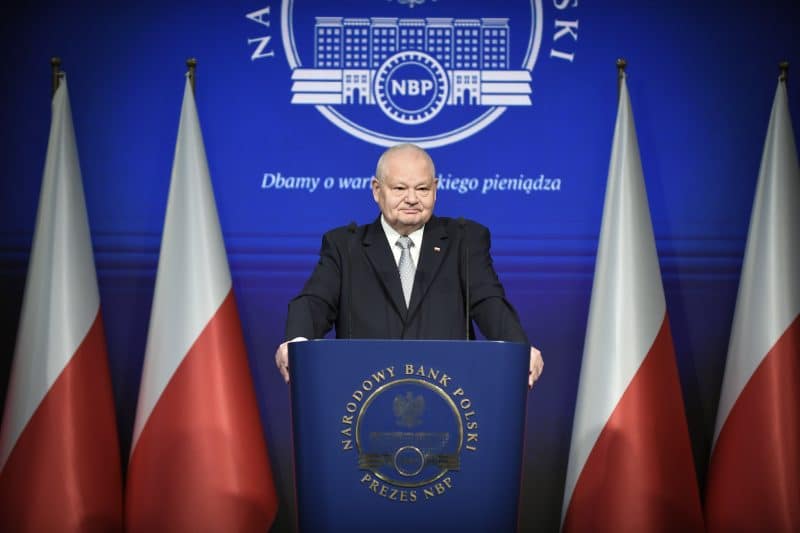


A parliamentary committee investigating whether National Bank of Poland Governor Adam Glapiński should face the State Tribunal intends to complete its work before the end of the current Sejm term. The proceedings have continued since May 2024, but the central bank governor has so far declined to engage with the committee.
The Sejm’s Constitutional Accountability Committee plans to present its report on the case of Adam Glapiński before the current parliamentary term expires, according to committee chairman Zdzisław Gawlik of the governing Civic Coalition.
The committee held another closed-door meeting on Tuesday, 28 July, as part of its examination of a preliminary motion seeking to hold the National Bank of Poland governor constitutionally accountable before the State Tribunal.
Gawlik said that the investigation was now closer to completion than to its starting point, although he stopped short of providing a specific deadline. The committee continues to question witnesses, examine documents and follow up on additional issues emerging during the hearings.
The initial list contained more than 60 witnesses. Further individuals have since been added because, according to Gawlik, testimony sometimes produces new information that needs to be checked before the committee can reach its conclusions.
Committee wants a comprehensive report
Gawlik said the committee was seeking to examine every allegation thoroughly rather than complete the proceedings as quickly as possible.
Each new testimony may reveal an additional line of inquiry, require further documentation or make it necessary to summon another witness. This makes it difficult to describe the committee’s progress as a percentage or set a precise completion date.
Nevertheless, the chairman said he wanted the report to be finished during the current parliamentary term, which is due to end in 2027.
Once the evidentiary proceedings have been completed, the committee will submit a report to the Sejm. It may recommend that Glapiński be held accountable before the State Tribunal or propose that the proceedings be discontinued.
The State Tribunal is a special judicial body responsible for examining alleged constitutional violations committed by some of Poland’s highest-ranking public officials. The process concerns constitutional responsibility and is separate from an ordinary criminal trial.
Glapiński has not responded to the committee
One of the unresolved issues is whether the committee will formally summon Glapiński for questioning.
According to Gawlik, the NBP governor is informed about every committee meeting but has not responded to the preliminary motion or made use of his right to appoint legal representatives in the proceedings.
The committee chairman accused Glapiński of behaving as though the investigation did not exist. He also suggested that the report could be completed without questioning the governor if he continued to refuse to participate.
Glapiński was given an opportunity to present his position after receiving the motion. Responding was his right rather than an obligation, but the committee considers his lack of engagement significant.
Earlier in the proceedings, Gawlik indicated that he would prefer to question the governor towards the end of the investigation, after evidence had been collected from other witnesses. The committee must now decide whether formally summoning him would serve any practical purpose.
What is Adam Glapiński accused of?
A group of governing-coalition MPs submitted the preliminary motion against Glapiński in March 2024.
The document accuses the central bank governor of violating the Constitution and statutory law in connection with several aspects of his management of the National Bank of Poland.
One of the central allegations concerns the NBP’s purchase of government-guaranteed securities in 2020 and 2021, during the economic disruption caused by the COVID-19 pandemic.
The motion’s authors argue that the programme amounted to the indirect financing of the state budget deficit. They also claim that the purchases were conducted without sufficient authorisation from the Monetary Policy Council.
Another allegation concerns the constitutional expectation that the NBP governor remain politically neutral. Glapiński’s critics accuse him of using public appearances and central bank communications in a manner that benefited the former Law and Justice government.
The allegations do not amount to a final legal finding. The committee’s task is to determine whether the available evidence provides sufficient grounds for the Sejm to refer the case to the State Tribunal.
NBP rejects all allegations
The National Bank of Poland considers the allegations against Glapiński entirely unfounded.
The central bank has argued that the asset-purchase programme was introduced to protect the Polish economy and preserve the stability of financial markets during an exceptional crisis. Similar measures were used by central banks in other countries during the pandemic.
NBP representatives maintain that the purchases were conducted on the secondary market and therefore did not constitute prohibited direct financing of government expenditure.
The bank has also warned that the parliamentary proceedings could threaten the institutional independence of the central bank and disrupt its ability to perform its statutory responsibilities.
Glapiński previously announced that NBP would not participate in the procedure. The bank maintains that the committee’s actions have no legal significance because of a Constitutional Tribunal ruling concerning the rules for holding an NBP governor accountable before the State Tribunal.
Constitutional Tribunal ruling complicates the procedure
The legal path to placing Glapiński before the State Tribunal is complicated by a Constitutional Tribunal judgment issued on 11 January 2024.
Under the State Tribunal Act, the Sejm could adopt a resolution referring the NBP governor to the Tribunal by an absolute majority, provided that at least half of the statutory number of MPs participated in the vote.
Such a resolution would also normally result in the immediate suspension of the official concerned.
The Constitutional Tribunal ruled that these provisions were unconstitutional insofar as they applied to the NBP governor. It found that allowing an absolute parliamentary majority to suspend the governor could undermine the constitutionally protected independence of the central bank.
The judgment also questioned the application of the existing voting threshold to the NBP governor. It did not, however, introduce a replacement procedure, leaving a dispute over what rules should now govern a potential parliamentary vote.
The ruling means that even if the committee recommends referring Glapiński to the State Tribunal, the Sejm could face serious legal uncertainty over the required majority and whether a resolution could lawfully suspend him from office.
Government has not abandoned the case
The attempt to hold Glapiński accountable was one of the political commitments made by Donald Tusk and his allies before the 2023 parliamentary election.
In February 2026, Finance and Economy Minister Andrzej Domański rejected reports that Civic Coalition had abandoned the plan. The continuation of witness hearings confirms that the governing majority still intends to complete the parliamentary procedure.
However, completing the committee’s report does not guarantee that Glapiński will appear before the State Tribunal.
The committee must first approve its conclusions. The full Sejm would then have to adopt a resolution, while any vote would almost certainly trigger another legal and constitutional dispute.
The political balance within parliament may also change before the committee finishes its work. The next parliamentary election is expected in autumn 2027, meaning that a change of government or parliamentary majority could affect the future of the case.
Central bank independence remains a key issue
The proceedings have implications extending beyond the personal and political future of Glapiński.
Central bank independence is protected by both Polish constitutional law and European Union rules. Monetary authorities are expected to make decisions concerning interest rates, inflation and financial stability without instructions from the government or other political institutions.
Supporters of the motion argue that independence cannot protect a central bank governor from responsibility for alleged constitutional violations.
Glapiński’s defenders respond that allowing a parliamentary majority to remove or suspend the governor on politically contested grounds would create a dangerous precedent. They warn that future governments could use similar proceedings to place pressure on the central bank whenever they disagreed with monetary policy.
The dispute therefore concerns two competing principles: the accountability of senior public officials and the protection of monetary authorities from political interference.
Glapiński’s term runs until 2028
Glapiński has served as governor of the National Bank of Poland since June 2016. The Sejm appointed him to a second and final six-year term in May 2022.
His current term is due to expire in June 2028, several months after the latest possible date of the next parliamentary election.
The NBP governor is appointed by the Sejm following a formal nomination from the president. Under ordinary circumstances, President Karol Nawrocki would therefore play an important role in selecting Glapiński’s successor.
Nawrocki’s presidential term runs until August 2030, making it likely that he will remain in office when a new NBP governor is chosen unless Glapiński’s tenure ends earlier under an exceptional constitutional procedure.
Final outcome remains uncertain
The committee appears determined to finish its work, but several stages remain before the case could reach the State Tribunal.
Witnesses are still being questioned, new evidence continues to emerge and Glapiński has not presented his position directly to the committee. Once the report is completed, MPs will still have to decide whether the allegations justify constitutional proceedings.
Even then, the Constitutional Tribunal’s 2024 judgment will complicate any attempt to adopt and implement a parliamentary resolution.
For the governing coalition, the investigation represents an effort to hold one of the most influential officials associated with the previous political order accountable.
For NBP, it is a politically motivated proceeding that risks weakening the independence of Poland’s central bank.
The committee’s intention to deliver its report before the end of the Sejm term establishes a broad political deadline. It does not yet provide a clear answer as to whether Adam Glapiński will ultimately face the State Tribunal.