
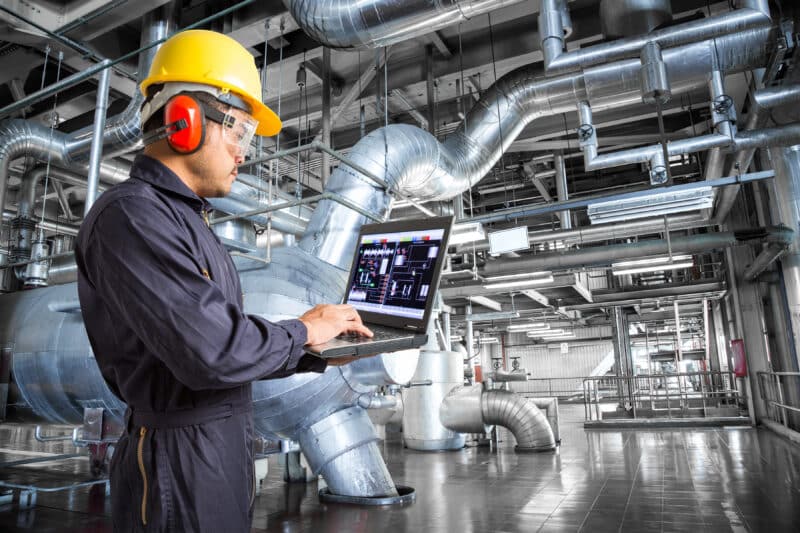


By applying solutions based on generative artificial intelligence, industrial companies can automate over one-third of their working hours, thereby radically increasing their efficiency, according to analysis from Bain & Company. Gen AI-based technologies find the greatest potential use in reporting and analysis, planning, quality control, and eliminating disruptions in the production process.
The benefits gained from the use of generative AI, measured by the percentage of work time that can be automated, are greater in the industry sector (at 35%) compared to fields such as tourism and recreation (27%) and retail (29%). However, they are lower than services such as consulting, media, administration, and management (40%). The adoption of methodologies like lean management, which have been successfully optimizing effectiveness and the quality of production for 50 years, only increase productivity by 6%. In contrast, Gen AI has the potential to increase production efficiency by 10%.
“Generative AI could revolutionize the industry; all that’s needed is for managers to be open to change and ready to fully implement new solutions to leverage their potential” – says Marcin Szczuka, a partner at Bain & Company. “Those managing production facilities are only beginning to realize just how much of their standard tasks can be supported by generative AI. The only limitation is imagination and the awareness that generative artificial intelligence is more than just a widely talked about gadget.”
The possibilities of generative AI go beyond techniques already used in the industry such as decision models based on large numerical data sets, which support statistical analyses, pricing policies, or ensure the continuity of supply chains.
Generative AI is mainly applied in two areas – the ongoing management of production processes and knowledge management within the organization. It also provides enormous support in human resources management.
Based on the data collected in real-time, necessary for assessing quality indicators or task lists, systems based on generative AI can monitor the production process and suggest specific actions via chatbots. They can also provide real-time instructions on how to operate machinery. Historical data allow them to predict downtimes and disruptions in production. Flexible planning of quality tests, ongoing analysis of safety indicators and working conditions are also possible.
Generative AI is particularly useful for supporting internal communication and knowledge management within an organization. Systems based on Gen AI can manage information by gathering, processing, analyzing, as well as generating messages and their ongoing modification. Simplified creation of reports, operation instructions, and technical documentation are feasible. The system can automate communication, for instance, prepare meeting notes immediately after their conclusion or write personalized emails. All communication processes can take place in multiple languages in real-time, which is crucial in a globalized economy.
Gen AI-based systems, powered by a database of documentation from previous projects, support continuity and maintenance of knowledge within an organization. These tools, while taking into account employee rotation, facilitate the adaptation of new employees to their workplaces.
“Thanks to generative AI, production lines analyze errors and correct themselves. It’s significant support for workers who can, freed from repetitive tasks, focus on more creative activities and oversee the operation of the entire system. The long-term role of generative AI is to automate processes, but initially, it serves as a tool to support and augment them” – adds Marcin Szczuka.
A survey conducted among 270 managers in the manufacturing sector worldwide showed that the group that implemented various digital technologies more intensively easily achieved the set factory targets.
A summary of the analysis regarding the use of AI in the industrial sector is available at:
https://www.bain.com/insights/factory-of-the-future-how-industry-4-0-and-ai-can-transform-manufacturing/
https://www.bain.com/insights/how-generative-ai-will-supercharge-productivity-snap-chart/