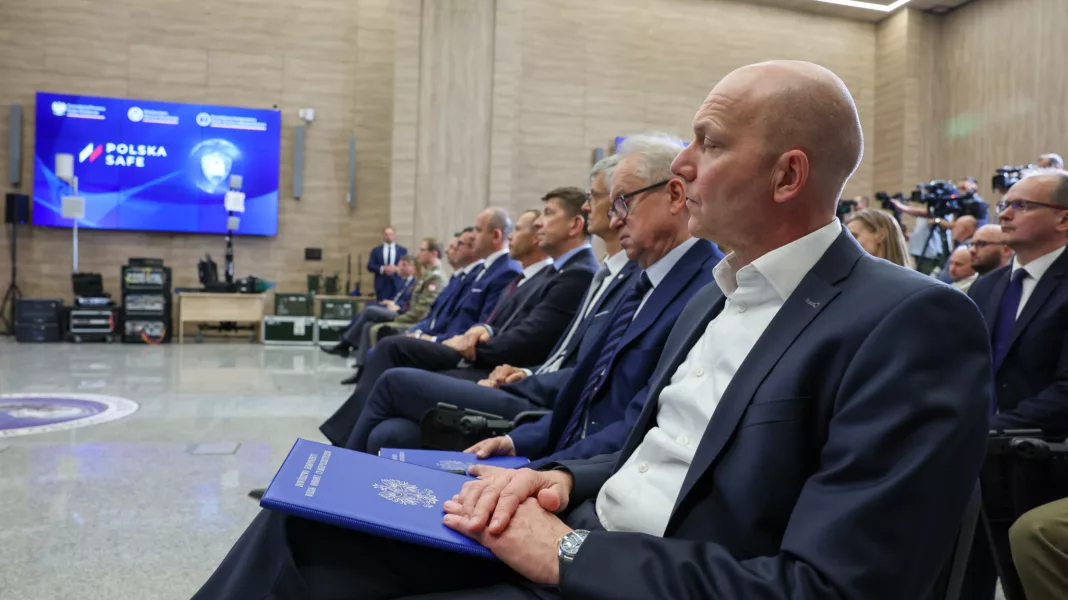


On 28 May 2026, the first agreements were signed for the purchase of equipment and technologies for the Polish Armed Forces, financed under the European SAFE programme. Some of the agreements were concluded at the Cyber Defence Forces Component Command in Legionowo, while others were signed at the Armament Agency and as part of cooperation with Polish companies from the defence sector.
The events were attended, among others, by Prime Minister Donald Tusk, Deputy Prime Minister and Minister of National Defence Władysław Kosiniak-Kamysz, Secretary of State at the Ministry of National Defence Cezary Tomczyk, and Magdalena Sobkowiak-Czarnecka, the government’s plenipotentiary for the Security Action for Europe instrument.
Cybersecurity agreements
The first signed agreements cover solutions intended for military units responsible for operations in cyberspace. The equipment and technologies are to be supplied by Polish companies and are intended to improve the security of communication and data exchange within military systems.
The agreements concern the acquisition of:
- a next-generation post-quantum IP encryptor,
- a high-trust cryptographic system for protecting communication at the application layer,
- a system enabling secure data exchange between automated command systems with different classification levels,
- a mobile cybersecurity laboratory for conducting operations in cyberspace.
During his visit to Legionowo, Prime Minister Donald Tusk stressed that financing from the SAFE programme is intended to enable the implementation of specific projects related to national security, European security and NATO defence capabilities. He also noted that investments made in peacetime are designed to reduce the risk of crisis scenarios occurring in the future.
Deputy Prime Minister Władysław Kosiniak-Kamysz announced that the signing of the first agreements marks the beginning of a broader cycle of activities to be carried out in various parts of the country. According to the Ministry of National Defence, the SAFE programme is intended to support the modernisation of the Polish Armed Forces, strengthen NATO’s eastern flank and enhance the security of the European Union’s border.
Magdalena Sobkowiak-Czarnecka pointed out that Poland is among the countries most advanced in preparing projects financed from SAFE and is applying for the largest allocation of funds under this instrument.
Helmets, vests and vehicles for the Polish Armed Forces
Further agreements were signed at the Armament Agency. They concern soldiers’ individual equipment and military vehicles. The Polish company MASKPOL S.A. is to supply several hundred thousand TYTAN HBT-02 programme helmets and several tens of thousands of integrated vest sets.
The head of the Armament Agency, Maj. Gen. Artur Kuptel, also signed three annexes concerning the refinancing of earlier agreements. These cover the delivery of fuel tanker-distributors by CELTECH Sp. z o.o. and the supply of JELCZ 442.32 and JELCZ S662D.43 trucks manufactured by JELCZ Sp. z o.o.
The Minister of National Defence indicated that the agreements being concluded form part of efforts to accelerate the modernisation of the army and are intended to strengthen the protection of borders, critical infrastructure and citizens’ security.
Development of drone capabilities
As part of SAFE programme financing, agreements were also signed with WB Electronics S.A., one of Poland’s largest manufacturers of advanced defence technologies. By 2030, the Polish Armed Forces are to acquire, among other items, 12 battery fire modules of GLADIUS unmanned search-and-strike systems, WARMATE loitering munition sets and 190 unmanned aerial system sets.
These purchases are part of the development of drone capabilities, which, according to the Ministry of National Defence, are currently among the priority areas in the modernisation of the Polish Armed Forces. Unmanned aerial systems and loitering munitions are regarded as important elements of modern reconnaissance, deterrence and defence systems.
Władysław Kosiniak-Kamysz stressed that the SAFE programme is important not only from a military perspective but also economically, as some of the orders are being placed with Polish defence companies. In his view, the development of the arms industry should include both the state-owned and private sectors.
Deputy Minister Paweł Bejda, referring to cooperation with WB Electronics, highlighted the importance of the engineering and technological competences of Polish companies for the development of the national defence sector.
SAFE programme as a source of modernisation funding
SAFE is an EU financial instrument designed to support the strengthening of the defence capabilities of Member States. Poland intends to use funds from the programme to finance the purchase of equipment, technologies and systems that will enhance the potential of the Polish Armed Forces.
The agreements signed on 28 May 2026 cover three main areas: cybersecurity, individual and logistical equipment for soldiers, and the development of unmanned systems. According to the Ministry of National Defence, the implementation of these contracts is to form part of a broader process of army modernisation carried out in the coming years.