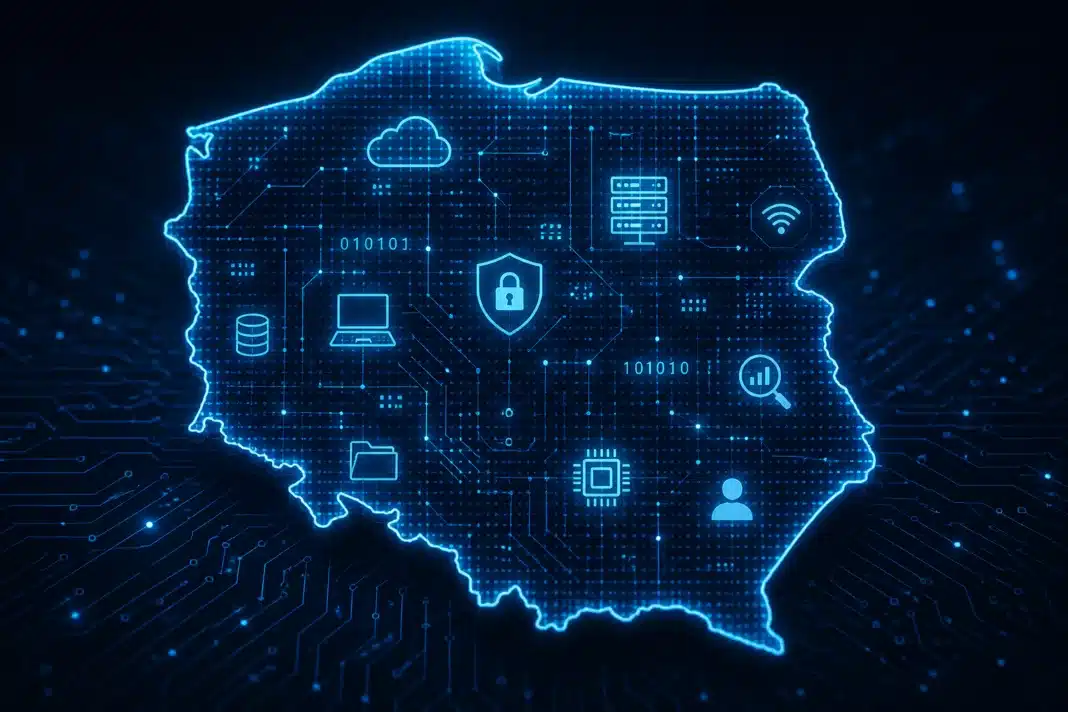

The report by Łukasiewicz Research Network, “Poland’s Digital Balance Sheet. How to Turn Dependence into Sovereignty?”, clearly shows that the scale of technological dependence is no longer merely an industry issue, but an economic one. In 2016, imports of digital products amounted to around PLN 9 billion. By 2024, they had reached nearly PLN 48 billion. The pace of growth averages 25% per year. Over the same period, exports remained practically unchanged at around PLN 3 billion. As a result, a persistent gap of around PLN 45 billion a year has emerged, feeding foreign cloud, licensing and platform ecosystems.
“This is not just a trade statistic. It is a real flow of money and control outside Poland. As a result, the domestic digital economy is now running on someone else’s engine — and paying more and more for it,” says Robert Czarniewski, Vice-President of the Management Board and CFO of Polcom.
We Are Importing Digital Reality
“Today we are talking about a situation in which Poland transfers tens of billions of zlotys every year to foreign technology providers. This is no longer a matter of choosing IT tools, but a structural dependence of the entire economy. If this trend continues, we will increasingly become a consumer of technology rather than its co-creator, and in the long term this means a loss of competitiveness,” says Robert Czarniewski.
Poland is not only buying technology, but is gradually giving up influence over it. Data is processed outside the country, key systems rely on foreign platforms, and decisions concerning digital infrastructure are made outside local jurisdiction. In public debate, this issue is often reduced to cybersecurity, but in practice it is about something more fundamental: who earns money from digitalisation and who sets its rules.
A similar message was recently heard during the inauguration of the Local Content project, where Prime Minister Donald Tusk spoke about the need to build Poland’s economic and technological sovereignty: “We also deeply believe that this local content means the development of Polish technological thought and security.”
In practice, this may mean growing pressure to develop local digital infrastructure, domestic technological competencies and a greater share of Polish and European providers in strategic IT and cloud projects.
There Is a Social Mandate, but the System Is Not Keeping Up
Society is already aware of the problem. Digital Poland research indicates that 56% of Poles consider technological sovereignty a priority, while as many as 71% declare readiness to allocate larger budgets in exchange for local solutions. This is a clear signal that the market is ready for change. The problem is that state policy does not always keep pace.
Meanwhile, Polcom’s report “Barometer of Digital Transformation of Polish Business 2025–2026” paints a picture of a system that, in practice, still favours global players. Fifteen percent of companies believe that state policy benefits foreign suppliers, while 25% point to a lack of real support mechanisms for Polish IT companies. Only 6% of enterprises see concrete actions supporting local or European providers, and the same percentage believe in equal opportunities in strategic projects.
“From the perspective of technology companies, the biggest problem is not a lack of competence or capital, but the absence of a coherent public procurement policy. If global suppliers win public projects in practice, it is difficult to talk about building a local ecosystem. Sovereignty begins with decisions about where public money goes and what criteria actually apply in tenders. These are not marginal opinions, but a signal that the market sees a clear asymmetry,” comments the Vice-President of Polcom.
The Digital State Is Growing, but on Someone Else’s Infrastructure
At the same time, the digitalisation of the state is progressing, although not at the pace of European leaders. In the European Union, 72% of residents already use e-government services, while in Poland the figure is 58.5%. Leaders such as Denmark and Finland reach levels of 96–98%.
This means that the number of digital public services is growing, and with it the amount of data generated by citizens and institutions. The problem is that increasing scale does not always go hand in hand with control over where this data is processed and who actually manages it.
“The state is accelerating digitalisation, but this is not always accompanied by reflection on where data goes and who has access to it. We may have modern e-services, but if their foundation is external platforms, then this modernity is, in a sense, illusory. Real independence begins only when we control not only applications, but also infrastructure and data,” adds Robert Czarniewski.
Business Is Already Calculating the Risk
A much more pragmatic approach can be seen in the private sector. As many as 43% of companies, when choosing a cloud provider, are guided by the location of data in a data centre within Poland. This is no longer a matter of image or ideology, but a hard business calculation.
Companies are increasingly analysing the jurisdiction in which their data operates and what regulations may affect it. In the background are laws such as the US Cloud Act, which allows access to data stored by American companies regardless of where that data is physically stored.
At the European level, the direction is clearly defined. Building digital sovereignty is becoming one of the pillars of economic policy. The aim is for the data of European companies and citizens to be processed within European regulations and under the control of entities operating in the same legal space. According to Gartner forecasts, by 2029 more than half of international organisations will have adopted a formal approach to digital sovereignty. Today, only around 10% do so, showing how dynamic this change is only now beginning to gather pace.
In this context, Poland faces a choice that can no longer easily be postponed. It can continue functioning as a sales market for global providers and accept the growing outflow of value, or it can begin consciously building its own competencies and strengthening the local technology ecosystem.
“The discussion about digital independence is no longer abstract. It is a conversation about money, about the model of economic development and about whether Poland wants to be only a user of technology or also its co-creator. In a world where data is becoming one of the most important resources, a lack of control over it means giving up part of the influence over one’s own future,” says Robert Czarniewski, Vice-President of Polcom.