
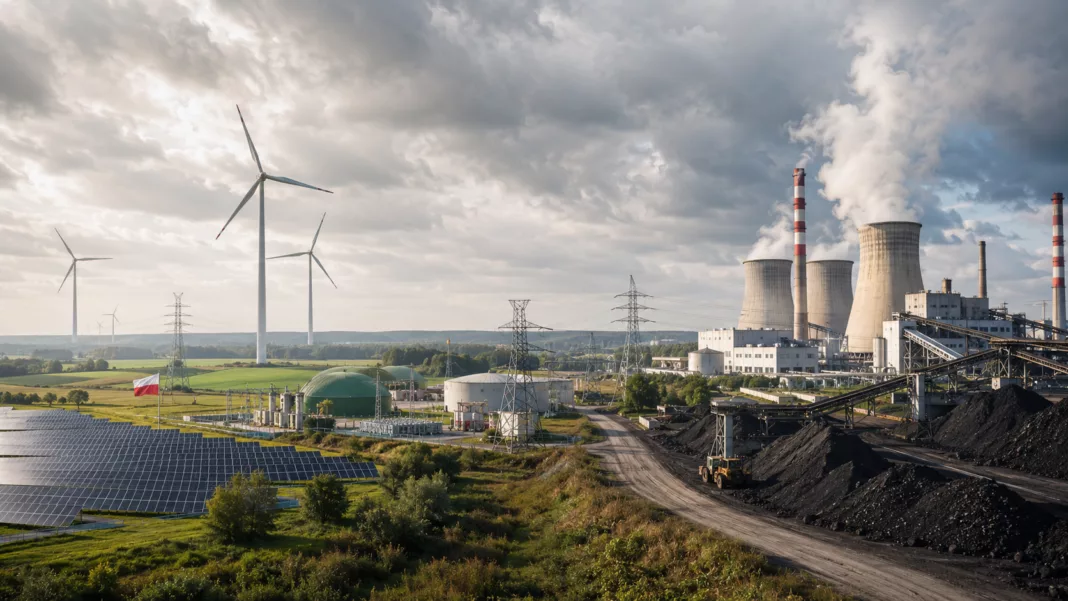

Poland remains one of the European Union’s largest energy producers, yet its energy system is still heavily dependent on fossil fuels and imports of key commodities. The latest “Energy 2026” publication prepared by Statistics Poland shows both the growing role of renewable energy sources, the significant importance of biomass in the domestic energy mix, and clear differences between Poland and the EU average.
Primary energy consumption in Poland amounted to 2,209.2 PJ in 2024. The share of renewable energy in gross final energy consumption reached 17.8%, compared with an EU average of 25.2%. Poland therefore remains below the European average, although renewable energy development has accelerated in recent years, particularly in solar and wind power.
Polish energy sector: significant scale, but continued dependence on fossil fuels
Poland continues to play an important role in the European energy sector. In 2024, it ranked third in the EU in primary energy production, second in electricity generation and first in fossil fuel production. At the same time, Poland ranked sixth in the European Union in renewable energy production.
This structure reflects the nature of Poland’s energy transition. On the one hand, the role of low-carbon and renewable sources is increasing. On the other, the economy still requires substantial volumes of coal, crude oil, natural gas and petroleum products. This means that the pace of change in the energy sector has a direct impact not only on climate policy, but also on industrial competitiveness, energy prices and security of supply.
| Indicator | Value |
|---|---|
| Primary energy consumption in Poland in 2024 | 2,209.2 PJ |
| Share of renewables in gross final energy consumption | 17.8% |
| Average renewable energy share in the EU-27 | 25.2% |
| Poland’s energy import dependency | 45.7% |
| Average energy import dependency in the EU-27 | 57.3% |
Poland still trails the EU in renewable energy share
Share of renewable energy in gross final energy consumption
Chart scale: 0–50%.
The gap between Poland and the EU average stands at 7.4 percentage points. In practice, this means that the country’s energy transition must involve not only further development of photovoltaics and wind power, but also faster changes in heating, industry and transport.
Renewables in Poland: biomass remains dominant
Public debate is currently focused mainly on wind farms and photovoltaic installations. However, Statistics Poland data shows that solid biofuels still clearly dominate Poland’s primary renewable energy production structure. Their share reached as much as 56.4%.
Wind energy accounted for 14.7% of the renewable mix, while solar energy represented 11.1%. Liquid biofuels, heat pumps and biogas also played an important role. This structure shows that Poland’s energy transition has two parallel dimensions: rapidly expanding electricity generation based on wind and solar power, and the continued large-scale use of biomass, particularly in heating.
| Renewable energy source | Share in Poland’s renewable energy production |
|---|---|
| Solid biofuels | 56.4% |
| Wind energy | 14.7% |
| Solar energy | 11.1% |
| Liquid biofuels | 8.0% |
| Heat pumps | 4.7% |
| Biogas | 2.8% |
| Hydropower | 1.2% |
| Municipal waste and geothermal energy | 1.1% |
Structure of Poland’s renewable energy sources in 2024
Energy imports: Poland is less dependent than the EU, but remains exposed
Poland’s energy import dependency stood at 45.7% in 2024. This was lower than the EU-wide average of 57.3%. However, it does not mean that Poland is fully energy independent. The country’s strong position in fossil fuel production does not eliminate the need to import crude oil, natural gas, hard coal and refined fuels.
In 2025, energy imports significantly exceeded exports. Crude oil, natural gas, hard coal and diesel fuel dominated the import structure. On the export side, the largest categories included coke, hard coal, diesel fuel, high-methane natural gas and electricity.
For businesses, the key issue is not only the volume of imports, but also the concentration of supply sources. The more dependent an economy is on imported fuels, the more vulnerable it becomes to currency fluctuations, commodity prices, transport costs and geopolitical risks.
Energy in Polish households: biomass, gas and coal still play a major role
The structure of household energy consumption in Poland differs significantly from the EU average. In the European Union, natural gas remains the most important energy carrier for households, while electricity also plays a major role. In Poland, solid biomass and hard coal continue to be highly significant.
| Energy carrier in households | Poland | EU-27 |
|---|---|---|
| Solid biomass | 22.5% | 16.7% |
| Natural gas | 21.6% | 29.4% |
| Hard coal | 18.4% | 1.9% |
| District heating | 16.7% | 8.5% |
| Electricity | 14.2% | 26.9% |
The share of hard coal in household energy consumption in Poland is almost ten times higher than the EU average. This highlights the scale of the challenge facing housing policy, heating source replacement programmes, district heating investments, thermal renovation and heat pump deployment.
Energy prices: Poland is not among the most expensive markets in the EU
A comparison of household energy prices shows that Poland is below the EU average in both electricity and gas prices. However, differences between countries remain substantial. Households in Germany, Belgium and Italy face some of the highest electricity prices, while the lowest rates are recorded in Hungary and Bulgaria.
In the case of gas, the highest household prices in 2025 were recorded in Sweden, the Netherlands and Portugal. Poland ranked below the EU average. It should be remembered, however, that for businesses and households, the retail price of energy is only one factor. Equally important are energy’s share in total operating costs, access to grid infrastructure and regulatory stability.
Energy efficiency: the strongest progress has been made in industry
Statistics Poland indicates that the energy efficiency of the Polish economy has improved since 2010. The ODEX indicator, used to assess technical energy efficiency, has declined across the economy, indicating lower energy intensity in relation to work performed, output produced or services delivered.
The strongest improvement was recorded in industry. This was driven by investments in modern equipment, automation, production line upgrades and growing cost pressure. In the coming years, energy efficiency will remain one of the most important areas of competition, as it can often reduce energy bills faster than the construction of new generation capacity.
What do the figures mean for business?
Poland’s energy transition will not be limited to changing the technologies used to generate electricity. It will also involve the transformation of heating, transport, industry and energy use in buildings. The growing share of renewables is an important signal, but it does not remove the challenge of fuel imports or the high share of coal and biomass in the national energy mix.
For businesses, three issues will be crucial: access to stable and competitively priced energy, the ability to secure long-term renewable energy contracts, and investments in energy efficiency. Companies that reduce the energy intensity of their operations and secure their energy supply may gain not only a cost advantage, but also regulatory and reputational benefits.
Source: Statistics Poland, “Energy 2026”; Eurostat; Odyssee-Mure.