


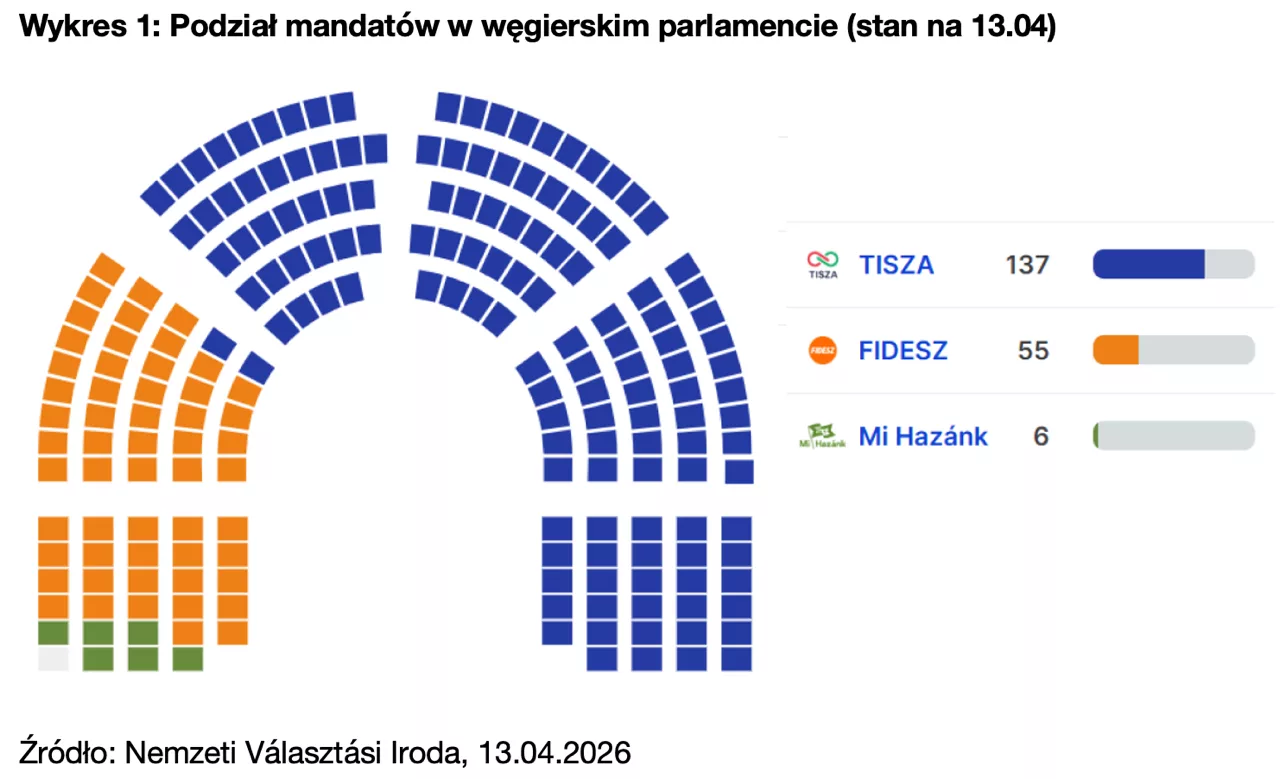
TISZA’s victory, bringing Viktor Orbán’s 16-year rule to an end, does not come as a major surprise. What did shake the markets, however, was the scale of the win. A historic mobilisation of Hungarian voters allowed the opposition party to secure 137 seats, giving it a constitutional majority. The forint and the Hungarian stock market are posting substantial gains.
The most optimistic market scenario has materialised: the opposition TISZA has won more than 132 seats, guaranteeing a constitutional majority. This makes it possible, among other things, to amend the constitution without opposition support and to adopt or change so-called “cardinal laws” covering issues such as electoral law, the status of public media, the powers of the judiciary, and certain tax and budget matters.
Although, in our view, TISZA’s victory had been partly priced in by investors (we see it as one of the factors behind the strong appreciation of the currency in 2025), markets did not assign a particularly high probability to a scenario in which the opposition would secure a constitutional majority. This explains the remarkable scale of the appreciation of the Hungarian currency, which has strengthened by more than 4% against the reference euro in recent days. Optimism is also visible on the Budapest Stock Exchange. Over the past week, Hungary’s BUX index has recorded gains of nearly 10%.
For investors, the key takeaway is that we can expect a significant warming of relations between Budapest and Brussels — an end to veto politics, constructive cooperation with Brussels, and preparation of the country for potential euro adoption. Over the coming months, this should lead to the unlocking of EUR 8.4 billion from the Cohesion Fund and EUR 9.5 billion from the RRF, as well as approval of a low-interest loan plan under the SAFE programme (EUR 17.4 billion). We expect this to provide a meaningful growth stimulus for the Hungarian economy.
We also draw attention to:
- the rule of law and the fight against corruption: Magyar has announced plans to hold the National System of Cooperation (NER) to account, join the European Public Prosecutor’s Office (EPPO), and ensure full transparency in the spending of public funds;
- the model of democracy and the approach to state media: restoring pluralism — for example by limiting the prime minister’s term to 8 years or allowing citizens to directly elect the president — is one of TISZA’s priorities. Considerable attention is also being paid to the depoliticisation of public media;
- the approach to Russia and the war in Ukraine: unlike Fidesz, TISZA supports maintaining sanctions against Russia and providing humanitarian aid to Ukraine. In his speeches, Magyar has announced a gradual reduction of energy dependence on Russia. He does not rule out Ukraine’s accession to the EU in the long term, though not through an accelerated process;
- values: although also conservative, TISZA is seen as a party that is decidedly more centrist and liberal than Fidesz. Magyar is far more cautious on issues related to LGBT rights, uses a more inclusive definition of patriotism, and treats Christianity in a less instrumental way.
Despite appearances, however, TISZA has much in common with Fidesz. Magyar consistently describes himself as a “conservative liberal”. Like Viktor Orbán, he fought for right-wing voters by referring in his rhetoric to national values, patriotism, and the country’s Christian roots.
Their shared features include:
- migration policy: TISZA has declared that it will keep the border fence built by Orbán on the border with Serbia and supports a hard-line anti-immigration policy. In many votes on this issue, it has maintained a common front with Fidesz in the European Parliament;
- pro-family policy: Magyar stresses that this was one of the “few good things” in Fidesz’s record and only requires refinement. His party’s election programme includes, among other things:
- doubling the family allowance, which has not been indexed for years,
- introducing a one-off childbirth benefit,
- maintaining tax relief for families with children,
- preserving preferential housing loan schemes,
- introducing tax relief for mothers in large families;
- Christian values: the new prime minister emphasises his attachment to Catholic values, and TISZA’s programme includes a reference to protecting “Christian culture”. It is worth recalling that one of Hungary’s largest demonstrations in recent years began in front of St Stephen’s Basilica;
- elements of state interventionism: despite being more liberal than Fidesz, TISZA is not a free-market party per se. Notable points include its willingness to:
- support sectors and companies considered strategically important for the state;
- intervene in the housing construction sector;
- continue controlling energy prices for households;
- undertake significant public investments, using EU funds.
Who is Hungary’s new prime minister?
The story of the 45-year-old is particularly interesting because he spent half of his life associated with Fidesz — he was already active in local party structures during his student years, when the party was in opposition to the MSZP (Hungarian Socialist Party) government. After Fidesz returned to power in 2010, he began working at the Ministry of Foreign Affairs. He later served as part of Hungary’s Permanent Representation to the EU, the Prime Minister’s Office, and the legal departments of major state-owned enterprises.
However, he never rose through the party ranks the way his former wife, Judit Varga, did, becoming justice minister in 2019. Senior politicians did not regard Magyar, who repeatedly criticised government actions in internal disputes, as a “team player”, and the breakdown of his relationship with Varga only pushed him further from Fidesz’s inner circle.
The turning point came with the scandal surrounding the presidential pardon granted to Endre Konyi, who had been convicted of covering up paedophile crimes. The media’s disclosure of details of the case in February 2024 remains one of the most severe crises for Fidesz to this day — it led to the resignation of President Katalin Novák and Justice Minister Judit Varga, who was already Magyar’s former wife.
Magyar saw in this situation the opportunity of a lifetime and shortly afterwards released an audio recording of Varga concerning the most high-profile corruption case of recent years (Schadl–Völner). He also gave an interview to the opposition-linked Partizán YouTube channel, which was viewed more than one million times within a few days and has now reached 2.5 million views.
Momentum around Magyar grew at an alarming pace, allowing TISZA, which he had joined only shortly before, to win nearly 30% of the vote in the European Parliament elections. Since then, the party’s ratings have risen almost continuously, making it the unexpected favourite in the parliamentary election that it ultimately won. Magyar will take office as prime minister no later than 12 May — the inaugural sitting must be convened by President Tamás Sulyok within one month of the election date.