
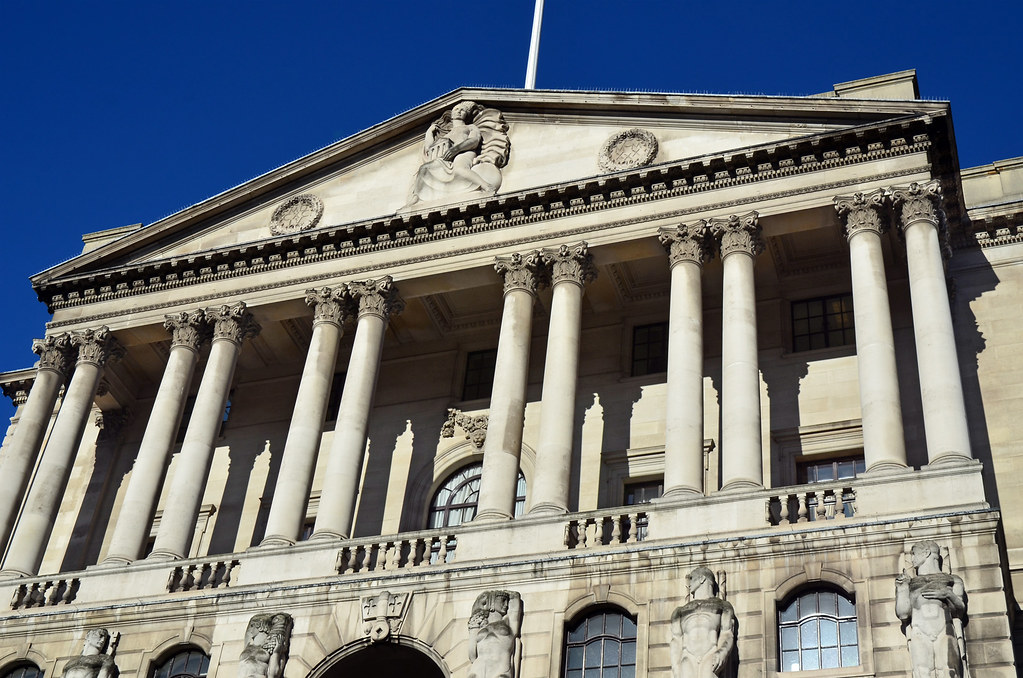
The Bank of England may need to keep raising interest rates in 2027, chief economist Huw Pill told the Financial Times, as he warned of persistent inflation risks. Bank Rate stands at 4% after November’s increase, while the Bank forecasts inflation of about 5% by the middle of next year. Markets expect further tightening that could take the policy rate close to 5%.
By Editorial Team. Adapted from the Polish original, published on 14 November 2026 at 08:01 UTC.
Photo: George Rex. This version released CC-by-SA provided you attribute: Photo by George Rex.
Pill sees a likely need for further tightening
In the Financial Times interview published on 14 November, Pill said further monetary tightening would probably be needed to bring inflation back to the 2% target. He indicated that increases could be necessary both at the December meeting and during 2027.
Pill viewed November’s decision as an important step towards an appropriate level of interest rates, rather than the end of the tightening cycle. He expects incoming economic data to provide further reasons to raise rates.
He also indicated support for another increase at the next meeting, scheduled for 17 December. That is his position, rather than a decision by the Bank as a whole: rates are set by the nine-member Monetary Policy Committee (MPC), on which he sits.
November’s decision took Bank Rate to 4%
On 5 November, the Bank of England announced an increase in Bank Rate from 3.75% to 4%. Eight MPC members voted for the 25-basis-point rise, while one favoured a larger increase of 50 basis points, to 4.25%.
The Bank cited rising energy prices, a deteriorating inflation outlook and economic activity that had been stronger than expected in recent months. Its November statement stressed that future decisions had not been predetermined.
The MPC will focus on whether higher energy costs are feeding into wages and the prices of other goods and services. Further changes in rates will depend on incoming data and the outlook for returning inflation to target.
Inflation could reach 5% in the second quarter of 2027
UK consumer price inflation was 3.5% in September 2026. The Bank’s November forecast projects an increase to about 4.5% in the first quarter of 2027 and about 5% in the second quarter.
That would put inflation at two and a half times the Bank’s target. The forecast nevertheless assumes that inflation will subsequently decline as the effects of earlier energy price rises fade and restrictive monetary policy takes effect.
Higher oil and gas prices remain the main risk to the UK’s inflation outlook. The Bank estimates that the direct effect of more expensive energy accounted for about 1 percentage point of annual consumer price inflation in September.
Wage and price responses could prolong the pressure
Pill is particularly concerned about the second-round effects of higher energy prices. These arise when more expensive fuel, gas and electricity push up production costs, prompt increases in other prices and lead workers to seek higher pay.
If businesses pass more of their rising costs on to customers and employees demand compensation for lost purchasing power, inflation could remain elevated even after energy prices stabilise. The Bank’s November statement said evidence of such effects had so far been limited, although the MPC noted that wages and prices usually respond to higher energy costs with a lag.
Pill expressed greater concern about those risks in the interview, warning that second-round effects could intensify inflationary pressure. He also said the Bank had waited too long to tighten monetary policy earlier.
Markets price in rates approaching 5%
Investors are pricing in about 90 basis points of additional rate increases by the end of 2027, according to data cited by Reuters. From the current level of 4%, that would take Bank Rate close to 5%.
Pill said those expectations were not excessive. They are not, however, a rate path adopted by the Bank: market pricing reflects investors’ expectations, which can change with new inflation, wage and activity data.
The next MPC decision is due on 17 December 2026, when policymakers will have further information on price pressures and economic conditions. The November statement set neither an eventual level for interest rates nor a number of future increases.
Reuters also reported that Pill does not intend to seek a third term as the Bank’s chief economist when his current term ends in September 2027.
Sources: Bank of England, Monetary Policy Summary and Minutes, 5 November 2026; Financial Times, BoE chief economist says further rate rises needed to combat inflation, 14 November 2026; Reuters, BOE likely to raise rates further in 2027, Pill tells FT, 14 November 2026.