
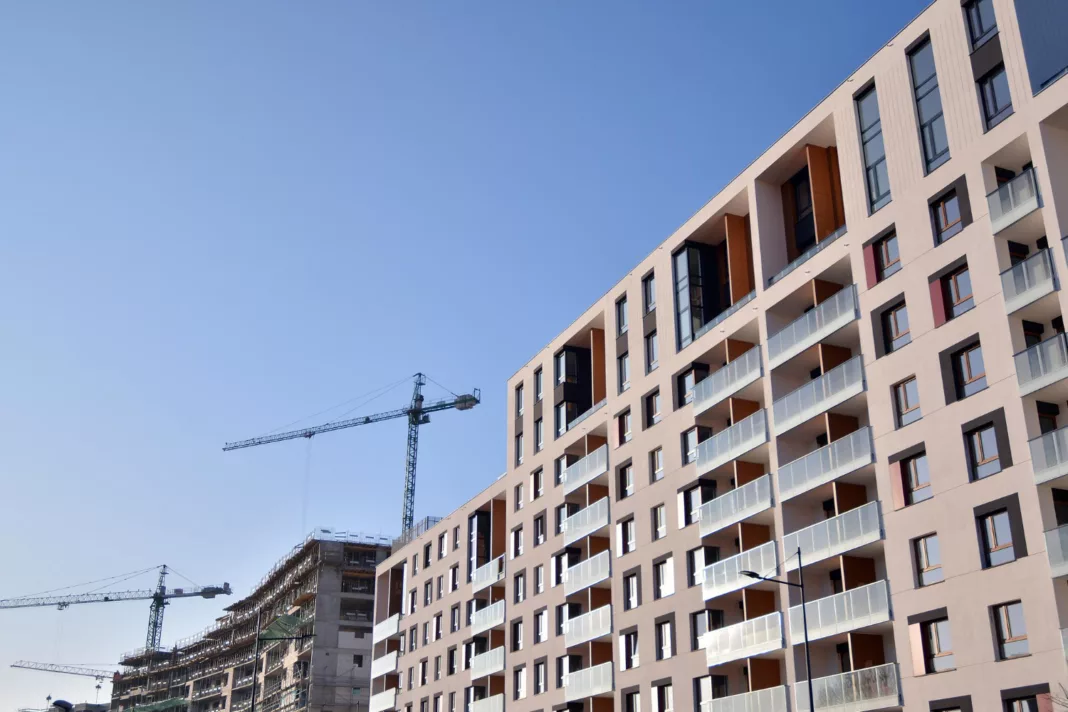

Building permits are rising sharply, but housing construction activity remains subdued. Poland’s developers are expanding their pipeline of future projects, while starts and completions have barely changed — a sign that the market is preparing for a potential recovery without fully committing capital to new sites yet.
Building permits up 16.3%, while starts and completions remain flat. Developers rebuild their project pipeline
Between January and May 2026, the number of homes covered by building permits rose by 16.3% year on year, while housing starts fell by 0.2% and completions declined by 0.5%. The market has entered a phase in which the project pipeline is growing faster than activity on actual construction sites.
The latest Statistics Poland data point to a market moving at two different speeds. The leading indicator — building permits — is accelerating, while current construction activity remains flat or is edging lower. This gap is the key signal from recent months: developers are building up projects ready to launch while remaining cautious about breaking ground.
Building permits: the one indicator gaining momentum
Between January and May 2026, building permits were issued for 119.9k homes, up 16.3% from a year earlier. Developers drove the increase, receiving permits for 79.5k homes, a 21.7% year-on-year rise. Individual investors obtained permits for 36.9k homes, up 10.0%. Together, these two forms of construction accounted for 97.2% of all homes covered by permits.
The rebound among developers matters because a permit is the first stage of the investment cycle. A rising number of permits means companies are accumulating projects ready to launch — a documented land bank that can be activated when demand and financing conditions improve.
Starts and completions: broadly unchanged from a year ago
On-the-ground activity remains stable but lacks momentum. Construction started on 94.7k homes, down 0.2% from a year earlier. Developers began work on 58.0k homes, a 2.6% decline, while individual investors started 34.5k homes, up 2.5%.
76.2k homes were completed, 0.5% fewer than in the same period of 2025. Developers delivered 45.7k units, down 2.4%, while individual investors delivered 28.7k, up 2.7%. The usable floor area of newly completed homes reached 7.0 million sq m, while the average dwelling measured 91.3 sq m.
The same pattern is visible across all three categories: the individual-investor segment is maintaining modest positive growth, while developers are reducing the number of homes started and completed despite a sharp increase in permits.
Over the longer term, the current completions figure extends the retreat from record highs. The peak came in 2022–2023, when more than 91k homes were completed between January and May, followed by a clear correction. At 76.2k units, 2026 marks the lowest reading since 2020 and confirms that the market has moved from expansion into a period of normalisation.
Developers drive permits but slow activity on construction sites
Comparing the two forms of construction across the three indicators shows precisely where the market is diverging. Developers account for the vast majority of permits, but their activity in homes started and completed is growing much more slowly.
The gap between 79.5k permits and 58.0k starts in the developer segment represents a buffer of projects that have documentation but have not yet entered construction. This overhang — permits without an immediate start — is a classic signal of a market preparing for a demand recovery while seeking to avoid financing construction too early.
Regional picture: three voivodeships set the pace for the market
Geographical concentration remains high. The largest figures across all three categories were recorded in the Mazowieckie, Małopolskie and Śląskie voivodeships. These three regions alone account for a significant share of national housing construction activity.
Mazowieckie leads the rest of the country on every measure, with 20.0k permits, 17.5k starts and 15.0k homes completed. Małopolskie is the only region where completions, at 8.6k, outpace those in voivodeships with more permits, pointing to a mature project pipeline that is being brought to completion efficiently. Śląskie, meanwhile, stands out for its particularly high level of permits, 13.0k, relative to completions of 6.9k, making it the region where future supply is being built up most aggressively.
| Voivodeship | Permits | Starts | Completed |
|---|---|---|---|
| Mazowieckie | 20.0 | 17.5 | 15.0 |
| Małopolskie | 10.9 | 9.2 | 8.6 |
| Wielkopolskie | 9.8 | 9.2 | 7.5 |
| Dolnośląskie | 11.4 | 7.4 | 7.3 |
| Śląskie | 13.0 | 8.3 | 6.9 |
| Pomorskie | 10.2 | 8.3 | 4.7 |
| Łódzkie | 7.6 | 5.5 | 5.1 |
| Podkarpackie | 6.7 | 4.4 | 3.5 |
| Lubelskie | 4.7 | 4.3 | 3.4 |
| Kujawsko-Pomorskie | 5.7 | 3.6 | 3.0 |
| Zachodniopomorskie | 4.7 | 5.7 | 2.5 |
| Warmińsko-Mazurskie | 3.6 | 2.9 | 2.2 |
| Lubuskie | 3.0 | 1.8 | 1.8 |
| Świętokrzyskie | 2.5 | 2.1 | 1.7 |
| Podlaskie | 4.3 | 3.0 | 1.7 |
| Opolskie | 1.8 | 1.4 | 1.2 |
May 2026: month-on-month declines across all indicators
On a monthly basis, May brought weaker results. Compared with April 2026, the number of homes completed fell by 0.6%, those covered by building permits by 13.8%, and housing starts by 18.2%. The sizeable monthly decline in permits and starts should be interpreted cautiously, as these indicators are highly volatile month to month and the annual picture remains more meaningful.
At the end of May 2026, 857.3k homes remained under construction, 0.5% more than a year earlier. Such a large and slightly growing pipeline means that the flow of new homes coming onto the market should remain stable in the coming quarters, even if the number of new starts does not increase.
What this means for the market and investors
Key takeaways
- The leading indicator is rising while real activity is softening. A 16.3% increase in permits alongside flat starts and completions signals that developers are building a pipeline for the future but holding back on launches. This points to potential supply acceleration once demand conditions improve.
- The individual-investor segment is a stabiliser. Individual investors are sustaining positive growth across all three categories, cushioning declines on the developer side.
- The project buffer is growing. The gap between permits and starts in the developer segment is a pipeline that can be activated quickly — a source of supply flexibility, but also a risk of overhang if demand does not recover.
- Activity remains geographically concentrated. Mazowieckie, Małopolskie, Śląskie, Wielkopolskie and Dolnośląskie set the pace for the national market; investment activity outside these regions is many times lower.
- A stable construction pipeline. With 857.3k homes under construction, the market has a predictable flow of completed units for the coming quarters, regardless of the current pace of new starts.
The current data describe a market at a turning point between correction and cautious preparation for the next growth phase. The key metric to watch in the second half of the year will be the pace at which the expanding stock of permits translates into actual housing starts. That will show whether developers consider market conditions sufficiently favourable to launch their accumulated project pipeline.
Preliminary data for January–May 2026. Source: Statistics Poland, “Housing Construction” release, Statistical Office in Lublin. Own analysis based on Statistics Poland data. Construction intended for sale or rent is referred to in the text as developer construction.