
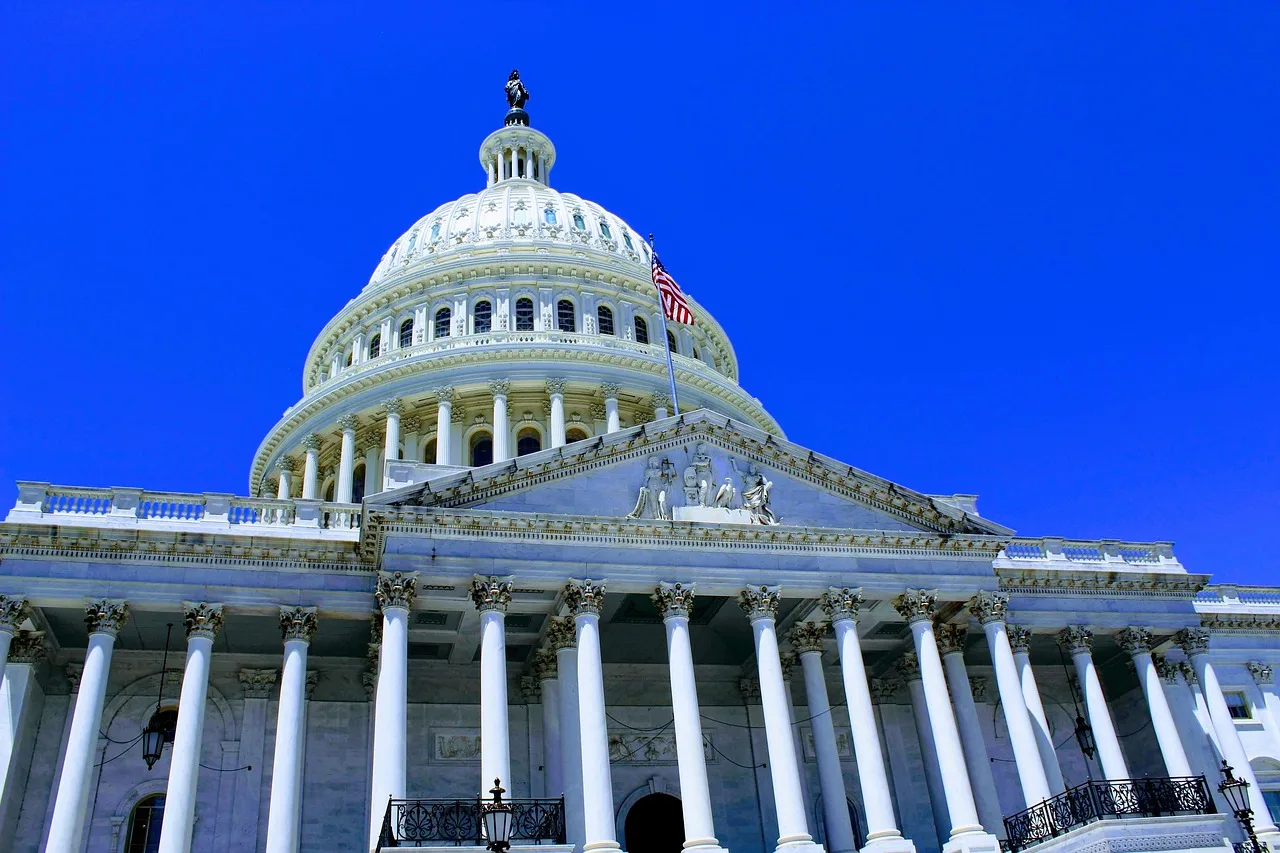
The Democrats’ sweeping midterm victory is unlikely to change the course of the US economy significantly, economist Krzysztof Błędowski argues. Presidential veto powers and a lack of agreement on spending and taxes will constrain the new congressional majority, leaving private-sector spending as the main driver of the business cycle.
Commentary by Krzysztof Błędowski, a visiting assistant professor at the University of Information Technology and Management in Rzeszów, Poland, and a member of the Association of Polish Economists (TEP). Source: TEP. Polish original published on 14 November 2026 at 10:43 UTC.
The scale of the Democratic victory in elections held halfway through the presidential term raises an obvious question: how much can a new majority in Congress alter economic conditions? Błędowski sets out five reasons why he expects its influence to be limited.
Business cycles rarely follow election cycles
His first argument is that economic cycles have only a weak relationship with political ones. He describes the current expansion as stretching back to 2009, interrupted by a brief, two-month recession caused by the coronavirus pandemic in 2020. That period spans nine congressional elections and five presidential terms: two each for Barack Obama and Donald Trump, and one for Joe Biden.
Despite the many laws and presidential initiatives introduced over that period, Błędowski argues that the economy largely followed its own course. Waves of rising and falling investment drove activity, while fluctuations in international financial markets had relatively little influence.
He identifies two notable exceptions to this broader pattern. One was the strong expansion after Franklin D. Roosevelt mobilised the economy for World War II; the other was the stagflation that he attributes to Richard Nixon’s incomes policy in the 1970s.
Inflation limits the scope for action
Second, Błędowski argues that Congress will be unable to bring persistent inflation under control, with Trump’s high tariffs partly responsible for the price pressures. A policy of sharply cutting public spending to reduce inflation would conflict with election promises, including commitments to maintain healthcare subsidies. Even the Federal Reserve’s current policy of more expensive borrowing will take longer to produce results, he writes.
AI investment has bipartisan backing
Third, the unprecedented wave of investment, including spending on data centres, cannot be stopped overnight. Many voters oppose these projects, but Błędowski argues that they and other investment supporting artificial intelligence underpin GDP growth, which he puts at more than 2% a year in each of the past five years.
Local governments can delay or block investment decisions. At the federal level, however, there is bipartisan agreement on the strategic importance of developing AI.
The presidential veto remains a barrier
Fourth, the president retains the power to veto legislation, and Democrats lack the two-thirds majority needed to override it. That may limit Congress’s ability to enact changes opposed by Republicans.
Deficit and debt reforms lack political support
Finally, Błędowski points to the growing budget deficit, at around 6% of GDP, and government debt of roughly 100% of GDP. Financial markets are concerned, he writes, but US politicians remain relatively unconcerned about addressing the problem.
Neither Democrats nor Republicans have a plan to reform healthcare financing or improve the balance of the reserves used to fund pensions, in his assessment. These programmes involve substantial sums, and restoring their financial health would require far-reaching tax reform. Congress has no appetite for such changes, regardless of which party controls it.
Błędowski expects some degree of legislative gridlock in both chambers. Campaign promises lack concrete spending plans, while politicians are unwilling to raise more tax revenue. He therefore expects the business cycle to continue on its own course, driven by private-sector spending.